
Reviewed · MONTMARTRE & SACRé-COEUR TOURS
Paris: Montmartre Macaron Baking Workshop
The best part of this Paris baking class is that you do not simply watch a pastry chef work. You make the shells yourself, pipe them, decorate them with a double nozzle, and fill them with ganache. Italian meringue gives the lesson a real pastry-school feel, while the small class keeps help close at hand.
I like the generous take-home box and the freedom to choose among 10 fillings, colors, and designs. I also like the family-run feel created by Kanika and Vouthy, whose patient instruction has worked well for children, teens, adults, and experienced bakers. The main consideration is that macarons are fussy: two hours gives you a good practical lesson, but not a guarantee that every shell will be perfect. People with food allergies or lactose intolerance should skip this one.
In This Review
- Key points to know before booking
- A hands-on pastry class at 175 Rue Legendre
- Starting with tant pour tant
- Macaronage, the moment that decides the shells
- Piping and decorating your own designs
- Ganache, fillings, and a useful taste lesson
- Why the small group helps
- Is $150 a fair Paris activity price?
- Fitting the workshop into your Montmartre day
- Who should book this class?
- Should you book the Maca’Rong workshop?
- FAQ
- Where does the macaron class take place?
- How long does the workshop last?
- How many people can join the class?
- Which languages are available?
- How many macarons do I take home?
- What fillings are available?
- Do I receive a box for the macarons?
- Can I attend only to watch someone else?
- Is the workshop suitable for children?
- Can I cancel the booking?
Key points to know before booking
- You make at least 15 macarons yourself: Each participant pipes, decorates, fills, and packs a personal batch.
- Italian meringue is the central technique: You learn a reliable method, plus how it differs from other macaron methods.
- Small groups make a difference: The class has a maximum of eight participants, so the instructors can watch your piping and macaronage.
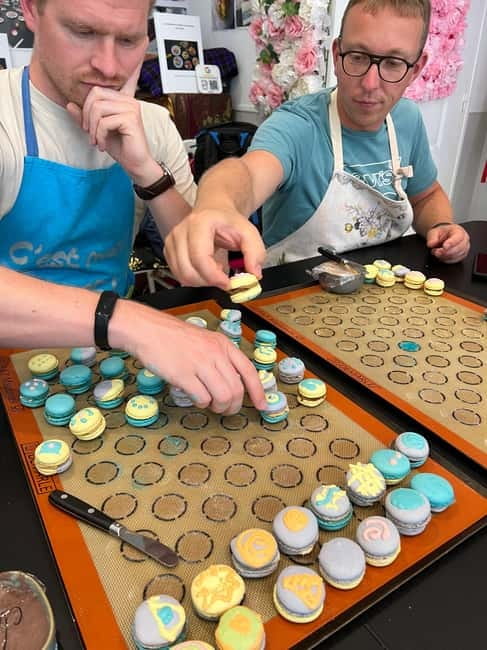
- You get real creative control: Use different colors, shell designs, and fillings rather than producing one identical batch.
- The class is near Montmartre: It takes place at Maca’Rong, 175 Rue Legendre, with the shop on the ground floor.
- The food restrictions are important: The class is not suitable for people with food allergies or lactose intolerance.
A hands-on pastry class at 175 Rue Legendre
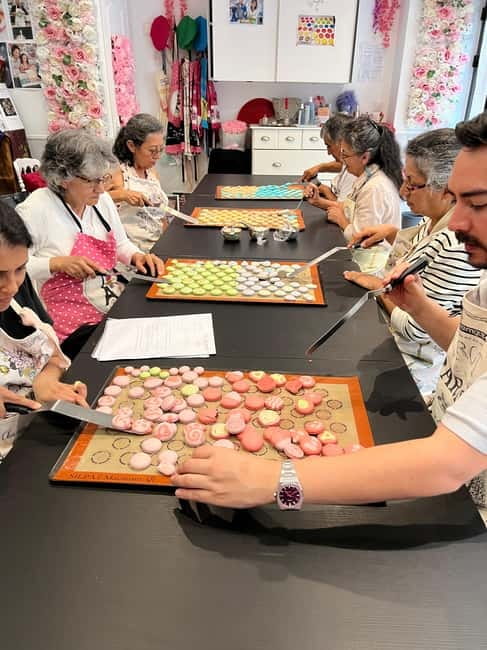
You begin at the Maca’Rong shop at 175 Rue Legendre. Go inside the ground-floor shop and look for the class setup. The activity begins and ends at this same location, so you do not need to manage a second meeting point halfway through the lesson.
The setting is practical rather than grand. That is part of the appeal. You are in a working macaron business, not a large demonstration kitchen where you sit far from the action. With no more than eight participants, you can see what is happening and ask for help when your mixture or piping looks uncertain.
The class is offered in English and French. Kanika and Vouthy lead the instruction, and the feedback from the sessions points to a warm, patient teaching style. English support is available, though one account noted that a strong French accent occasionally made parts of the explanation harder to catch. If a technical instruction matters, ask for it to be repeated or demonstrated. With macarons, seeing the motion is often more useful than hearing a long explanation anyway.
You should arrive ready to work. All participants must reserve a place, and you cannot stay only to watch. Oversize luggage is not allowed, so leave large bags at your accommodation.
More Montmartre walks and visits:
- Montmartre Hidden Gems and Scenic Highlights Walking Tour
★ 5.0 · 2,684 reviews - Montmartre Hill French Gourmet Food and Wine Tasting Walking Tour
★ 5.0 · 2,588 reviews - Paris: Montmartre Cheese, Wine & Pastry Guided Walking Tour
★ 4.8 · 2,255 reviews
Starting with tant pour tant
The class begins with a prepared bowl of tant pour tant ingredients for each participant. In pastry terms, this refers to the almond and sugar mixture used for macaron shells. Having the ingredients portioned in advance saves time and lets you focus on technique instead of weighing every component.
That preparation matters in a two-hour class. Macarons involve several stages, and a small mistake in measurement can affect the final texture. The prearranged ingredients give beginners a cleaner start while still leaving the key work in your hands.
You learn the Italian meringue method, which uses a cooked sugar syrup with whipped egg whites. It is a little more technical than simply whipping sugar and egg whites together, but the class presents it as a dependable route to smooth shells. The instructors also explain alternative methods, giving you useful context for home baking instead of treating one recipe as the only correct answer.
This section is where the class earns its place as more than a decorative food activity. You learn why precision matters, how the meringue should look, and which small choices can help prevent cracked shells. The lesson includes a secret recipe to take with you, so you have something concrete to use after returning home.
Macaronage, the moment that decides the shells
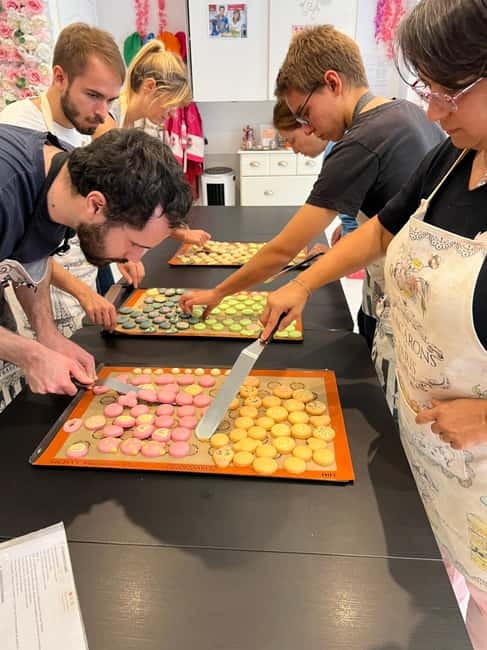
After the meringue and dry ingredients meet, you work on macaronage. This is the folding process that turns the mixture into a smooth, flowing batter. Too little mixing leaves the batter thick and rough. Too much can make it loose and difficult to pipe.
The instructors wait for the mixture to become glossy. That shine is an important visual cue. You will also learn how the batter should move before you transfer it to the piping bag. For a first-time baker, these visual signals are valuable because recipes often say to mix until smooth without explaining what smooth really means.
Filling the piping bag is treated as a skill of its own. The aim is to avoid trapped air and wasted batter. This may sound like a minor step, but a badly filled bag can make the next stage frustrating. You get a demonstration before taking over.
The class uses round templates for the first piping exercise. This gives you a target and helps produce shells that are close enough in size to pair later. Do not expect perfect circles on your first try. The point is to learn pressure, angle, and stopping technique, not to win a pastry contest.
Piping and decorating your own designs
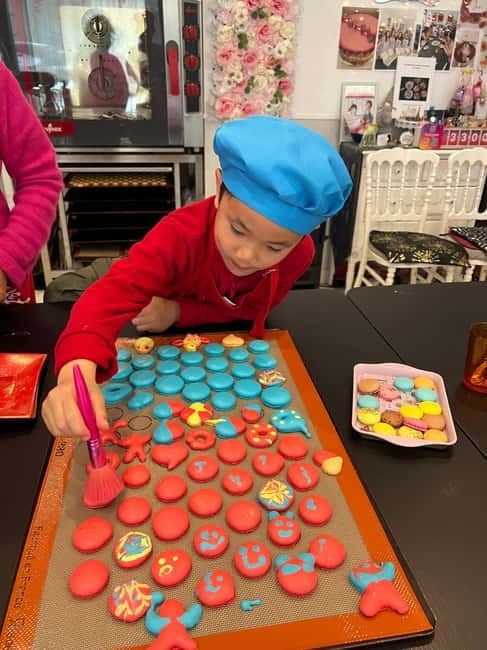
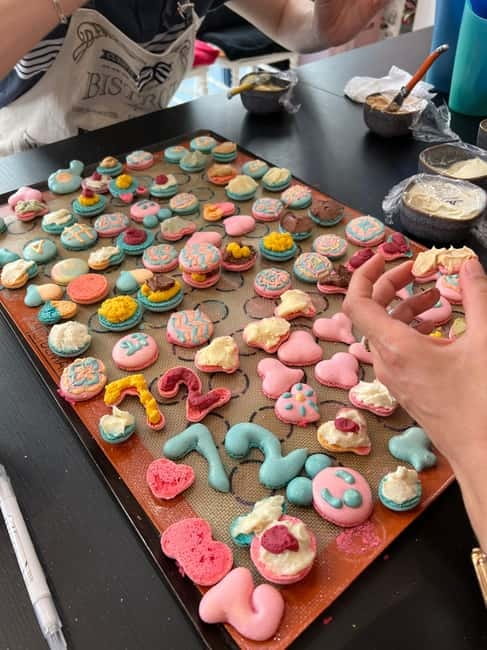
Once the basic rounds are piped, the creative part begins. You use a smaller double nozzle to add designs to the shells. This is one of the more unusual features of the class because the final macarons are not limited to plain, identical discs.
You can personalize the appearance with different colors and designs. The freedom is especially useful for families, since children can take ownership of their own batch. The adults still have plenty to learn, but the decorative stage keeps younger participants involved during a process that might otherwise feel technical.
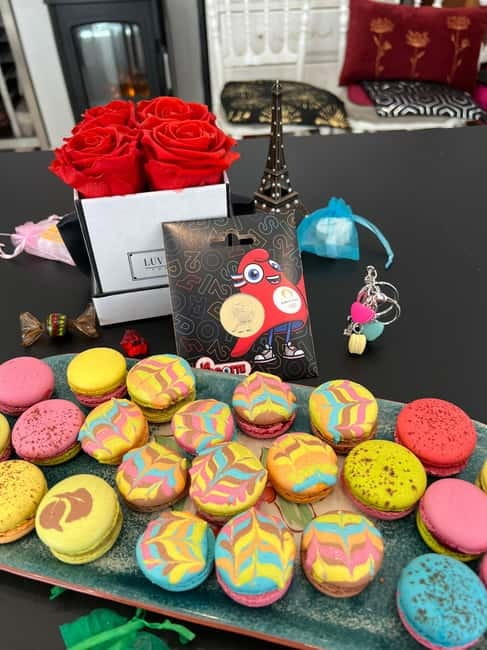
The number you take home depends on how accurately you pipe. The stated amount is at least 15 macarons per person. Some class sessions have produced more than that, but you should treat 15 as the dependable expectation. A family of four could leave with a substantial supply, so plan how you will carry the boxes for the rest of the day.
The box is provided, along with bags for carrying it. That simple detail matters in Paris, where you may still have hours of sightseeing ahead. The macarons are not handed over loose or wrapped in a way that makes transport awkward.
More pastry and macaron classes:
- Paris Croissant Small-Group Baking Class with a Chef
★ 5.0 · 910 reviews - Paris: Macaron Class at Galeries Lafayette
★ 4.3 · 905 reviews - Paris: French Croissant Baking Class with a Chef
★ 4.9 · 712 reviews - Paris Cooking Class: Learn How to Make Macarons
★ 5.0 · 634 reviews
Ganache, fillings, and a useful taste lesson
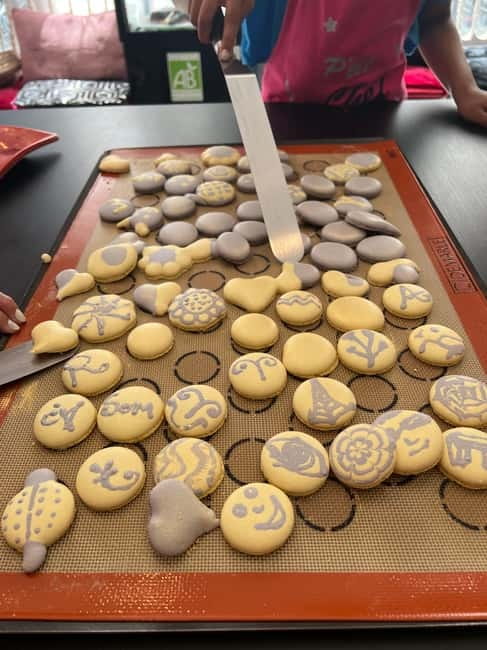
While the shells bake, the lesson moves to filling. You see how to prepare a raspberry ganache, with mango-passion as another possible flavor. The fruit-based fillings give the finished macarons a sharper, more distinctive taste than a basic sweet cream.
You also get access to 10 fillings. The exact selection can vary, but the important point is choice. You are not required to make one flavor for the entire group. That is a real advantage over classes that give everyone the same two options.
Some sessions have included less expected flavors, including a French cheese filling. If that option is offered during your class, it is worth trying at least one. It shows how macarons can move beyond the familiar sweet flavors found in pastry-shop boxes.
Tea, coffee, and macarons are included during the class. You may also taste prepared macarons as part of the introduction and filling work. This gives you a chance to compare textures and flavors before you pack your own creations.
The filled macarons go into your special box for the trip home. You should handle them with care, especially if you have added fine designs. The class is focused on making and packing them, not on providing a long-term storage solution, so follow the instructors’ advice about keeping them after the workshop.
Why the small group helps
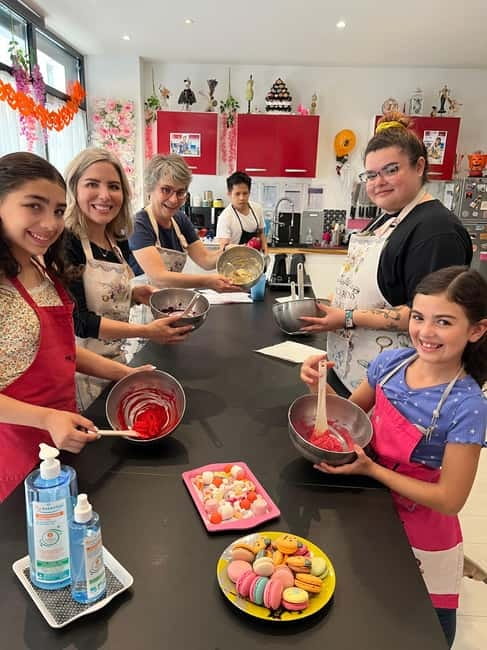
A maximum of eight people is a strong feature here. Macaron making rewards close observation, and an instructor cannot easily correct piping or batter consistency in a crowded room. In this format, you have a better chance of receiving a quick correction before a small error spreads through the whole batch.
The teaching team also makes the class workable for mixed ages and ability levels. Families have included children as young as five in individual sessions, while the official minimum age is six. The practical sweet spot may be school-age children and older, when they can follow instructions and handle a piping bag with some control.
Adults do not need baking experience. The class starts with guided steps and explains the Italian method before asking you to work independently. At the same time, an experienced macaron baker can still pick up useful details about meringue, macaronage, piping, and fillings. That makes it a better choice for a mixed group than a class aimed only at complete beginners.
You should book every person who plans to take part. There is no option for an unregistered family member to sit in as an observer. This rule keeps the group size accurate and the workstations manageable, but it is easy to overlook when planning a family outing.
Is $150 a fair Paris activity price?
At $150 per person, this is not a cheap way to buy macarons. If your only goal is to eat French sweets, a pastry shop will cost much less. The price makes more sense when you count the two-hour lesson, the ingredients, the instructors, the tasting, the recipe, the multiple filling choices, and at least 15 macarons to take away.
A box of high-end macarons can become expensive quickly, but I would not book this class simply as a way to get the lowest possible price per cookie. Your payment is mainly for the hands-on instruction and the shared activity. The box is the souvenir, not the whole product.
The value is strongest for families, couples, small groups, and anyone who wants a practical food experience rather than another sightseeing stop. You leave with a skill you can repeat at home and a batch that reflects your own work. That feels more personal than buying a standard box from a famous shop.
The value is weaker if you dislike precise cooking, have a tight budget, or want a relaxed demonstration with no participation. Macaron making involves several careful stages, and the class expects you to take part from start to finish.
Fitting the workshop into your Montmartre day
The shop is in the Montmartre area, but the meeting point is not described as being directly beside the hill’s main sights. One family found it was about a 20-minute walk to or from central Montmartre. Build that walk into your schedule rather than assuming you can leave the class and be at the Sacré-Cœur steps in a few minutes.
The two-hour duration works well as a break from museum and monument visits. You can schedule it in the middle of a day, then continue exploring after your macarons are packed. Since the activity ends where it begins, you can plan your route around Rue Legendre without arranging transport between the start and finish.
Take the box seriously when planning the rest of your day. At least 15 macarons per person can add up fast, especially with children in the group. The supplied carrying bags help, but you still need to keep the box level and avoid crushing it under other purchases.
Starting times vary, so check the available slot before building your Montmartre plans. Free cancellation is available up to 24 hours before the activity for a full refund, and you can reserve now and pay later. Those terms help if your Paris schedule is still changing.
Who should book this class?
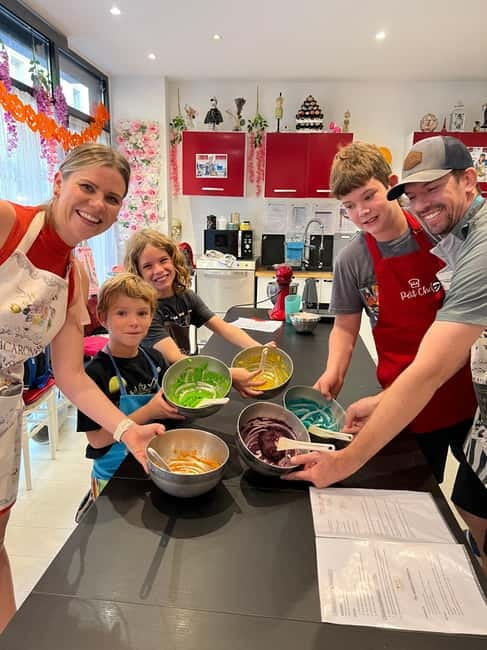
I would choose this for a family that wants one shared activity with a clear result. Children can decorate and pipe, adults can focus on the technique, and everyone gets a box to enjoy later. The sessions have suited ages from around seven through the mid-70s, with younger children needing more direct help.
It also suits a couple or a small group of friends who enjoy food and want to bring home something they made in Paris. The choice of colors, designs, and fillings gives the class a personal angle. You are not just following a demonstration and taking a photo.
Experienced bakers can join too. The Italian meringue approach and the comparison with other methods offer useful technique notes, while the French cheese or fruit fillings may add ideas for your own kitchen. Beginners should not feel out of place, since the work is broken down into manageable stages.
I would not choose it for anyone with a food allergy or lactose intolerance. The activity is also not suitable for wheelchair users, babies under one year, or children under six. Large luggage is prohibited, and anyone hoping to watch without booking cannot attend as an observer.
Should you book the Maca’Rong workshop?
Book it if you want an active Paris food experience, especially if you are traveling with family or friends. The strongest reasons are the small eight-person group, patient guidance from Kanika and Vouthy, several filling choices, and a generous box of handmade macarons at the end.
Skip it if you only want to sample pastries, need strict allergy accommodations, or prefer a quiet demonstration. Macarons demand care, and your results will depend partly on your piping and mixing.
For most suitable participants, the class offers a good change of pace from sightseeing. You learn a real French pastry technique, make something with your own hands, and leave with a sweet souvenir that can be shared during the rest of your Paris stay.
FAQ
Where does the macaron class take place?
The class takes place at Maca’Rong, 175 Rue Legendre, in the Ile-de-France region of France. Enter the Maca’Rong shop on the ground floor.
How long does the workshop last?
The workshop lasts two hours. Starting times vary, so check availability for the date you want.
How many people can join the class?
The class is limited to eight participants, making it a small-group activity.
Which languages are available?
Instruction is available in English and French.
How many macarons do I take home?
You can expect at least 15 macarons per participant. The exact number depends on how accurately you pipe the shells.
What fillings are available?
The class includes 10 fillings. The filling demonstration features raspberry ganache or mango-passion ganache, and other options may include unusual choices such as a French cheese filling.
Do I receive a box for the macarons?
Yes. You receive a special box and bags for carrying your macarons.
Can I attend only to watch someone else?
No. Everyone at the workshop must have a reservation, so unregistered observers cannot stay for the class.
Is the workshop suitable for children?
Children under six are not permitted. The activity has been suitable for older children and mixed-age families, but every participant needs a reservation.
Can I cancel the booking?
You can cancel up to 24 hours in advance for a full refund. You can also reserve now and pay later.
More Workshops in Paris
- Fragonard Paris: Mini Perfume Workshop
★ 4.5 · 1,924 reviews - Paris Cooking Class and Lunch with Wine plus Market Visit Option
★ 5.0 · 1,024 reviews - Paris: 2-Hour Perfume Creation Workshop
★ 4.8 · 731 reviews - Paris: French Macaron Culinary Class with a Chef
★ 4.9 · 591 reviews
Newest additions around Paris
- Family escape Game with kids and teens on the Île de la Cité★ 4.5 · 11 reviews
- Private Photoshoot with the Iconic Eiffel Tower in Paris★ 5.0 · 11 reviews
- 2-day Private Mont Saint-Michel, 3 Loire Castles, D-Day Express★ 4.5 · 11 reviews
- Paris: Batobus Hop-On Hop-Off Cruise & Landmarks Audio Tour★ 3.0 · 11 reviews
- Paris Revolutionary Walking Tour: Iconic French Sights & Stories★ 5.0 · 11 reviews
- Guided and Private Tour of 3 hours through Paris aboard a Citroën 2cv★ 5.0 · 11 reviews
- Kids in the Kitchen – CrOisSaNtS★ 4.0 · 11 reviews
- Paris: Ghosts and Dark Stories Guided Walking Tour★ 4.1 · 11 reviews
Montmartre & Sacré-Coeur Tours, compared.
Montmartre Hidden Gems and Scenic Highlights Walking Tour
Read our review →
Montmartre Hill French Gourmet Food and Wine Tasting Walking Tour
Read our review →
Montmartre Cheese, Wine & Pastry Guided Walking Tour
Read our review →
Montmartre Highlights Walking Tour with a Local Guide
Read our review →
Sacré-Coeur and Montmartre Tour with Expert Guide
Read our review →
Private Montmartre Food Tour with Wine, Cheese & Pastries
Read our review →
Paris Montmartre Food Tour – A Full French Meal by Do Eat Better
Read our review →
Hidden Montmartre: Paris’ Secret Streets Walking Tour
Read our review →Browse the lists this tour appears in