
Reviewed · MONTMARTRE & SACRé-COEUR TOURS
Hidden Montmartre: Paris’ Secret Streets Walking Tour
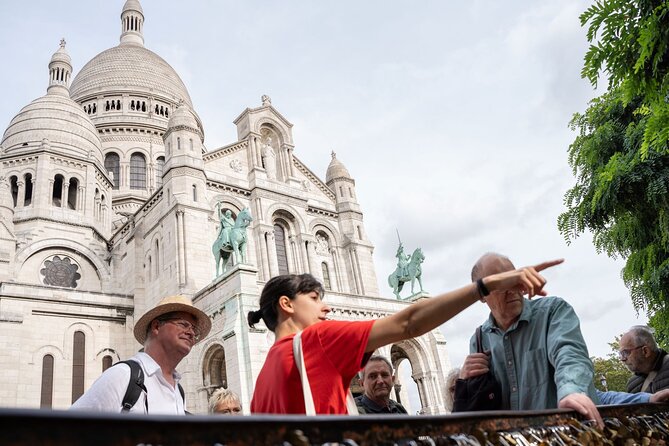
Montmartre reveals itself best away from the main staircase and souvenir stalls. This two-hour walk starts by the Moulin Rouge, then climbs through old lanes, artists’ haunts, a working urban vineyard, and quiet corners with broad views over Paris. The final stop is Sacré-Coeur, but the route takes you there by a far more interesting path.
I especially like the award-winning croissant stop, which gives the tour a delicious start, and the effort to show you lanes and viewpoints you could easily miss alone. Guides such as Max, Cecilia, and Benjamin bring different strengths, from art and painting to political history and local life.
The main thing to consider is the hill. You walk about 2 kilometers, but the route includes stairs, steep slopes, and cobblestones. It is manageable for most people, yet it is not a flat stroll. The croissant is included, while other food, drinks, tips, and any Moulin Rouge show cost extra.
In This Review
- Key points to know before you book
- Starting at Place Blanche and the Moulin Rouge
- A warm croissant at a prize-winning bakery
- From the Wall of Love to Picasso’s Montmartre
- Windmills, expensive houses, and a quiet passage
- Montmartre’s vineyard and the story of Lolo
- Reaching Sacré-Coeur by the quieter side
- The guides make the difference
- How much value do you get for $44.44?
- Who will enjoy this Montmartre walk?
- Should you book it?
- FAQ
- Where does the Hidden Montmartre tour start?
- Where does the tour end?
- How long is the walking tour?
- Is the croissant included?
- Is the Moulin Rouge show part of the tour?
- How large is the group?
- Is the tour suitable for children?
- Can I cancel for a refund?
Key points to know before you book
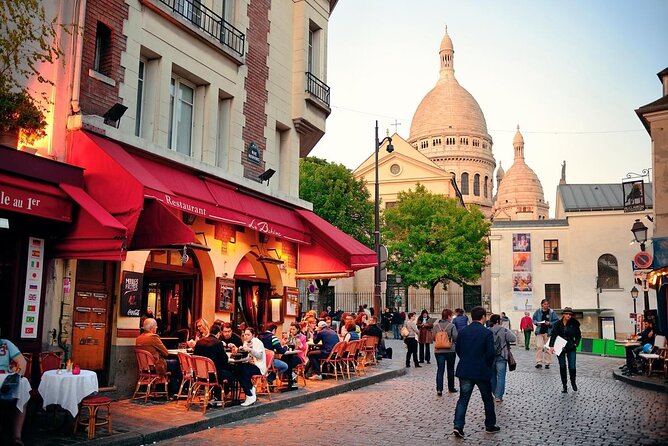
- The route finishes at Sacré-Coeur: You end near the basilica and one of Montmartre’s best city views, rather than returning to Place Blanche.
- A bakery stop is part of the walk: You taste a buttery croissant from a bakery known for major prizes.
- The tour goes beyond the usual route: Expect narrow passages, quiet streets, artists’ addresses, windmills, and the last vineyard in Paris.
- The group is capped at 14 people: You can also choose a private option or ask about group discounts.
- The guides shape the experience: Max, Cecilia, Benjamin, and other English-speaking guides bring strong knowledge of art, local stories, and Paris recommendations.
- Plan for an uphill 2-kilometer walk: Wear shoes with a good grip and allow extra energy for stairs and uneven paving.
Starting at Place Blanche and the Moulin Rouge
Your meeting point is Place Blanche, directly opposite the Moulin Rouge. This is a lively, easy-to-recognize start, with the famous red windmill giving you an instant sense of Montmartre’s old cabaret world.
The Moulin Rouge show is not part of the tour. You stop outside, hear about the area, and begin walking uphill. That distinction matters if you are hoping for a performance. This experience is a neighborhood walk, not a cabaret package.
From Place Blanche, the route leaves the crowded boulevard and begins the climb toward the village-like upper district. Along the way, the guide points out the café connected with the film Amélie and the former home of Vincent van Gogh. These are quick outdoor stops, but they help set the tone: Montmartre is not just a pretty hill. It is a place where cinema, painting, nightlife, and ordinary Parisian life overlap.
The opening section also gives you useful orientation. You see how quickly the broad commercial streets give way to smaller lanes. Montmartre’s nickname, the Village, makes sense once you reach these winding streets and old houses.
More Montmartre walks and visits:
- Montmartre Hidden Gems and Scenic Highlights Walking Tour
★ 5.0 · 2,684 reviews - Montmartre Hill French Gourmet Food and Wine Tasting Walking Tour
★ 5.0 · 2,588 reviews - Paris: Montmartre Cheese, Wine & Pastry Guided Walking Tour
★ 4.8 · 2,255 reviews
A warm croissant at a prize-winning bakery
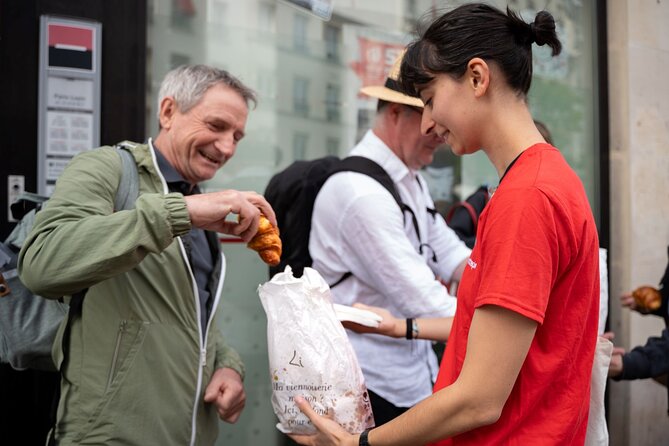
The bakery visit is one of the tour’s best practical touches. Instead of beginning with a long lecture, you pause at one of Paris’s highly awarded bakers and taste a classic French croissant.
That sounds simple, but it adds real value. You get to judge the pastry for yourself: buttery, flaky, and fresh, rather than treating food as decoration around a sightseeing route. It also gives the group a natural break early in the walk.
The tour includes one croissant, but additional food and drinks are not included. If you are vegetarian, the operator says it can accommodate that dietary need. The schedule can change on public holidays if the bakery or another usual stop is closed, so do not treat the food stop as an absolute guarantee on every date.
I would book a morning departure if you want this to feel like a classic Paris start, though the experience can also run in the afternoon. One afternoon group had a particularly good route up the hill and reached Sacré-Coeur around sunset, but timing and light will depend on the departure you choose.
From the Wall of Love to Picasso’s Montmartre
The next section brings you to Le Mur des Je t’aime, the Wall of Love. The artwork presents the words I love you in 250 languages. It is a short stop, but it gives the tour a lighter moment before the climb continues.
Your guide also tells the story of the first Parisian bishop and the unusual legend tied to him. This is the kind of local tale that helps keep a walking tour from becoming a string of dates and names. The stories are meant to be heard on the street, in the setting where the neighborhood’s old religious and artistic identities meet.
You then reach one of Montmartre’s attractive squares and the former home of Pablo Picasso. Here, the focus shifts to the artists who lived in the area before they became famous. Montmartre’s artistic story was not only about celebrated painters. Many artists struggled, shared cramped rooms, and worked for years before finding money or recognition.
This is where Cecilia can be especially appealing. She is described as an artist and art historian, and her tours focus closely on the painters, their working lives, and the art made in Montmartre. Max also brings an artist’s eye, with attention to painting methods and the way the local art scene changed over time.
The exact balance can vary by guide. Benjamin is noted for giving more attention to political and cultural history, while other guides may focus more strongly on art. That variety is a strength, but it means the tour will not feel identical every time.
Windmills, expensive houses, and a quiet passage
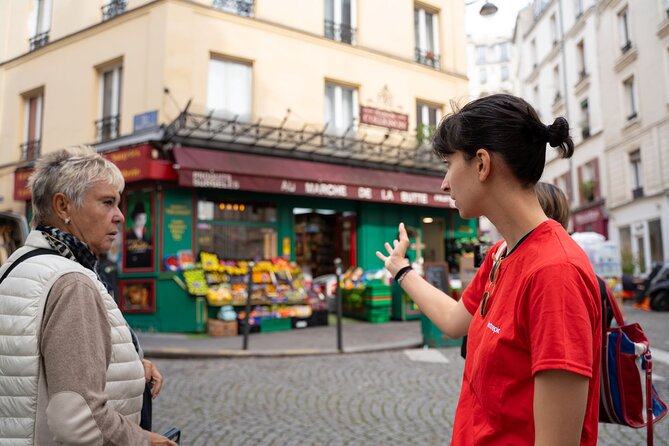
Montmartre once had a working rural side, and the Moulin de la Galette is a reminder of it. You pass one of the last surviving windmills in Paris. The windmill is privately owned, so you view it from outside rather than entering.
The route then follows what the guide calls Montmartre’s Champs-Élysées, a street lined with some of the capital’s most expensive houses. This is a useful correction to the usual picture of Montmartre as only a poor artists’ quarter. The neighborhood has changed, and parts of it are now highly desirable.
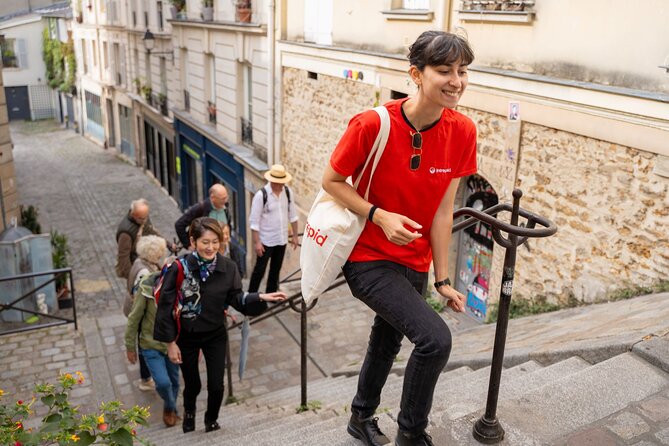
The most memorable part of this stretch is a little passage that opens toward a city panorama and a charming cobbled lane. The route description calls it a secret passage, but the practical point is more important than the label: it leads you away from the thickest crowds and gives you a better sense of the residential hill.
One guide, Max, was particularly good at avoiding the crowds, even on an afternoon tour. That matters in Montmartre, where the Sacré-Coeur steps and main squares can feel packed. A guide who knows the side routes can turn the climb into a calm walk instead of a slow shuffle behind a tour group.
The paving is uneven in places, and the hill does not disappear just because the route is scenic. I would not wear smooth-soled shoes. If you have limited walking ability, ask yourself if 2 kilometers with slopes and stairs sounds comfortable before booking.
More Paris walking tours:
- Paris Top Sights Half Day Walking Tour with a Fun Guide
★ 5.0 · 2,893 reviews - Paris Île de la Cité and Notre-Dame Walking Tour With Crypt
★ 5.0 · 2,272 reviews - Paris in a Day: Louvre or Orsay, Eiffel Tower, City Walk & Cruise
★ 5.0 · 1,956 reviews - Paris: Montmartre Highlights Walking Tour with a Local Guide
★ 4.9 · 1,668 reviews
Montmartre’s vineyard and the story of Lolo
Near the top of the hill, you reach Montmartre’s vineyard. The vines grow in the city and produce a small amount of red wine. You do not visit a tasting room as part of this tour, and wine is not included. The appeal is seeing this unexpected patch of agriculture in Paris and learning how it fits the neighborhood.
The vineyard is opposite Le Lapin Agile, one of Montmartre’s famous cabarets. The guide tells the story of Lolo, the painting donkey associated with the cabaret. It is an entertaining piece of local folklore, and it connects the area’s cabaret culture with its long-running artistic reputation.
This stop also gives you a good pause before the final climb. The views toward the outer parts of Paris help you see Montmartre’s position on the city’s northern hill. On a clear day, the height is obvious. In fog or poor weather, the panorama may be muted, but the vineyard and cabaret stories still give the walk a reason to continue.
Reaching Sacré-Coeur by the quieter side
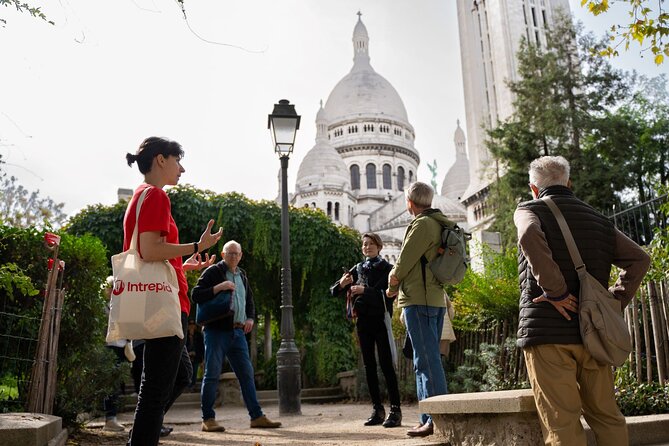
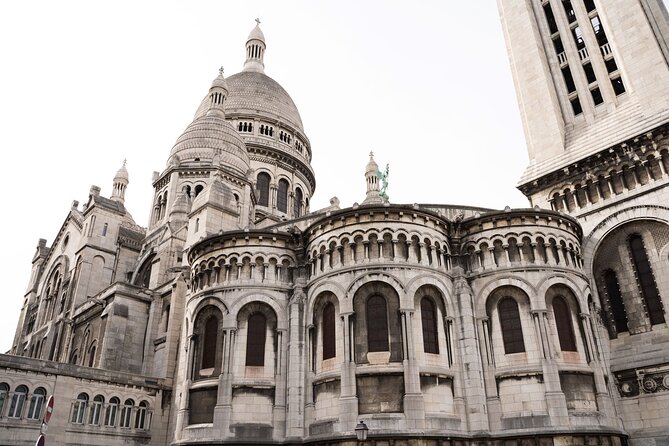
The tour ends at the Basilica of the Sacred Heart, better known as Sacré-Coeur. You stop first for a less familiar view of the church, then continue to a broad panorama over Paris.
The basilica itself is free to admire from outside, and the tour does not list an interior visit as part of the route. If you want to explore inside, you can do so after the tour, subject to the site’s conditions. The official end point is 35 Rue du Chevalier de la Barre, near the basilica.
The final approach is one of the strongest reasons to book this rather than simply taking the Métro to Montmartre and walking straight to the church. The guide can lead you through a quieter garden route and bring you to the upper area without relying only on the standard tourist path.
One especially well-timed afternoon walk reached the basilica near sunset. You cannot count on that exact timing, but it shows why the end point works well: after two hours of stories and side streets, you finish with a major Paris view instead of ending beside a busy metro station.
You should plan your next activity from Sacré-Coeur, not Place Blanche. The tour does not return you to the starting point. That is convenient if you want to continue exploring the basilica, the upper streets, or nearby cafés, but less convenient if you have a timed booking back in the lower part of the city.
The guides make the difference
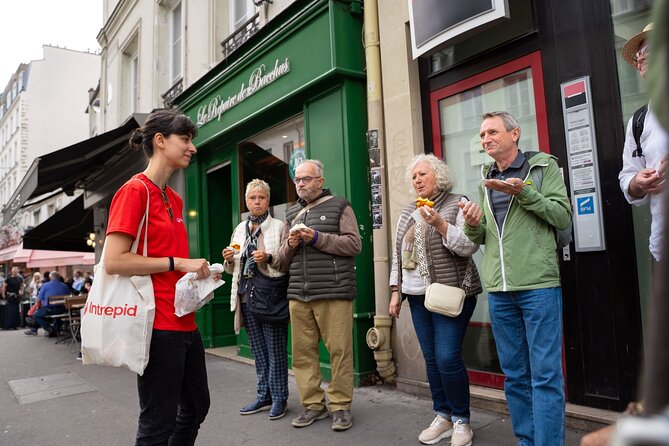
The tour uses local English-speaking guides, and the names most often associated with this experience include Max, Cecilia, Benjamin, Sarah, Camilla, Hugo, Silvana, and Benoît. You may not be able to select a specific guide when booking, so consider the names as examples of the team rather than a promise.
Max is described as warm, funny, and highly engaged with the area’s art and history. He has guided families with a 7-year-old child and an 83-year-old parent, keeping a pace both could manage. He has also led very small tours, including one with only two participants, which can make the experience feel more like exploring with a local friend.
Cecilia brings an art historian’s and artist’s perspective. Her style suits you if you want to understand the people behind the famous names, not just photograph their former addresses. Benjamin is a strong choice for political and cultural background, with an energetic approach and plenty of answers for first-time visitors.
The small maximum of 14 people is important. Montmartre’s streets are narrow, and a group of 30 would make it harder to hear, stop, or move through quiet passages. A smaller group also gives you more room to ask for restaurant, bookstore, and sightseeing suggestions.
At the end, use that access. Ask your guide what to eat, see, or do next in Paris. Benoît, for example, gave bookstore recommendations after the walk, while other guides have helped with restaurant suggestions. This informal advice can be as useful as the formal sightseeing, especially early in a Paris stay.
How much value do you get for $44.44?
At $44.44 per person, this is not the cheapest way to see Montmartre. You can walk up the hill on your own for free, visit the basilica, and use a map to find several famous addresses.
The fee makes more sense when you value the route design and the human context. You get about two hours with an English-speaking guide, a croissant tasting, a small group capped at 14, access to side streets, and a planned finish at Sacré-Coeur. You are paying to connect the pieces, avoid some crowds, and hear the stories that are easy to miss when you move from photo stop to photo stop.
The tour is especially good value if this is your first time in Montmartre or your first day in Paris. You get your bearings, learn which streets are worth revisiting, and can ask for practical advice before the rest of your stay.
For repeat visitors, the value depends on how much of Montmartre you already know. Several experienced Paris visitors still found the quieter passages and art stories worthwhile, but you should not book it if you only want major monuments or a long food tour. The walk includes one croissant, not a full tasting program.
Group discounts and private tours are available, giving you some flexibility. A private version may suit families or friends who want to set the pace and ask many questions. The regular small-group format is the better deal for most people.
Who will enjoy this Montmartre walk?
I would choose this tour for:
- First-time Paris visitors who want a clear introduction to Montmartre.
- Art lovers interested in Picasso, Van Gogh, Renoir, and the area’s working artists.
- Families, since guides have kept children engaged and adjusted their pace for older adults.
- Repeat visitors who want a quieter route and fresh local stories.
- People who like food, but only need one well-chosen taste rather than a full culinary tour.
- Anyone who wants to finish near Sacré-Coeur with time for further exploring.
I would hesitate if you dislike hills, stairs, cobblestones, or group walking. I would also choose another experience if your priority is going inside the Moulin Rouge, tasting Montmartre wine, or touring Sacré-Coeur with a specialist in religious art. Those elements are not included.
The activity is child-friendly, but you should tell the operator if you are bringing a child under 12. Service animals are allowed, public transportation is nearby, and most people can take part. The 2-kilometer distance is not extreme, yet the incline is the real measure of effort.
Should you book it?
Book this tour if you want Montmartre as a living neighborhood, not just a staircase leading to a basilica. The croissant, vineyard, windmill, artists’ homes, cabaret stories, and lesser-used viewpoints give the walk a pleasant mix of food, art, gossip, and city views.
I would book it near the start of your Paris stay so you can use the guide’s advice afterward. Choose comfortable shoes, expect a steady uphill walk, and remember that the Moulin Rouge show, extra food, drinks, and gratuities are separate.
The tour has a 4.8 rating from 809 reviews, with 96 percent recommending it, and that matches its strongest qualities: excellent guides, a personal feel, and a route that adds more than the standard Montmartre photo stops. If you can handle the climb, $44.44 is a fair price for two focused hours in one of Paris’s most rewarding neighborhoods.
FAQ
Where does the Hidden Montmartre tour start?
The tour starts at Place Blanche in Paris, opposite the Moulin Rouge.
Where does the tour end?
It ends at the Basilica of Sacré-Coeur at 35 Rue du Chevalier de la Barre, 75018 Paris.
How long is the walking tour?
The experience lasts about two hours and covers approximately 2 kilometers, or 1.2 miles, of walking.
Is the croissant included?
Yes. The tour includes a taste of a buttery croissant from a highly awarded bakery. Additional food and drinks are not included.
Is the Moulin Rouge show part of the tour?
No. The tour begins opposite the Moulin Rouge and includes information about the landmark, but the Moulin Rouge show is not included.
How large is the group?
The tour has a maximum of 14 participants. A private tour option is also available.
Is the tour suitable for children?
Yes. It is child-friendly, but you should inform the operator if you are bringing a child under 12.
Can I cancel for a refund?
You can cancel at least 24 hours before the experience starts for a full refund. Cancellations or changes made less than 24 hours before the start time are not accepted for a refund.
Newest additions around Paris
- Family escape Game with kids and teens on the Île de la Cité★ 4.5 · 11 reviews
- Private Photoshoot with the Iconic Eiffel Tower in Paris★ 5.0 · 11 reviews
- 2-day Private Mont Saint-Michel, 3 Loire Castles, D-Day Express★ 4.5 · 11 reviews
- Paris: Batobus Hop-On Hop-Off Cruise & Landmarks Audio Tour★ 3.0 · 11 reviews
- Paris Revolutionary Walking Tour: Iconic French Sights & Stories★ 5.0 · 11 reviews
- Guided and Private Tour of 3 hours through Paris aboard a Citroën 2cv★ 5.0 · 11 reviews
- Kids in the Kitchen – CrOisSaNtS★ 4.0 · 11 reviews
- Paris: Ghosts and Dark Stories Guided Walking Tour★ 4.1 · 11 reviews
Montmartre & Sacré-Coeur Tours, compared.

Montmartre Hidden Gems and Scenic Highlights Walking Tour
Read our review →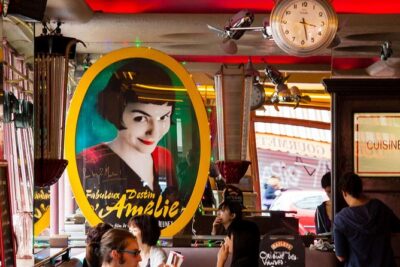
Montmartre Hill French Gourmet Food and Wine Tasting Walking Tour
Read our review →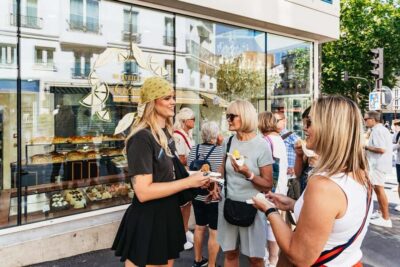
Montmartre Cheese, Wine & Pastry Guided Walking Tour
Read our review →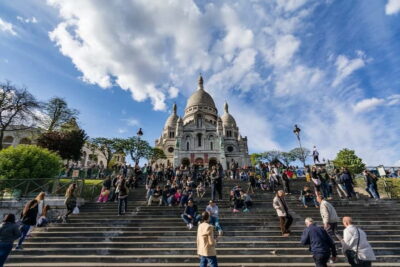
Montmartre Highlights Walking Tour with a Local Guide
Read our review →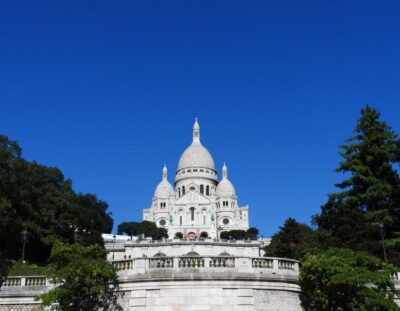
Sacré-Coeur and Montmartre Tour with Expert Guide
Read our review →
Private Montmartre Food Tour with Wine, Cheese & Pastries
Read our review →
Paris Montmartre Food Tour – A Full French Meal by Do Eat Better
Read our review →
Paris Montmartre Food & Wine Tour with Eating Europe
Read our review →Browse the lists this tour appears in