
Reviewed · PASTRY & MACARON CLASSES
Paris Cooking Class: Learn How to Make Macarons
French macarons look simple in a pastry case, but these little sandwich cookies are famously fussy. At Le Foodist, you’ll make the meringue shells, pipe the filling, and learn the small tricks that help turn a nervous first attempt into a proper French macaron. Chefs including Stéphane, Paulo, Luc, Fanny, Florence, and Stefan lead the classes.
I like two things right away: the hands-on format means you do the work instead of watching a demonstration, and the small advertised group size of four gives the instructor time to help with tricky steps. You also leave with roughly 20 to 30 macarons, not just a recipe and a quick taste.
The main consideration is the price, $156 per person, and the three-hour afternoon commitment. Macarons are sweet, and they take care and patience. If you want a fast sightseeing stop or dislike precise baking, this may feel like a lot of time and money for one dessert.
In This Review
- Key points to know before booking
- Why macarons make a good Paris cooking class
- Meeting Le Foodist at 3 p.m.
- Mixing meringue shells and choosing colors
- Filling, assembling, and tasting the results
- The value of $156 per person
- Who will enjoy this afternoon most
- What the three hours feel like
- Booking details and practical planning
- Should you book the Le Foodist macaron class?
- FAQ
- Where does the Paris macaron class begin?
- What time does the class start?
- How long does the activity last?
- Is the class offered in English?
- How many people can attend?
- What is included in the price?
- What is the minimum age?
- Can I cancel for a refund?
Key points to know before booking
- Make the shells from scratch: You’ll work with meringue, color the shells, and practice piping.
- A small class helps: The advertised maximum is four people, although class arrangements described by participants have sometimes been larger.
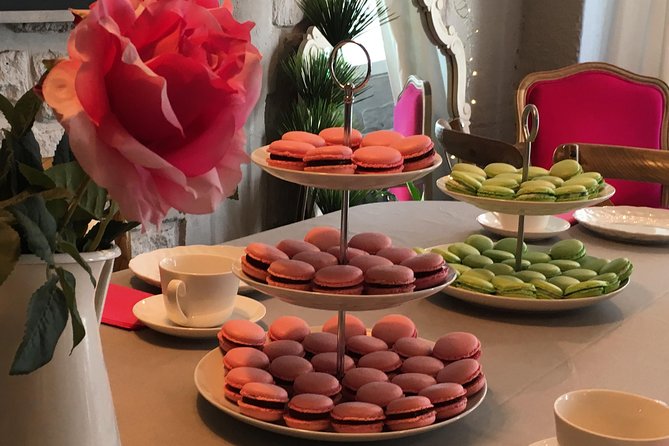
- Take home a generous box: Expect about 20 to 30 macarons, with a tasting at the end.
- Meet in the Latin Quarter: Le Foodist is at 59 Rue du Cardinal Lemoine in central Paris, near public transportation.
- Choose your level: The standard class covers the essentials, while the upgrade explores more macaron subtleties.
- Plan for an afternoon: The class begins at 3 p.m. and lasts about three hours.
Why macarons make a good Paris cooking class
A macaron class gives you a close look at a part of French pastry culture that is easy to admire and hard to reproduce. The finished cookies are small, colorful, and elegant, but the process depends on details such as mixing, piping, baking, and assembling.
That makes this more satisfying than simply buying a box from a famous pâtisserie. You learn why the shells need the right texture and why the filling matters just as much as the cookie itself. The lesson also gives you a better eye for the skill behind the macarons you see in Paris pastry windows.
You do not need to arrive as an experienced baker. The class is designed around step-by-step guidance, and the instructor works with different skill levels. The goal is not perfect decoration on every shell. It is to understand the method well enough to produce something attractive and delicious.
That said, you should enjoy careful work. Macarons are not a throw-everything-in-the-bowl dessert. You’ll need to listen, follow instructions, and accept that a few shells may be less than perfectly shaped. That is part of the charm, and the uneven ones still taste good.
More pastry and macaron classes:
- Paris: Montmartre Cheese, Wine & Pastry Guided Walking Tour
★ 4.8 · 2,255 reviews - Paris Croissant Small-Group Baking Class with a Chef
★ 5.0 · 910 reviews - Paris: Macaron Class at Galeries Lafayette
★ 4.3 · 905 reviews
Meeting Le Foodist at 3 p.m.
The class begins at Le Foodist, 59 Rue du Cardinal Lemoine, in the 5th arrondissement. This puts you in the Latin Quarter, an easy area to reach by public transportation and a pleasant place to be before or after class.
The scheduled start time is 3 p.m., so this works well as a break between morning sightseeing and dinner. You might spend the morning around the Île de la Cité, the Luxembourg Gardens, or the Latin Quarter, then make your way to the cookery school for the afternoon.
The activity ends at the same meeting point. There is no second location to find and no complicated transfer at the end. Allow yourself enough time to arrive calmly, since the class has a set start and the first steps of pastry work depend on the group moving together.
You begin with a welcome drink before the baking starts. It is a small touch, but it helps everyone settle in and meet the instructor. If you come alone, the social format makes it easier to join the group. If you come with family or a friend, you can work together while still receiving direct help.
Mixing meringue shells and choosing colors
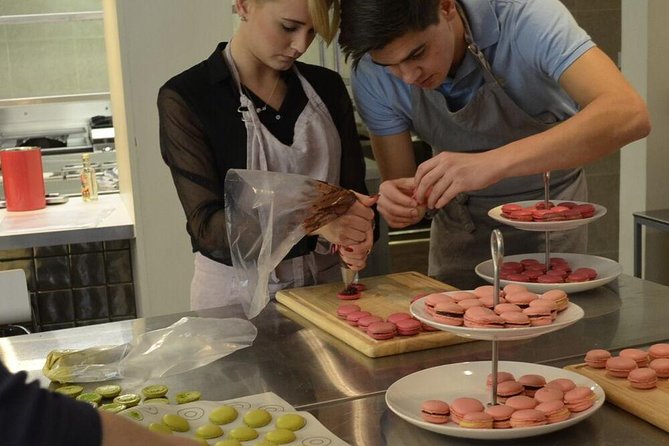
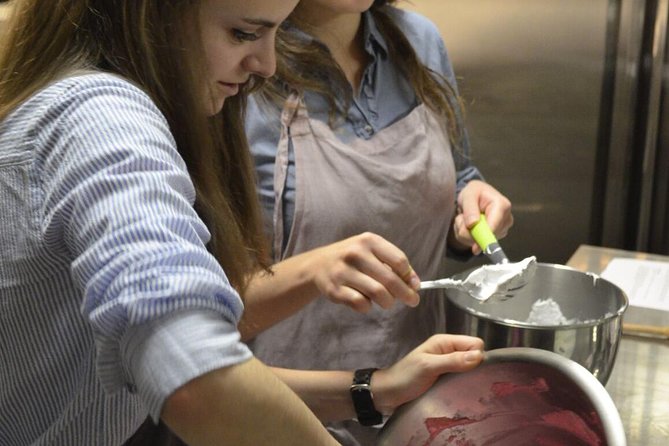
The heart of the class is the meringue shell. Your instructor explains the process step by step, then guides you through preparing the mixture and shaping it with a piping bag.
Piping is one of the moments when close instruction matters. The size and shape of the shells affect how they bake and how they fit together later. A good instructor can show you how to hold the bag, control the pressure, and stop cleanly instead of leaving a peak on top.
You can make the shells in colors of your choosing. This adds a creative element without turning the class into a decoration workshop. The color choices help you make the finished box feel personal, while the basic method keeps the lesson focused on technique.
During the class, you’ll also learn the practical habits that make macarons more reliable. Stéphane, one of the instructors praised for his pastry background and clear teaching, is described as sharing tips intended to make the process less intimidating. Other instructors, including Luc and Paulo, are noted for patient guidance and individual help.
The class may be organized around pairs, depending on the group. One participant described six people being paired up, with each pair preparing a different flavor. Other descriptions refer to groups of four or eight. The published tour information gives a maximum of four travelers, so check the exact arrangement shown when you book or in your confirmation.
Filling, assembling, and tasting the results
Once the shells are ready, you’ll work on the buttercream filling. The instructor demonstrates how to pipe it onto one shell and place the matching shell on top without crushing the cookie.
This is where macarons begin to look like macarons rather than colorful meringue rounds. You’ll see how the filling brings the two halves together and how small differences in size or shape can affect the finished sandwich.
At the end of the baking session, you sit down with tea or coffee and taste the results. This pause is one of the nicest parts of the afternoon. You can compare the flavors made by the group, enjoy the pastries at their freshest, and hear about the macaron’s place in French culture and tradition.
The class is not only about taking home a recipe. It gives you time to talk with the chef about French food and Paris. Instructors have also offered restaurant, food shop, and culinary recommendations during the relaxed periods of the class. Those suggestions are a useful bonus if you are still planning meals for the rest of your stay.
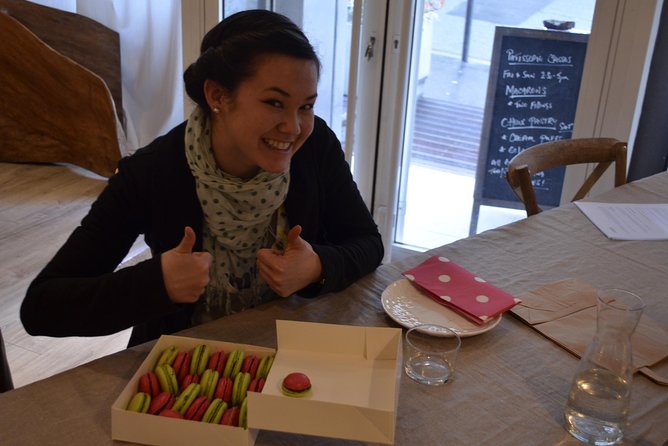
You receive a box of approximately 20 to 30 macarons to take away. That is a substantial amount for one person, and it can make the $156 price easier to justify if you value both the lesson and the edible souvenir. You may also receive recipes or extra samples, depending on the class arrangement.
More cooking classes in Paris:
- Paris Cooking Class and Lunch with Wine plus Market Visit Option
★ 5.0 · 1,024 reviews - Paris: French Croissant Baking Class with a Chef
★ 4.9 · 712 reviews - Paris Evening Cooking Class French Dinner and Market Visit Option
★ 5.0 · 430 reviews - Paris French Cuisine Small Group Cooking Class with Lunch
★ 4.5 · 418 reviews
The value of $156 per person
At $156, this is not a bargain activity. You are paying more than the cost of a pastry tour or a box of macarons from a shop. The price needs to cover instruction, ingredients, equipment, the cookery school setting, drinks, and a large take-home batch.
The value is strongest for you if you want a real activity rather than a passive tasting. You spend about three hours learning a skill, eating what you make, and leaving with a sizable box. A pastry lover who has always wondered how macarons are made may find that combination worth the cost.
The small-group promise is also important. A class capped at four should give you more direct access to the chef than a large demonstration. That matters when you are piping shells or trying to judge the texture of the mixture. If the class is arranged in a larger group, the pairing system can still give you a practical role, but it may not feel as personal as a four-person session.
For families, the price can work well when the adults and teenagers genuinely want to bake. The minimum age is 12, and children cannot attend without an accompanying adult. Several class arrangements described by participants included teenagers, mother and daughter pairs, and family groups.
If one person in your party is not interested in baking, the cost becomes harder to defend. This is a focused lesson, not a general Paris food experience where everyone can simply sample a range of dishes.
Who will enjoy this afternoon most
I would choose this class for:
- Pastry fans who want to understand French macarons beyond the pastry counter.
- Families with teenagers, provided everyone is interested in taking part.
- Couples and friends looking for a shared activity with a sweet result.
- Solo visitors who like meeting people through a structured class.
- Home bakers who want techniques and a recipe to try after returning home.
- Visitors needing a rainy-day plan that keeps them indoors for an afternoon.
The class also suits people who prefer intimate activities. Several instructors are described as warm, funny, and willing to answer questions. Stéphane, Fanny, Paulo, Luc, Ann, Florence, and Stefan are all named in connection with classes, though you should not assume a particular chef will lead your date unless that is confirmed.
I would skip it if you need a gluten-free menu for medical reasons without further clarification. The supplied information says the tour is suitable for people with gluten allergies, but it does not explain the kitchen’s allergy procedures or list every ingredient. Contact the provider before booking if cross-contact is a serious concern.
I would also skip it if you are hoping to bring macarons home on a long flight without planning ahead. One class arrangement includes a take-home box, but a participant found that the box did not protect the pastries well in checked luggage. Keep them in your carry-on rather than checking them, or simply enjoy them during your stay.
What the three hours feel like
The class has a useful rhythm. You begin with a drink and introductions, then move into instruction and hands-on preparation. While mixtures are being whipped or shells are baking, the chef can talk about pastry work, French food, and Paris.
This mix keeps the afternoon from feeling like a nonstop technical drill. You get practical work, short waiting periods, conversation, and a final tasting. It is social without requiring you to be outgoing.
The pace is also suitable for beginners because the chef explains each stage before you attempt it. Still, three hours is a real block of time. You should not schedule a major museum reservation immediately afterward, especially if you want to stay for the full tasting and collect your box.
The finished macarons may not all look identical. That is normal for a hands-on class, and the point is to learn the process rather than produce a professional pastry display on your first try. The instruction is most useful when you pay attention to the small corrections and ask questions as you work.
Booking details and practical planning
The experience is offered in English and includes a mobile ticket. Confirmation is sent at booking. The meeting point is near public transportation, but the information provided does not name a specific metro stop, so use the full street address when planning your route.
The standard start time is 3 p.m. and the duration is about three hours. The tour is often reserved well ahead, with an average booking time of 57 days in advance. If your Paris dates are fixed, reserve early rather than assuming a convenient afternoon will remain open.
An advanced macarons class is available as an upgrade. Choose it if you have already made macarons or want to spend more time on the finer points of the pastry. For a first attempt, the regular class should be the sensible choice unless you specifically want a more technical lesson.
Cancellation terms are strict close to the start date. A full refund requires cancellation at least six full days before the experience. Cancelling two to six full days ahead brings a 50 percent refund, while cancelling less than two full days ahead brings no refund. The provider may offer another date or a full refund if the minimum number of participants is not reached.
Should you book the Le Foodist macaron class?
Book it if you want an active Paris afternoon, enjoy sweets, and like the idea of learning from chefs who bring personality as well as technique. The combination of hands-on baking, tea or coffee, cultural context, and 20 to 30 macarons gives you more than a quick pastry demonstration.
The strongest reason to go is the personal instruction. The best class moments come when the chef corrects your piping, explains why a step matters, or helps you recover from an imperfect batch. The social side is another plus, especially for families and solo visitors.
Think twice if $156 feels high for a dessert lesson, if you dislike precise baking, or if you need a guaranteed very small class but are uncomfortable with differing group arrangements. Also plan how you will carry the macarons afterward.
For the right person, this is a memorable way to spend three hours in Paris. You return home with a new pastry skill, a recipe to practice, and a box of French macarons that you made yourself.
FAQ
Where does the Paris macaron class begin?
The class begins at Le Foodist, 59 Rue du Cardinal Lemoine, 75005 Paris, France.
What time does the class start?
The scheduled start time is 3 p.m.
How long does the activity last?
The class lasts approximately three hours.
Is the class offered in English?
Yes. The experience is offered in English.
How many people can attend?
The published maximum is four travelers. Some class arrangements described by participants used larger groups and paired participants, so check the group details connected to your booking.
What is included in the price?
The experience includes a welcome drink, use of the required equipment and attire, coffee or tea, and a box of approximately 20 to 30 macarons to take home. The advanced macarons class is included only when that option is selected.
What is the minimum age?
Participants must be at least 12 years old. Children cannot attend unaccompanied.
Can I cancel for a refund?
You can receive a full refund if you cancel at least six full days before the start time. Cancelling two to six full days ahead qualifies for a 50 percent refund, while cancelling less than two full days ahead is nonrefundable.
More Workshops in Paris
- Fragonard Paris: Mini Perfume Workshop
★ 4.5 · 1,924 reviews - Paris: 2-Hour Perfume Creation Workshop
★ 4.8 · 731 reviews - Paris: French Macaron Culinary Class with a Chef
★ 4.9 · 591 reviews - Paris: French Wine Tasting Class with Sommelier
★ 4.8 · 505 reviews
Newest additions around Paris
- Family escape Game with kids and teens on the Île de la Cité★ 4.5 · 11 reviews
- Private Photoshoot with the Iconic Eiffel Tower in Paris★ 5.0 · 11 reviews
- 2-day Private Mont Saint-Michel, 3 Loire Castles, D-Day Express★ 4.5 · 11 reviews
- Paris: Batobus Hop-On Hop-Off Cruise & Landmarks Audio Tour★ 3.0 · 11 reviews
- Paris Revolutionary Walking Tour: Iconic French Sights & Stories★ 5.0 · 11 reviews
- Guided and Private Tour of 3 hours through Paris aboard a Citroën 2cv★ 5.0 · 11 reviews
- Kids in the Kitchen – CrOisSaNtS★ 4.0 · 11 reviews
- Paris: Ghosts and Dark Stories Guided Walking Tour★ 4.1 · 11 reviews
Pastry & Macaron Classes, compared.
Montmartre Cheese, Wine & Pastry Guided Walking Tour
Read our review →
Paris Croissant Small-Group Baking Class with a Chef
Read our review →
A Morning in Paris Food Tour: Croissants, Baguettes & Chocolate
Read our review →
Paris Chocolate, Macaron & Pastry Food Tour: 10 Gourmet Tastings
Read our review →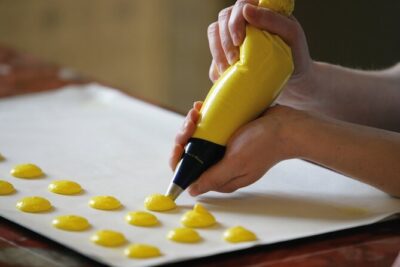
Paris Macarons Small-Group Baking Class with a Chef
Read our review →Browse the lists this tour appears in