
Reviewed · WWI & WWII BATTLEFIELD DAY TRIPS
WW1 Australians in the Somme -Villers Bretonneux, Le Hamel – Day trip from Paris
The most striking part of this Somme day trip is the way it links widely scattered Australian sites into one long, moving story. In a single day, you see the memorial at Villers-Bretonneux, the trenches at Le Hamel, the blasted Lochnagar Crater, and the ground where Australian casualties were especially heavy.
I like the small maximum group of seven, which gives the guide room to explain details and answer questions. I also like the mix of open-air memorials and the Historial de la Grande Guerre in Péronne, where uniforms, weapons, and trench art add human detail to the battlefield story. The drawback is the very early 6:30 am start and the long 12 to 13-hour day from Paris.
In This Review
- Key points at a glance
- Why this Somme day trip matters
- Leaving Paris at 6:30 am
- Villers-Bretonneux and 10,773 missing Australians
- Le Hamel and the preserved trenches
- Lochnagar Crater at La Boisselle
- Pozières and the Windmill Memorial
- The Second Australian Division at Mont Saint-Quentin
- Péronne’s castle and the Great War museum
- Is $300.06 fair value?
- Who will enjoy this day most?
- Booking, cancellation, and timing
- Should you book the Somme Australian WW1 tour?
- FAQ
- Where does the Somme tour begin?
- What time does the tour start?
- Where does the tour end?
- How long does the experience last?
- How many people can join the tour?
- Is the tour offered in English?
- Is lunch included?
- Is admission to the Péronne museum included?
- Can I cancel for a full refund?
Key points at a glance
- 10,773 names at Villers-Bretonneux: See the Australian memorial to soldiers with no known grave from the Western Front.
- Preserved trenches at Le Hamel: Walk through a site linked to General Monash’s carefully coordinated 1918 attack.
- A huge mine crater at La Boisselle: Lochnagar Crater gives you a physical sense of the force used on the first day of the Somme.
- Pozières and Mont Saint-Quentin: Visit two important Australian remembrance sites tied to intense fighting and heavy losses.
- A 13th-century castle museum: Explore Péronne’s Great War collection, including weapons, uniforms, and Otto Dix’s stark trench art.
- Small-group transport from central Paris: Your driver-guide handles the route, leaving you free to focus on the sites.
Why this Somme day trip matters
The Somme is not a single battlefield with one grand entrance. It is a wide area of villages, cemeteries, roads, fields, memorials, and preserved remnants. That makes independent sightseeing difficult in one day, especially from Paris.
This tour solves the main problem: getting between the sites. You leave Paris in an air-conditioned vehicle with an English-speaking driver-guide, then move from one location to another without having to work out the roads or public transport. With no more than seven people, the day should feel more personal than a large coach excursion.
I particularly value the focus on Australia’s role in the First World War. The tour is not limited to a general account of the Somme. It follows Australian service and sacrifice from Villers-Bretonneux and Le Hamel to Pozières, Mont Saint-Quentin, and the museum at Péronne.
Guide Regis receives especially strong praise for giving a personal, informed account of the war and its villages. The guide can help connect what you see on the ground with the wider military story, which matters at sites where a simple monument might otherwise be hard to interpret.
More battlefield remembrance trips from Paris:
- Somme Battlefields Small-Group Day Trip with John Monash Centre from Paris
★ 4.5 · 270 reviews - Somme Battlefields from Paris with Australian memorial & Amiens Cathedral
★ 5.0 · 228 reviews - WWI Somme Battlefields Day Trip from Paris
★ 4.9 · 111 reviews
Leaving Paris at 6:30 am
The meeting point is outside the Théâtre du Lido at 116 bis Avenue des Champs-Élysées. There is no hotel pickup or drop-off, so you need to reach this central Paris location on your own.
The early departure is necessary for a full day in the Somme, but it is still a real commitment. You should be ready to leave before most of Paris has properly started its day. The return is to the same location after roughly 12 to 13 hours.
The long duration is not wasted on a rushed single stop. It reflects the distance from Paris and the spread of the sites across the former Western Front. Still, you should book this only if you are comfortable with a full day of transport, outdoor visits, and sustained attention.
The vehicle is air-conditioned, a useful detail for a long road day. The tour is offered in English, and most people can participate. The maximum of seven is one of the strongest practical features because it allows the guide to speak with the group rather than simply deliver a fixed speech.
Villers-Bretonneux and 10,773 missing Australians
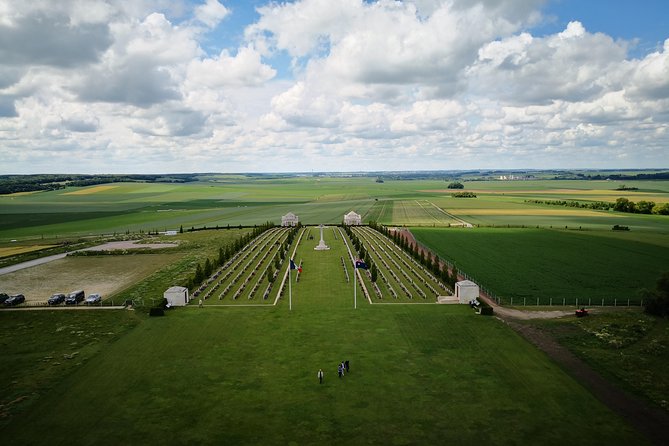
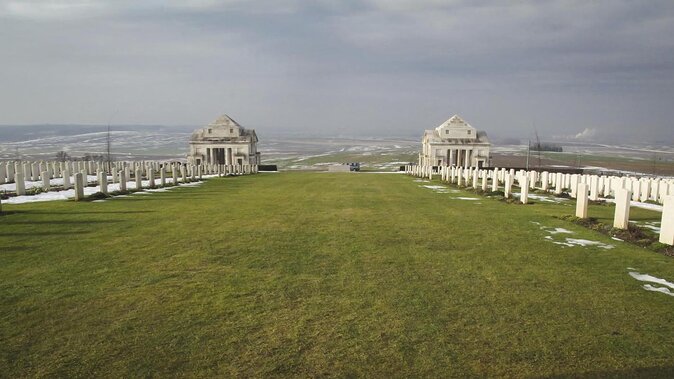
The Australian National Memorial at Villers-Bretonneux is the emotional center of the day. It commemorates Australian military personnel killed on the Western Front who have no known grave.
The memorial lists 10,773 names of Australian Imperial Force soldiers killed between the arrival of Australian forces in France and Belgium in 1916 and the end of the war. Seeing those names arranged on the memorial walls gives the losses a scale that a battlefield map cannot provide.
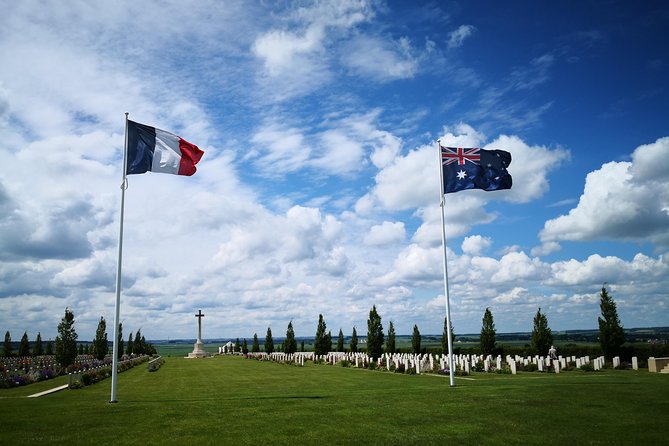
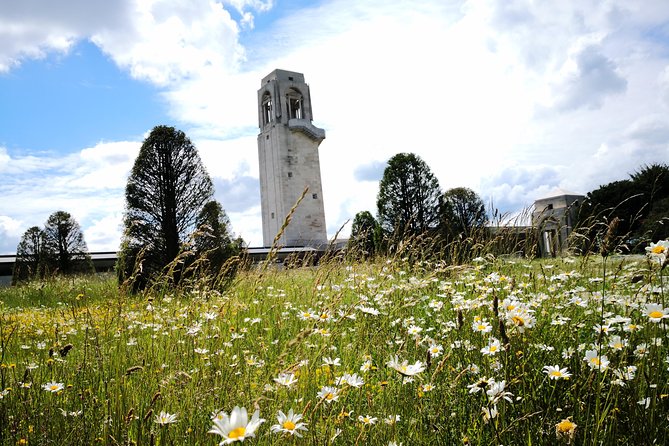
The location was chosen for the part Australian forces played in the Second Battle of Villers-Bretonneux from 24 to 27 April 1918. Sir Edwin Lutyens designed the memorial, which includes a tower within Villers-Bretonneux Military Cemetery. A Cross of Sacrifice and the surrounding cemetery add to the quiet, formal setting.
You have about 40 minutes here. That is enough to see the main memorial, read the inscriptions in French and English, and take in the cemetery. It is not a long time for close study of every name, so you may want to decide in advance what matters most to you.
The Commonwealth War Graves Commission maintains the memorial and cemetery. The setting is orderly and restrained, with little to distract you from the names and the purpose of the site. I like that the tour begins here, since it gives the rest of the day a clear human focus.
Le Hamel and the preserved trenches
The Australian Corps Memorial at Le Hamel looks at the battle of 4 July 1918. General Monash launched an attack here with American support, bringing infantry, artillery, aircraft, and tanks together in a coordinated operation.
The site helps explain why Le Hamel is often linked with changing methods of warfare. Panoramic displays and explanatory panels show the strategic problem faced by the attacking forces, while preserved trenches provide a direct reminder of how close and confined the fighting could be.
You have about 30 minutes at the memorial park. That is a sensible amount of time for the displays and trenches, though you will not have hours to examine every panel in detail.
The trenches are the special feature. A museum case can show equipment, but a trench helps you picture the physical limits of movement and visibility. I would listen closely to the guide here, since the terrain and displays make more sense when someone explains how the attack was organized.
The memorial park was created by the Australian state and opened in 1998. It is a later place of remembrance, but it interprets an earlier battle in a clear and practical way.
A few more Paris ideas to compare
- Disneyland® Paris 1-Day Ticket
★ 4.6 · 49,412 reviews - Normandy D-Day Sites & Cemetery Day Trip from Paris with Lunch
★ 5.0 · 6,877 reviews - Day Trip to Mont-Saint-Michel from Paris
★ 4.5 · 4,876 reviews - Disneyland® Paris 1-Day Flexible Date Ticket
★ 4.3 · 4,347 reviews
Lochnagar Crater at La Boisselle
Lochnagar Crater is a brief stop, only about 10 minutes, but it gives the day one of its strongest physical sights. The crater was made by a British underground mine detonated at 7:28 am on 1 July 1916, the first day of the Battle of the Somme.
The explosion left a crater about 30 metres deep and 100 metres wide. It was one of 19 mines placed beneath German positions on the British part of the Somme front to help the infantry advance.
The sheer size of the crater makes the mechanics of the battle easier to grasp. This is not just a plaque marking an event. You can look into the hollow left by the blast and understand how much earth was thrown aside before the infantry attack even began.
The short stop is the main limitation. You will have time to see the crater and hear the essential explanation, but not to linger. The site is also exposed, so suitable clothing matters, especially in poor weather.
Lochnagar is preserved as a memorial, and a religious service is held there each 1 July. Its place in the day provides useful contrast: Villers-Bretonneux focuses on names and remembrance, while Lochnagar shows the destructive force of the battle itself.
Pozières and the Windmill Memorial
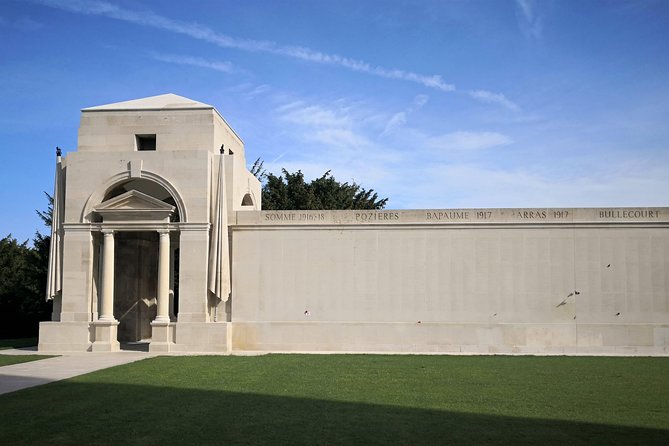
At Pozières, the Windmill Memorial marks ground associated with some of the heaviest Australian losses of the Somme. Over seven weeks in 1916, the Australian Imperial Force suffered 23,000 casualties in the area, including more than 6,700 deaths.
The memorial site was established in the 1930s after a suggestion from Charles Bean, Australia’s official war historian. His reason for choosing this ridge was blunt: it marked a place of exceptional Australian sacrifice.
You spend about 10 minutes here. That is enough for a quiet look at the memorial and the surrounding ground, but the stop is not designed as a long walk or a full battlefield study. The value lies in the guide’s explanation and in placing the scale of the losses on the exact area being discussed.
The site also has a later connection with Australian remembrance. Soil from the Windmill site was placed over the coffin of Australia’s Unknown Soldier during his funeral at the Australian War Memorial in Canberra in 1993.
That detail helps explain why small sites matter. The memorial is modest, but its ground became part of a national act of mourning decades later.
The Second Australian Division at Mont Saint-Quentin
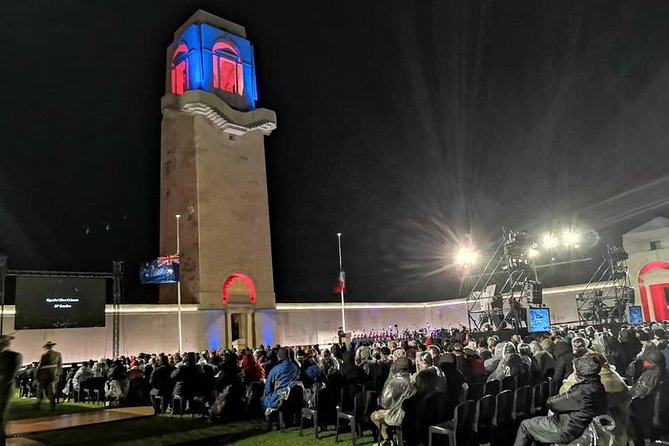
The Second Australian Division Memorial is on the road between Bapaume and Péronne, in the Mont Saint-Quentin area. It is distinctive because it was the only one of the five Australian division memorials initiated by members of the division itself.
The original base was erected in 1925. Its bronze reliefs show soldiers hauling and pushing a gun, then advancing with bayonets and hand grenades. The first statue showed an Australian soldier driving a bayonet through a German eagle.
That statue was destroyed by German soldiers in 1940. A replacement was installed in 1971, showing a thoughtful Australian soldier looking down. The change gives the memorial another layer, showing how monuments can be damaged, rebuilt, and reinterpreted over time.
You have about 10 minutes here. This is a roadside memorial rather than a large museum or cemetery, so the guide’s context is important. The stop works best as part of the wider sequence, linking military units, battles, and remembrance.
Péronne’s castle and the Great War museum
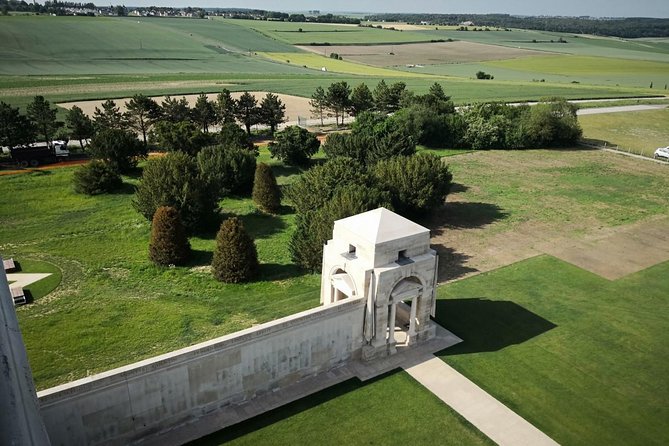
After lunch, the tour finishes at the Historial de la Grande Guerre in Péronne. Museum admission is included, and you have about an hour to explore.
The museum is housed in a 13th-century medieval castle, an unusual setting for a collection about the First World War. Inside, you can see uniforms, weapons, and other objects designed, worn, or used by soldiers during the conflict.
This is a valuable change of pace after several outdoor memorials. At the earlier sites, you think about distance, terrain, and military movement. In Péronne, objects bring the war back to clothing, equipment, and the daily experience of the people who served.
The permanent collection also includes trench artists such as Otto Dix. His graphic etchings confront the physical and moral damage of the war. They are not decorative battlefield souvenirs. They show how artists recorded the violence and its effect on those who witnessed it.
One hour is enough for a focused visit, but not for every display. If military equipment interests you most, start with the uniforms and weapons. If you want the strongest artistic response, make time for the trench art collection.
Lunch is not included, so you need to budget for it separately. The exact lunch arrangement is not specified, but the schedule places it before the museum visit. This is another reason to treat the $300.06 price as the cost of a guided full-day excursion, not an all-inclusive package.
Is $300.06 fair value?
At $300.06 per person, this is not a cheap day out. The price makes more sense when you consider what it includes: a 12 to 13-hour round trip from Paris, an air-conditioned vehicle, an English-speaking driver-guide, navigation between widely scattered sites, and entry to the Historial de la Grande Guerre.
You are paying mainly for time and access. Reaching Villers-Bretonneux, Le Hamel, Pozières, Mont Saint-Quentin, and Péronne independently would require careful planning and several transport connections. A rental car could reduce the direct cost for some groups, but then you would need to drive, navigate, and create your own historical explanation.
The group limit improves the value. With only seven people, the guide can tailor explanations and handle questions. That matters most at the smaller memorials, where there may be little printed information immediately in front of you.
The price does not include hotel pickup, hotel drop-off, or lunch. You also pay for the early start with your time and energy. I would recommend it most strongly to someone who wants a focused Australian military history day and does not want to manage the route alone.
Who will enjoy this day most?
This tour suits you if you have a strong interest in the First World War, Australian military history, cemeteries, memorial design, or battlefield archaeology. It also works well for families with older teenagers. The mix of memorials, trenches, a huge crater, and museum displays offers more variety than a day made up only of cemetery visits.
The experience has been particularly well received by families with teenagers aged 16 and 18, which makes sense. The subject is serious, but the changing locations keep the day from becoming one long museum visit.
You should think twice if you dislike early starts, long drives, outdoor sites, or solemn subject matter. The tour requires attention and patience. Some stops last only 10 minutes, while the museum visit lasts an hour, so the pace is structured rather than leisurely.
Good walking shoes and weather-appropriate clothing are sensible choices, although the supplied information does not give a detailed dress or walking requirement. Since the tour can be canceled for poor weather, conditions clearly matter to the operation of the day.
Booking, cancellation, and timing
The tour is often booked far ahead, with an average booking lead time of 203 days. That suggests you should not leave it until the last moment if the date matters to your Paris plans.
Confirmation is provided when you book. Free cancellation is available until 24 hours before the start time, with a full refund. Changes or cancellations inside that 24-hour window are not accepted for a refund.
The experience requires a minimum number of participants. If that minimum is not reached, you are offered another date or experience, or a full refund. Poor weather can also lead to a new date or full refund.
Should you book the Somme Australian WW1 tour?
I would book this tour if you want to understand Australia’s First World War story through actual places rather than a city museum alone. Villers-Bretonneux supplies the names, Le Hamel shows the trenches and tactics, Lochnagar reveals the force of the opening bombardment, and Pozières and Mont Saint-Quentin add the weight of Australian sacrifice.
The strongest reasons to go are the small group, the range of sites, and the quality of explanation available from guides such as Regis. The main cautions are the $300.06 price, the extra cost of lunch, no hotel pickup, and the demanding 6:30 am to evening schedule.
For a casual sightseeing day, choose something shorter. For a serious, well-organized look at Australian service on the Somme, this is a strong use of one full day from Paris.
FAQ
Where does the Somme tour begin?
It begins at the Théâtre du Lido, 116 bis Avenue des Champs-Élysées, 75008 Paris.
What time does the tour start?
The scheduled start time is 6:30 am.
Where does the tour end?
The tour returns to the Théâtre du Lido in Paris.
How long does the experience last?
The day lasts approximately 12 to 13 hours.
How many people can join the tour?
The maximum group size is seven people.
Is the tour offered in English?
Yes. The experience is offered in English and includes a driver-guide.
Is lunch included?
No. Lunch is not included in the price.
Is admission to the Péronne museum included?
Yes. Admission to the Historial de la Grande Guerre in Péronne is included.
Can I cancel for a full refund?
Yes. You can cancel at least 24 hours before the start time for a full refund. Cancellations or changes made less than 24 hours before departure are not refunded.
Newest additions around Paris
- Family escape Game with kids and teens on the Île de la Cité★ 4.5 · 11 reviews
- Private Photoshoot with the Iconic Eiffel Tower in Paris★ 5.0 · 11 reviews
- 2-day Private Mont Saint-Michel, 3 Loire Castles, D-Day Express★ 4.5 · 11 reviews
- Paris: Batobus Hop-On Hop-Off Cruise & Landmarks Audio Tour★ 3.0 · 11 reviews
- Paris Revolutionary Walking Tour: Iconic French Sights & Stories★ 5.0 · 11 reviews
- Guided and Private Tour of 3 hours through Paris aboard a Citroën 2cv★ 5.0 · 11 reviews
- Kids in the Kitchen – CrOisSaNtS★ 4.0 · 11 reviews
- Paris: Ghosts and Dark Stories Guided Walking Tour★ 4.1 · 11 reviews
WWI & WWII Battlefield Day Trips, compared.
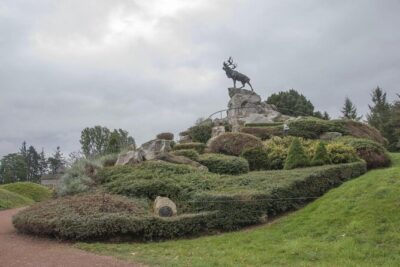
Somme Battlefields Small-Group Day Trip with John Monash Centre from Paris
Read our review →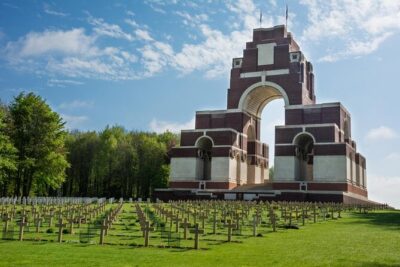
Somme Battlefields from Paris with Australian memorial & Amiens Cathedral
Read our review →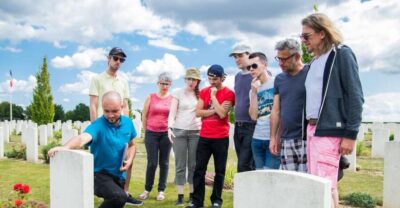
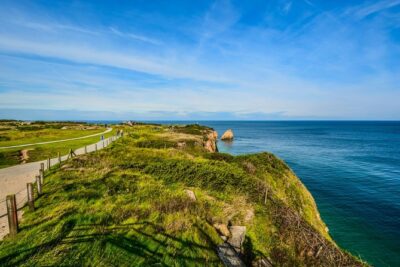
Normandy D-Day Beaches and World War II Sites Day Trip from Paris
Read our review →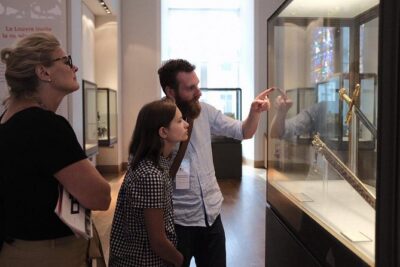
Skip-the-line Les Invalides World War Museum Guided Tour – Semi-Private 8ppl Max
Read our review →
WWI Private Day Trip with Ypres Salient Battlefield in Flanders from Paris
Read our review →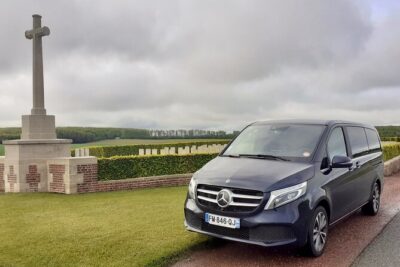
WW1 Australian Battlefield Day Tour from PARIS: Somme, Villers-Bretonneux…
Read our review →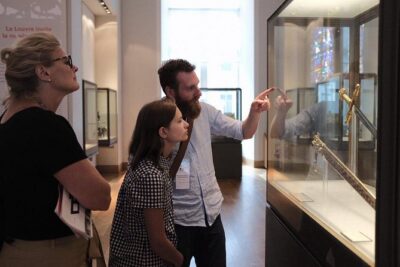
Skip-the-line Les Invalides World War Museum Guided Tour – Exclusive Guided Tour
Read our review →Browse the lists this tour appears in