

Reviewed · ORSAY & ART MUSEUM TOURS
Skip-the-line Rodin Museum Guided Tour Semi-Private 8ppl Max
Rodin’s museum is a fine place to see sculpture up close, but the real treat is the link between the rooms and the garden. You move from Rodin’s studies of hands and bodies to major works such as The Walking Man, The Thinker, and The Gates of Hell, then step outside among more sculpture.
I like the eight-person limit, which gives a guide room to explain details without shouting across a crowd. I also like that admission is included and the tour is built around one artist rather than trying to race through all of Paris. The main caution is that guide quality can affect the visit: Dunya and Anatole received warm praise, while one guest found the guide repetitive and too focused on time checks.
In This Review
- Key points to know before booking
- Why Musée Rodin works so well for a short guided visit
- Meeting your guide at 77 Rue de Varenne
- Inside the museum: hands, bodies, and working methods
- The Gates of Hell and The Thinker
- Rodin’s gardens provide the breathing room
- What the eight-person limit really gives you
- Is $143.13 a fair price?
- Timing, dress, and museum rules
- Who should choose this Rodin tour?
- My booking advice
- FAQ
- How long does the Rodin Museum tour last?
- Where does the tour begin and end?
- How many people can join the tour?
- Is museum admission included?
- What should I bring into the museum?
- Can I cancel for a refund?
Key points to know before booking

- Small group of eight or fewer: The cap keeps the visit more personal than a large museum walk.
- Rodin’s major works in one focused visit: Expect The Walking Man, The Gates of Hell, The Thinker, and studies of the human form.
- Indoor rooms plus sculpture gardens: The outdoor section adds space, air, and a different view of Rodin’s work.
- English-speaking professional guide: Dunya and Anatole are named guides associated with especially strong visits.
- About two hours at Musée Rodin: The tour starts and ends at 77 Rue de Varenne, with admission included.
- A few practical limits: Large bags are not allowed, access may be difficult for wheelchair users, and occasional museum closures can change the plan.
Why Musée Rodin works so well for a short guided visit
The Musée Rodin offers something many Paris museums lack: a clear artistic focus and a setting that lets you see the work from several angles. Instead of spending hours moving from one famous name to another, you follow Rodin’s development through studies, portraits, figures, and large compositions.
That focus matters because Rodin’s sculpture can look simple at first glance. A hand may seem like a small study, but it reveals how he tested movement, tension, and gesture. A head or torso may feel unfinished, yet the rough surface can be part of the effect. A good guide helps you notice these choices rather than treating each object as another item on a checklist.
I especially like the way the visit connects the inside rooms to the grounds. You begin among works and paintings Rodin collected over his lifetime, then continue outdoors where sculpture has more room to breathe. The change of setting helps you see how a work feels when viewed from different distances.
The tour lasts about two hours, although the stated duration ranges from one and a half to two hours. That is enough time for a well-paced introduction, but not enough for every work in the museum. If you want a slow, highly detailed study of the entire collection, plan to return on your own.
More Orsay and art museum visits:
- Paris: Orsay Museum Entry Ticket
★ 4.7 · 25,647 reviews - Paris: Orsay Museum Entry Ticket and Digital Audio Guide App
★ 4.4 · 3,170 reviews - Paris in a Day: Louvre or Orsay, Eiffel Tower, City Walk & Cruise
★ 5.0 · 1,956 reviews
Meeting your guide at 77 Rue de Varenne
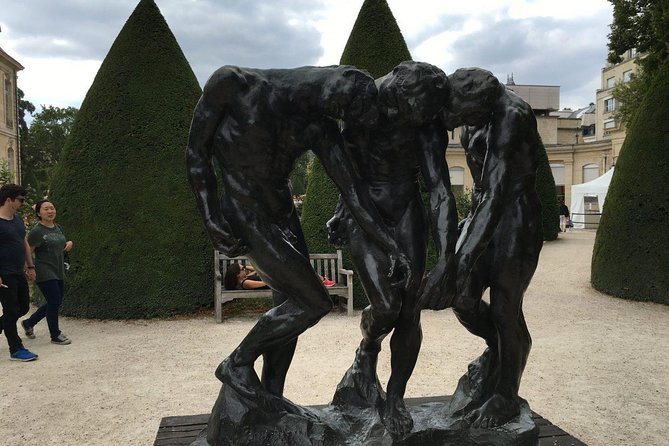
The meeting point is the Musée Rodin at 77 Rue de Varenne in Paris. The tour ends back at the same place, so you do not need to arrange a complicated transfer after the visit. The museum is near public transportation, and the operator recommends using a taxi or Uber if you need door-to-door transport, since hotel pickup and drop-off are not included.
Arrive ready for a museum visit, not a long walking tour. You should expect to walk through several rooms and the garden, and a moderate level of physical fitness is required. The experience is not recommended for people with walking disabilities or those using a wheelchair.
Security rules can affect your arrival. Large bags and suitcases are not allowed inside, while handbags and small, thin backpacks are permitted through security. I would pack lightly and leave bulky luggage elsewhere rather than risk a delay at the entrance.
The skip-the-line wording does not mean you will never encounter a pause. Security checks and increased measures at attractions can still create short lines. The benefit is priority access where available, not a promise that every step will be instant.
Inside the museum: hands, bodies, and working methods
The indoor section gives you a close look at Rodin as a working artist. The rooms contain sculptures as well as selections from more than 200 paintings he collected during his life. Those paintings help place his sculpture within the wider artistic world he followed and valued.
Rodin’s studies of the human form are a major reason to take this tour with a guide. You may see repeated explorations of hands, limbs, and bodies. These studies show that large finished works often grew from smaller experiments. The guide can point out how a gesture changes when Rodin alters the angle of a wrist, the turn of a shoulder, or the balance of a figure.
The life-sized The Walking Man is one of the key works to watch for. Its force comes from the body in motion, even though the figure is presented without a head. That unusual choice gives you a useful lesson in Rodin’s approach: the body does not need a face to communicate direction, weight, and energy.
I find this part of the tour most useful for people who think modern sculpture began with abstract shapes. Rodin still worked with the human body, but he treated it in a less polished and more active way. Surfaces, fragments, and incomplete forms can carry as much meaning as a smooth, finished figure.
The rooms may also include portraits of Rodin’s contemporaries, including the French writer Balzac. These works connect the artist to the people and culture around him. You are not only seeing anonymous bodies. You are also seeing how Rodin interpreted real personalities.
Some rooms require quiet or limit speaking. In those spaces, your guide will give information before you enter. That arrangement may interrupt the flow slightly, but it is better than trying to hear a full talk where conversation is restricted.
The Gates of Hell and The Thinker
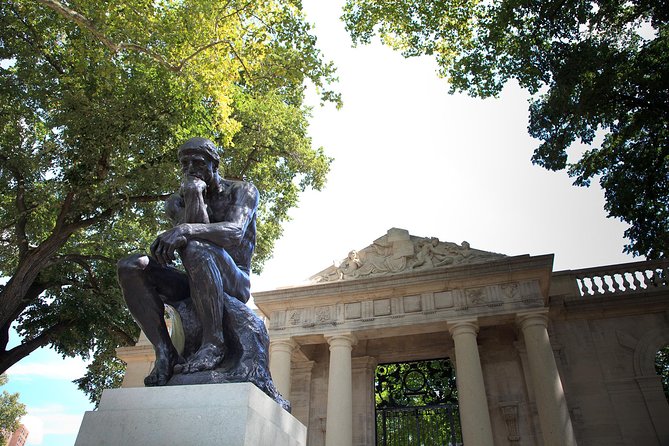
The Gates of Hell deserves careful attention. The work contains a large number of figures and details, and it can be difficult to understand by looking at it quickly. Your guide can help you see how separate figures relate to the larger composition and how some of Rodin’s best-known forms appear within it.
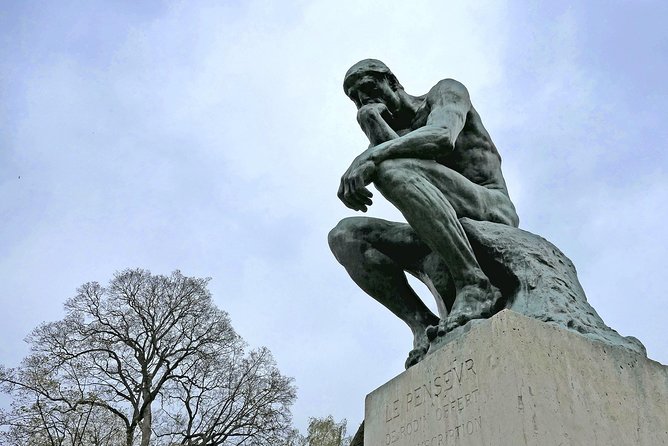
The Thinker is the most recognizable figure connected with The Gates of Hell. A short guided explanation adds useful context because the statue is often treated as a stand-alone symbol. Here, you can consider its place in the larger work and the way Rodin used the seated figure to suggest thought, strain, and physical power at once.
This is where guide quality becomes especially important. A strong guide can turn a familiar statue into a fresh subject by showing you details you might pass without noticing. Dunya was praised for adding dimension to both the artist and the man behind the work, and Anatole was also singled out for his presentation. Those names are worth noting when you receive your guide assignment, though the operator does not promise one particular guide.
There is one fair warning. A small group does not automatically guarantee an excellent tour. One poor account described a guide who repeated information, gave frequent reminders about the remaining minutes, and did little to keep three participants together. That sounds frustrating, especially in a museum where you want time to look. The overall score is 4.8 from 20 ratings, and 95 percent of customers recommend the experience, but the individual guide still matters.
More Paris museums to visit:
- Paris: Louvre Museum Timed-Entrance Ticket
★ 4.6 · 71,977 reviews - Louvre Museum Masterpieces Guided Tour with Access
★ 4.5 · 12,023 reviews - Paris: Louvre Museum Entry Ticket With Host and River Cruise
★ 4.6 · 9,926 reviews - Les Invalides: Napoleon’s Tomb & Army Museum Entry
★ 4.6 · 9,185 reviews
Rodin’s gardens provide the breathing room

After the indoor rooms, you can stroll through the manicured gardens where additional sculptures are displayed. This is not filler at the end of the tour. The outdoor setting changes how you read the work.
Inside, lighting and room size control your view. Outside, you can step back, see a sculpture against open space, and notice how its silhouette changes as you move. The garden also gives you a natural pause after concentrating on detailed forms and crowded compositions.
The garden is one reason I would choose this visit instead of a purely indoor sculpture lecture. It lets you compare the controlled museum rooms with works placed in a more open setting. You can also enjoy a slower final stretch, although the guide may keep the group moving so the schedule stays on track.
Collections can vary during the year, and occasional museum closures may happen without advance warning from museum management. If the opening is delayed by more than an hour, the operator says it will offer an appropriate alternative. Refunds or discounts are not provided in those situations, so keep your schedule somewhat flexible.
What the eight-person limit really gives you
The tour is semi-private, not private. You may share the guide with as many as seven other people, and the minimum is two participants. That distinction matters when you compare the price with a private tour.
A group capped at eight is small enough for questions and eye contact. It is also compact enough to move through museum rooms without the long pauses and scattered conversations common in larger groups. You are still part of a group, though, so the guide’s pace must suit several people.
The size is most valuable if you want interpretation but do not want the cost of a fully private guide. It also works well for couples, families, or friends who prefer a more personal visit. If your group has different interests, remember that two hours will not allow everyone to stop at every work for as long as they wish.
The tour is offered in English. If detailed art explanation is important to you, an English-speaking guide can make the difference between recognizing famous names and understanding how the works connect.
Is $143.13 a fair price?
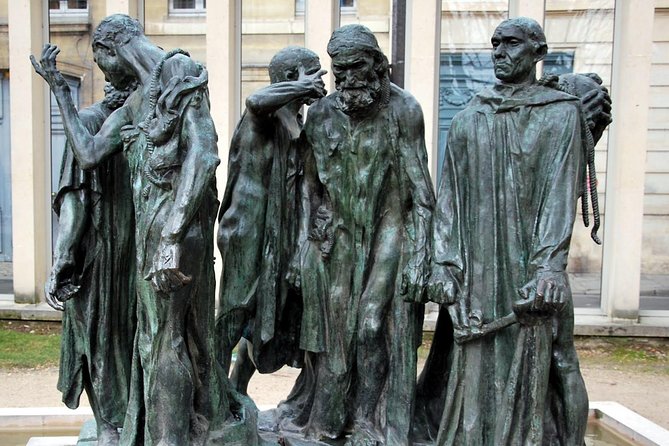
At $143.13 per person, this is not a budget museum entry. You are paying for more than admission: the price covers a professional guide, skip-the-line access, and a semi-private group limited to eight people. Admission fees are included, so there should not be a separate museum charge at the meeting point.
The value depends on what you want from Musée Rodin. If you mainly need entrance and prefer to read labels at your own speed, buying a standard ticket and exploring independently may cost less. If you want help making sense of The Gates of Hell, The Thinker, Rodin’s studies, and the garden collection in a short period, the guide adds real value.
I would be more comfortable with this price for a first visit than for a repeat visit. On your first stop, the guide can give you a framework and direct your attention to works that reward close looking. On a later visit, you may prefer to spend your time with a few favorite sculptures without a fixed schedule.
Group discounts are listed as a feature, though the supplied details do not explain the discount amount or eligibility. Check the final price for your party before booking.
Timing, dress, and museum rules
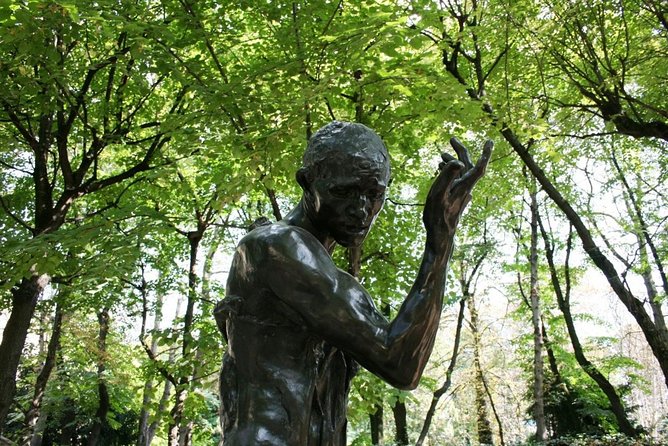
The visit takes about two hours and begins at the museum entrance. Appropriate dress may be required for entry into some sites on the wider operator’s program, so modest, comfortable clothing is the safe choice here.
The museum can restrict speech in specific rooms. Your guide will explain what you need to know before entering those areas. Do not expect to hear a running commentary in every room, and use those quiet sections as time to look closely.
Mobile tickets are available. Confirmation is provided at booking, which makes the experience easy to add to a Paris schedule. Still, I would avoid placing an important timed connection immediately afterward. The normal visit is short, but security, museum procedures, or a delayed start can take extra time.
Free cancellation is available up to 24 hours before the local start time. Changes or cancellations inside that window are not refunded. The tour also needs at least two participants to operate, and if that minimum is not reached, you will be offered another option or a full refund.
Who should choose this Rodin tour?
I would recommend it to you if you want a focused art visit, prefer an English-speaking guide, and value a small group over the lowest possible ticket price. It suits first-time visitors who know The Thinker but want to understand more about Rodin’s other work.
It is also a good choice if you have only a short period for the museum. Two hours gives you a useful introduction without consuming an entire Paris morning or afternoon. The indoor collection and garden make the visit varied, and the meeting point is simple.
You may want another option if you use a wheelchair, have significant walking limits, carry large luggage, or dislike fixed group pacing. You should also think twice if you need a private guide. Eight people is a firm maximum, but the tour is not exclusive to your party.
My booking advice
Book this tour if you want Rodin’s work explained rather than simply seen. The best elements are the tight focus, the group limit, the garden setting, and the chance to connect familiar works such as The Thinker with lesser-known studies and portraits.
At $143.13, it makes sense only if you plan to use the guide. Arrive at 77 Rue de Varenne with a small bag, allow a little time for security, and keep your schedule flexible. If the guide is as strong as Dunya or Anatole, the visit can give you a far clearer picture of Rodin’s methods and ambitions than a quick self-guided walk.
FAQ
How long does the Rodin Museum tour last?
The experience lasts approximately two hours. The included tour information gives a duration range of about one and a half to two hours.
Where does the tour begin and end?
It begins at Musée Rodin, 77 Rue de Varenne, 75007 Paris. The activity ends back at the meeting point.
How many people can join the tour?
The semi-private group has a maximum of eight people. At least two participants are required for the tour to operate.
Is museum admission included?
Yes. The tour includes all entrance fees and skip-the-line semi-private museum access.
What should I bring into the museum?
Large bags and suitcases are not allowed. Handbags and small, thin backpacks are permitted through security. The tour is available as a mobile ticket.
Can I cancel for a refund?
Yes. You can cancel at least 24 hours before the experience start time for a full refund. Cancellations or changes made less than 24 hours before the start time are not refunded.
More Skip the Line in Paris
- Versailles: Skip-the-Line Tour of Palace with Gardens Access
★ 4.7 · 9,778 reviews - Versailles: Skip-the-Line Guided Palace Tour and Full Access
★ 4.6 · 5,214 reviews - Louvre Museum: Skip-the-Line Small Group Guided Tour
★ 4.6 · 3,960 reviews - From Paris: Versailles Skip-the-Line Tour & Gardens Access
★ 4.7 · 3,011 reviews
Newest additions around Paris
- Family escape Game with kids and teens on the Île de la Cité★ 4.5 · 11 reviews
- Private Photoshoot with the Iconic Eiffel Tower in Paris★ 5.0 · 11 reviews
- 2-day Private Mont Saint-Michel, 3 Loire Castles, D-Day Express★ 4.5 · 11 reviews
- Paris: Batobus Hop-On Hop-Off Cruise & Landmarks Audio Tour★ 3.0 · 11 reviews
- Paris Revolutionary Walking Tour: Iconic French Sights & Stories★ 5.0 · 11 reviews
- Guided and Private Tour of 3 hours through Paris aboard a Citroën 2cv★ 5.0 · 11 reviews
- Kids in the Kitchen – CrOisSaNtS★ 4.0 · 11 reviews
- Paris: Ghosts and Dark Stories Guided Walking Tour★ 4.1 · 11 reviews
Orsay & Art Museum Tours, compared.
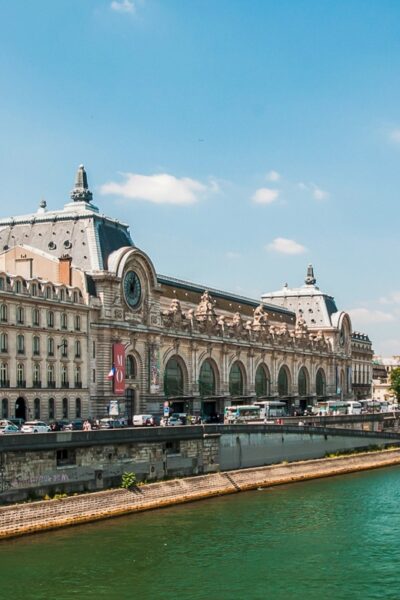
Orsay Museum Entry Ticket and Digital Audio Guide App
Read our review →
Paris in a Day: Louvre or Orsay, Eiffel Tower, City Walk & Cruise
Read our review →
Musée d’Orsay Skip-the-Line Tour with Expert Guide
Read our review →
Musée d’Orsay Skip-the-Line Tour with Expert Guide
Read our review →
The Musée d’Orsay Guided Tour Orsay Museum Semi-Private 6ppl Max
Read our review →
Louvre & Musée d’Orsay Guided Museum Tour Semi-Private 6ppl Max
Read our review →
Browse the lists this tour appears in