
Reviewed · MONTMARTRE & SACRé-COEUR TOURS
Paris Jewish Heritage: Le Marais & Montmartre Guided Walking Tour
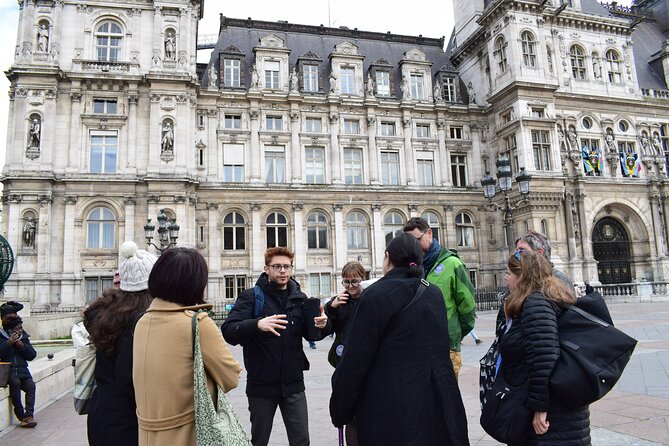
Jewish Paris comes into focus through two very different neighborhoods on this small-group walking tour. In Le Marais, you follow streets tied to religious life, migration, wartime loss, and today’s Jewish shops. In Montmartre, the subject shifts to artists such as Modigliani, Max Jacob, and Chagall, whose work helped shape 20th-century Paris.
I like the personal scale, which leaves room for questions and a guide who can adjust the pace. I also like the short public-transport connection between districts, since it saves your legs and gives the tour a clear change of mood. The main consideration is that the first part can feel slow if you want a tightly plotted sightseeing walk, and the tour visits major sites from the outside rather than taking you indoors.
In This Review
- Key points to know before booking
- What this Jewish Paris tour is really about
- Starting in Le Marais near Rue Saint-Antoine
- The Agoudas Hakehilos Synagogue from the street
- Rue des Rosiers and the everyday side of Jewish Paris
- The Shoah Memorial and the weight of remembrance
- The public-transport ride to Montmartre
- Montmartre, Jewish artists, and modern Paris
- Finishing at Sacré-Cœur and Square Louise-Michel
- Guide quality and the importance of the person leading you
- Is $102.12 a fair price?
- Who should book this walk?
- My call: book it for context, not a checklist
- FAQ
- How long does the Jewish heritage walking tour last?
- Where does the tour begin?
- Where does the tour end?
- Are synagogue interiors included?
- Are public-transport tickets included?
- What is the cancellation policy?
Key points to know before booking
- Two neighborhoods, two chapters: Le Marais presents community life and memory, while Montmartre focuses on Jewish artists and creative circles.
- The Agoudas Hakehilos Synagogue is exterior-only: You see Hector Guimard’s Art Nouveau design but do not enter.
- The Shoah Memorial adds difficult but important context: The guide discusses occupation, resistance, persecution, and remembrance.
- A falafel tasting may be included: Several guides, including Pierre Louis and PL, have offered a small taste near Rue des Rosiers.
- The group is kept small: The experience is described as private or intimate, with booking information listing a maximum of 12 and another description saying up to 9.
- Plan for an afternoon of walking: The tour begins at 2:30 p.m. and ends near the Sacré-Cœur steps after about three and a half hours.
What this Jewish Paris tour is really about
This is not simply a tour of old synagogues. It is a guided walk through the changing shape of Jewish life in Paris.
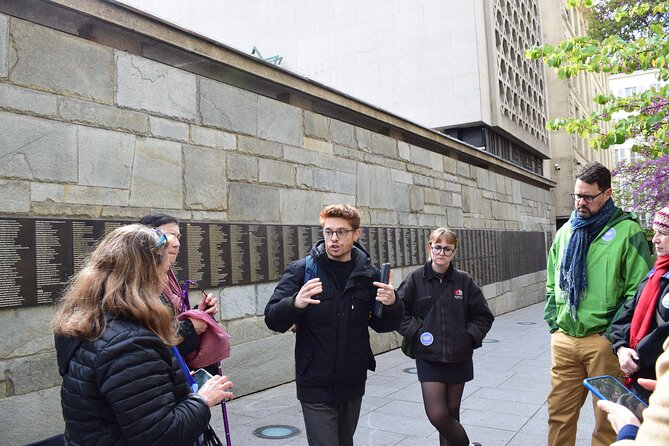
Le Marais gives you the strongest physical connection. You pass streets where Jewish businesses, schools, religious institutions, and family life developed over many years. The area also carries the marks of rupture: wartime destruction, deportation, rebuilding, and the continuing work of remembrance.
Montmartre tells a different story. Here, the focus turns to immigrant artists, writers, and musicians who gathered in cafés and studios during the early 20th century. The tour links figures such as Amedeo Modigliani, Max Jacob, and Marc Chagall to the creative world of Paris, while also explaining the antisemitism and political danger surrounding that period.
That contrast is the tour’s main idea. Le Marais is presented as a place of communal roots. Montmartre is presented as a place of artistic reinvention. Together, they show that Jewish Paris was never one single thing.
The experience is offered in English and takes about 3 hours and 30 minutes. At $102.12 per person, it is not a cheap stroll. You are paying for a dedicated guide, historical explanation, a small group, and public-transport tickets, not for admission to indoor monuments. The value depends heavily on the guide you receive and on how much you want interpretation rather than a list of buildings.
More Montmartre walks and visits:
- Montmartre Hidden Gems and Scenic Highlights Walking Tour
★ 5.0 · 2,684 reviews - Montmartre Hill French Gourmet Food and Wine Tasting Walking Tour
★ 5.0 · 2,588 reviews - Paris: Montmartre Cheese, Wine & Pastry Guided Walking Tour
★ 4.8 · 2,255 reviews
Starting in Le Marais near Rue Saint-Antoine
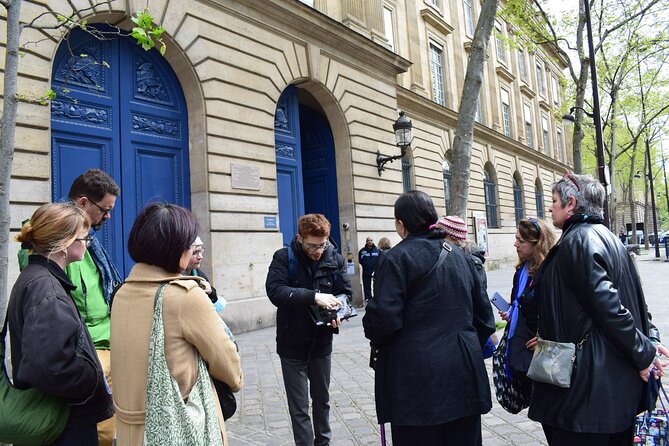
The meeting point is L’Elephant Du Nil at 125 Rue Saint-Antoine in the 4th arrondissement. You should arrive 5 to 10 minutes early. Joining after the tour has started is not possible, so this is not a good booking to squeeze between a late lunch and another timed entry.
The opening stretch can require patience. The tour begins by setting the wider historical scene, and the Jewish focus may not feel fully clear in the first half hour. If you prefer a fast succession of obvious sights, you may wonder where the walk is heading.
That slow opening also has a purpose. The guide is building the background needed to understand how Jewish communities formed, changed, and endured in Paris. I would treat the first section as an orientation rather than a highlight reel. Ask questions early if you want the route and historical periods explained more clearly.
The small group helps here. With fewer people around the guide, you can ask about a family tradition, a street name, French Jewish history, or a point that needs more explanation. Guides named in the feedback include Benjamin, Thomas, Pierre Louis, Benoit, Adrian, and Boniet. The strongest descriptions focus on their storytelling, patience, and ability to place Paris within wider European events.
The Agoudas Hakehilos Synagogue from the street
One of the most distinctive stops is the exterior of the Agoudas Hakehilos Synagogue. Designed by Hector Guimard, better known for his Paris Métro entrances, it is an unusual Art Nouveau place of worship.
The guide explains how Jewish immigration from Eastern Europe changed this part of Paris in the late 19th and early 20th centuries. The story covers more than architecture. It includes the institutions, schools, religious life, and cultural networks that grew as new arrivals made a life in the city.
Be clear about what you are booking: there is no indoor synagogue visit. You will see the building from outside and hear its story. If entering a historic synagogue is your main goal, this tour will feel limited.
Still, the exterior stop works well when the guide explains the building as part of a living neighborhood rather than an isolated architectural object. Look for the connection between the synagogue’s design and the community it served. That is where this stop earns its place.
Rue des Rosiers and the everyday side of Jewish Paris
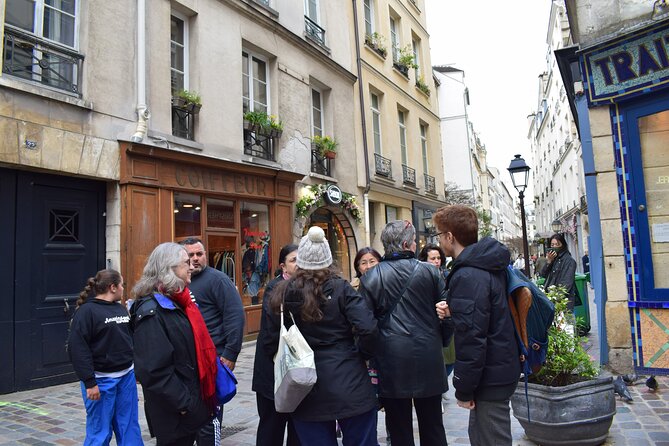
Rue des Rosiers is the most immediately recognizable part of the Le Marais section. Bakeries, delis, falafel shops, and specialty businesses give the street a strong present-day identity, while the guide explains how commercial and community life developed here.
This is where the walk can move beyond general history. You hear about migration, work, food, religious life, and the way traditions remain visible in ordinary businesses. Several guides have offered a small taste of falafel, including Pierre Louis and PL. It is a modest extra, but it connects the historical story to something you can see and taste on the street.
Do not expect a full food tour. The falafel sample is a possible touch within a history walk, not a series of tastings. Also, the street can feel more like a busy shopping area than a preserved historic quarter. That is part of the point. Jewish Paris is not only a memory site. It is also a present-day neighborhood with businesses and daily routines.
One weakness raised by the experience is that some explanations may remain broad. If you want detailed information about how Jewish families lived, worked, worshiped, and organized their community, ask for it directly. The quality of the walk depends on whether the guide connects the buildings and businesses around you to specific local life.
More Le Marais walks:
- Award-Winning Paris French Bakery Experience — Le Marais, 4th Arr
★ 4.5 · 1,186 reviews - Paris Le Marais Food Tour With 10+ Tastings, Cheese, Wine & More
★ 5.0 · 985 reviews - Paris Le Marais District Original Food and Wine Tasting Tour
★ 4.5 · 880 reviews - Paris Bike Tour Hidden Secrets in the Latin Quarter & Le Marais neighborhoods
★ 5.0 · 766 reviews
The Shoah Memorial and the weight of remembrance
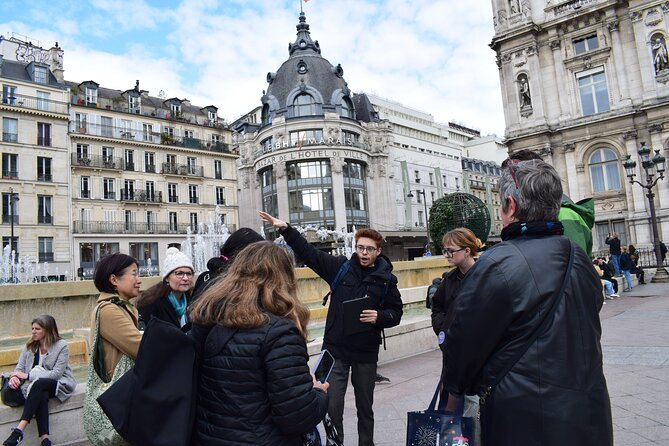
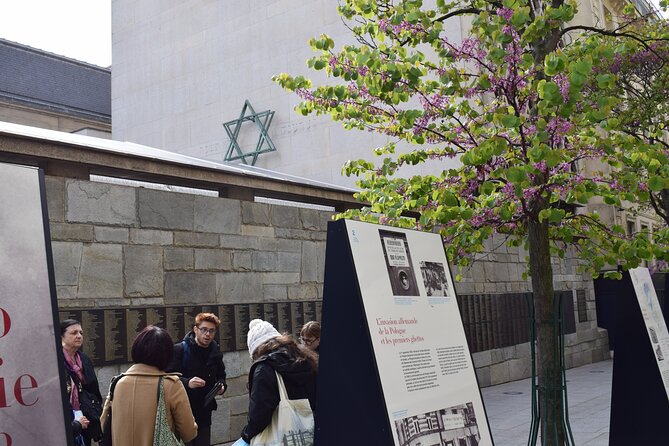
The tour stops at the Mémorial de la Shoah, viewed from the exterior. The guide places the memorial within the history of Nazi occupation, French collaboration, resistance, deportation, and postwar remembrance.
This is a serious section, and the tone matters. The strongest guides handle it with care while still giving enough historical context to show how events affected French Jews and the city around them. Benjamin is particularly praised for explaining Jewish history alongside the wider story of Europe and the world. Pierre Louis is also described as able to answer detailed questions and keep the history clear.
The memorial can become one of the most meaningful parts of your afternoon, but remember that the tour does not include an indoor museum visit. You may choose to return on your own and spend more time inside. The experience gives you a useful introduction, not a complete museum visit.
Some people may find the Shoah section too central if they hoped for a tour focused mainly on Jewish customs, architecture, or present-day community life. That concern is fair. The Holocaust and remembrance are essential to understanding modern Jewish Paris, but they occupy emotional and historical space that leaves less time for lighter neighborhood detail.
The public-transport ride to Montmartre
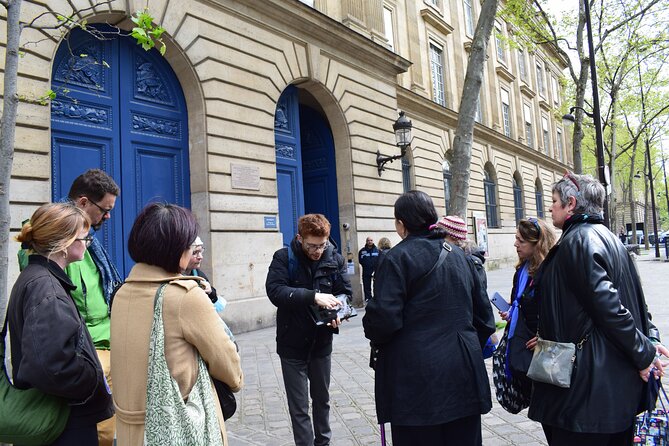
After the Marais section, the guide takes you toward Hôtel de Ville and then uses public transport to reach Montmartre. Tickets are included.
This short transfer is practical. It breaks up the walking and lets the tour shift from the older Jewish quarter to a district associated with artists and bohemian Paris. You do not have to arrange the ticket yourself, though you still need to follow the guide through the transfer.
The change of setting is one of the tour’s better design choices. Rather than forcing you to walk a long distance between unrelated districts, the ride creates a natural pause. It also helps you see that Jewish history in Paris cannot be confined to one neighborhood.
The route is still a walking tour, so wear comfortable shoes. The afternoon ends around Square Louise-Michel, near the Sacré-Cœur steps, with uphill streets and stairs likely forming part of the Montmartre section. The supplied information says most people can participate, but it does not provide a detailed mobility assessment. If you have specific walking needs, ask before booking.
Montmartre, Jewish artists, and modern Paris
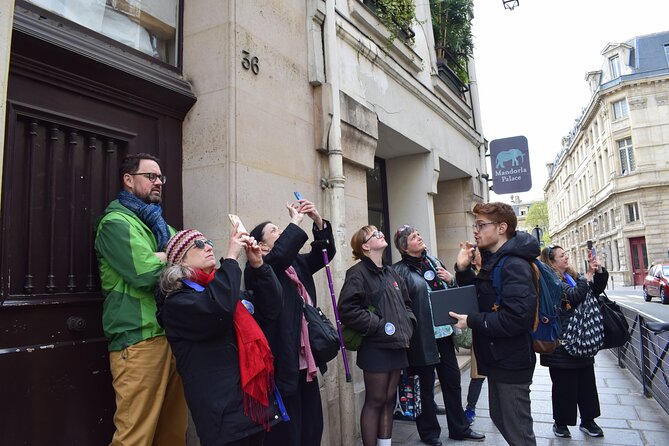
Montmartre brings a different kind of story. In the early 20th century, immigrant artists, writers, and musicians came to the area seeking work, community, and creative freedom. The guide discusses Modigliani, Max Jacob, and Marc Chagall as part of this Jewish artistic world.
The value here is not just learning which famous people lived or worked in Paris. The guide explains how cafés, studios, and literary circles helped artists meet and develop ideas. You also hear about the pressure surrounding them: nationalism, antisemitism, political uncertainty, exile, and the destruction caused by the Second World War.
This section may appeal most to you if you already enjoy art, literature, or the social history of Paris. It gives Montmartre a more serious frame than the usual cabaret and painter story. You see the district as a place where ambition and danger existed side by side.
At the same time, Montmartre may feel less visibly Jewish than Le Marais. The connection often comes through stories about people and artistic circles rather than a long line of clearly marked Jewish landmarks. If you want a route filled with synagogues, memorials, and community buildings, the Montmartre section may seem less concrete.
The guide’s storytelling makes a major difference. Benjamin, Thomas, and Pierre Louis receive especially strong praise for making complex history understandable and engaging. One guide may give you memorable stories about individuals and their choices. Another may lean more heavily on broad European history. It is worth asking questions about specific artists and how their Jewish identity shaped their work and lives.
Finishing at Sacré-Cœur and Square Louise-Michel
The tour ends at Square Louise-Michel, below the Sacré-Cœur Basilica. You get one of Paris’s classic high views, a fitting visual finish after an afternoon spent looking at the city through history.
The basilica itself is not an included interior visit. The advertised finish is about the setting and the view, not a guided monument entry. This gives you freedom to continue exploring Montmartre, visit the basilica independently, or simply stop for a rest after the walk.
Ending here also makes the tour easy to fold into an evening in Montmartre. You are already in the area for dinner or a later stroll. The afternoon start at 2:30 p.m. avoids the hottest midday period in warmer months, but weather can still affect the experience. One account describes a cold, rainy day that did not prevent the guide from keeping the group engaged. Bring suitable layers and rain protection rather than assuming Paris will cooperate.
Guide quality and the importance of the person leading you
This tour relies more on the guide than a monument tour does. You are not entering a famous interior with labels and displays. The guide has to connect streets, buildings, people, and historical events into a clear story.
The most praised qualities are strong command of the subject, warmth, patience, and storytelling. Benjamin is repeatedly singled out for his context and clarity. Thomas is praised for making the history interesting through stories. Pierre Louis, also called PL, is described as friendly, patient, and especially good at answering questions. Benoit is praised for his historical background, while Adrian receives credit for energy and enthusiasm.
There are also clear cautions. Some guides may give long speeches without pointing out enough about the immediate surroundings. One disappointing experience felt more like a general history lesson than a neighborhood walk. Another found too much opinion and too little detail about local community life.
You can improve your odds by deciding what you want to learn and saying so at the start. Ask about modern Jewish life in Le Marais, the role of local schools, migration from Eastern Europe, or what remains of older institutions. A small group gives you a better chance to steer the conversation.
Is $102.12 a fair price?
At $102.12 per person, this is a premium walking tour. You are not paying for admission to the synagogue, the Shoah Memorial, or Sacré-Cœur. Those are exterior or neighborhood stops.
The price makes more sense if you value a private or very small group, an English-speaking local guide, a long route across two districts, and historical interpretation that you could not easily assemble from a guidebook. Included public-transport tickets are useful, though they represent only a small part of the cost.
The experience is less convincing value for a visitor who wants many indoor entries, food tastings, or a fast tour of famous Jewish buildings. You may get more from it if you already know the major Paris sights and want a focused subject that changes how you see Le Marais and Montmartre.
The group-size information deserves attention. One part of the description presents it as an exclusive experience for your group, another says it is interactive for up to 9 people, and the additional information lists a maximum of 12. Confirm the exact arrangement when booking if group size is important to you.
Who should book this walk?
I would choose this tour if you want Jewish history connected to the streets of Paris rather than presented only in a museum. It suits adults interested in migration, memory, art, architecture, and the survival of community life.
It can also work for families with children, especially if your guide uses stories and keeps the pace flexible. The subject includes painful material, so older children and teenagers who can engage with the Holocaust section will get more from it.
You should think twice if your priority is interior access. The synagogue, memorial, and basilica are not included as indoor visits. You should also look elsewhere if you want a tightly timed sightseeing route with a clear attraction at every stop.
The walk is best for people willing to listen, ask questions, and accept that some of the most important places are meaningful because of what happened there, not because they offer a dramatic visual display.
My call: book it for context, not a checklist
I recommend this tour for a visitor who wants to understand how Jewish life shaped Paris across centuries and how persecution, migration, art, and rebuilding changed that story. The strongest guides, especially Benjamin, Thomas, Pierre Louis, and Benoit, appear to bring the subject to life with care and useful context.
I would not book it solely for synagogue interiors or museum access. I would also confirm the group size and ask about the day’s guide if possible. At $102.12, the tour earns its price through the guide’s explanation and the chance to connect two very different neighborhoods.
If that sounds like your kind of afternoon, book it. If you want quick landmarks, lots of entries, or a food-focused outing, spend your budget elsewhere.
FAQ
How long does the Jewish heritage walking tour last?
The advertised duration is approximately 3 hours and 30 minutes. The Le Marais portion is listed at about 1 hour, Montmartre at about 1 hour and 30 minutes, and the finish near Sacré-Cœur at about 15 minutes, with public transport between the districts.
Where does the tour begin?
It begins at L’Elephant Du Nil, 125 Rue Saint-Antoine, 75004 Paris. The scheduled start time is 2:30 p.m.
Where does the tour end?
The tour ends at Square Louise-Michel, 6 Place Saint-Pierre, 75018 Paris, near the steps of the Sacré-Cœur Basilica.
Are synagogue interiors included?
No. The tour visits the exterior of the Agoudas Hakehilos Synagogue. Indoor synagogue visits are not included.
Are public-transport tickets included?
Yes. Tickets for the short public-transport transfer between Le Marais and Montmartre are included.
What is the cancellation policy?
You can cancel up to 24 hours before the experience starts for a full refund. Cancellations or changes made less than 24 hours before the start time are not accepted for a refund.
More Paris walking tours
- Paris Top Sights Half Day Walking Tour with a Fun Guide
★ 5.0 · 2,893 reviews - Paris Île de la Cité and Notre-Dame Walking Tour With Crypt
★ 5.0 · 2,272 reviews - Paris in a Day: Louvre or Orsay, Eiffel Tower, City Walk & Cruise
★ 5.0 · 1,956 reviews - Paris: Montmartre Highlights Walking Tour with a Local Guide
★ 4.9 · 1,668 reviews
More Paris history walks
- Paris: Louvre Museum Entry with History of Mona Lisa
★ 3.9 · 2,823 reviews - Paris: Dark History and Ghostly Guided Walking Tour
★ 4.7 · 1,000 reviews - Le Marais/Paris – The Historic, Trendy, Jewish, LGBT district
★ 5.0 · 341 reviews - Paris City of Fashion History Private Guided Walking Tour
★ 5.0 · 221 reviews
Newest additions around Paris
- Private Photoshoot with the Iconic Eiffel Tower in Paris★ 5.0 · 11 reviews
- Family escape Game with kids and teens on the Île de la Cité★ 4.5 · 11 reviews
- 2-day Private Mont Saint-Michel, 3 Loire Castles, D-Day Express★ 4.5 · 11 reviews
- Paris: Batobus Hop-On Hop-Off Cruise & Landmarks Audio Tour★ 3.0 · 11 reviews
- Paris Revolutionary Walking Tour: Iconic French Sights & Stories★ 5.0 · 11 reviews
- Guided and Private Tour of 3 hours through Paris aboard a Citroën 2cv★ 5.0 · 11 reviews
- Kids in the Kitchen – CrOisSaNtS★ 4.0 · 11 reviews
- Paris: Ghosts and Dark Stories Guided Walking Tour★ 4.1 · 11 reviews
Montmartre & Sacré-Coeur Tours, compared.

Montmartre Hidden Gems and Scenic Highlights Walking Tour
Read our review →
Montmartre Hill French Gourmet Food and Wine Tasting Walking Tour
Read our review →
Montmartre Cheese, Wine & Pastry Guided Walking Tour
Read our review →
Montmartre Highlights Walking Tour with a Local Guide
Read our review →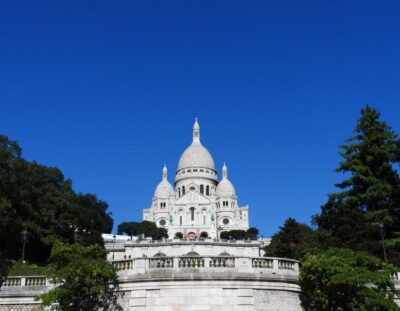
Sacré-Coeur and Montmartre Tour with Expert Guide
Read our review →
Private Montmartre Food Tour with Wine, Cheese & Pastries
Read our review →
Paris Montmartre Food Tour – A Full French Meal by Do Eat Better
Read our review →
Hidden Montmartre: Paris’ Secret Streets Walking Tour
Read our review →Browse the lists this tour appears in