

Reviewed · MONTMARTRE & SACRé-COEUR TOURS
Kids/teens escape game in Montmartre
Montmartre becomes a giant outdoor puzzle in this family game. Instead of asking children to trail behind while adults stare at buildings, the host gives them questions and small challenges tied to Sacré-Cœur, Picasso, street art, old cabarets, and local statues. You walk, look closely, and learn as you go.
I like the hands-on format, which gives children a reason to study the neighborhood. I also like the guide’s practical role: your host explains the area, handles small needs such as finding a toilet, and can take free family photos. The main catch is that some puzzles may be too hard for children under 10, and the younger children’s booklet has reportedly used cursive writing that some children could not read.
In This Review
- Key points for families
- Turning Montmartre into a family game
- Starting above Rue Foyatier
- Sacré-Cœur: a grand first clue
- The streets of Montmartre become the puzzle board
- Au Lapin Agile and Montmartre’s artistic past
- Le Mur des Je t’aime and the pleasure of looking closely
- Place du Tertre: a classic Montmartre scene
- Le Bateau-Lavoir and Picasso’s studio
- Le Passe-Muraille and a playful final challenge
- What the guides add to the experience
- Age levels, puzzle difficulty, and family fit
- Price, timing, and physical demands
- Who should choose this Montmartre experience
- Should you book it?
- FAQ
- Where does the Montmartre escape game start?
- Where does the experience finish?
- How long does the activity last?
- What is the price?
- What age can children join?
- Is there more than one difficulty or format?
- Do you visit inside Sacré-Cœur Basilica?
- Which Montmartre sights are included?
- Can the guide take family photos?
- What happens if the weather is poor?
- Can I cancel for a refund?
Key points for families
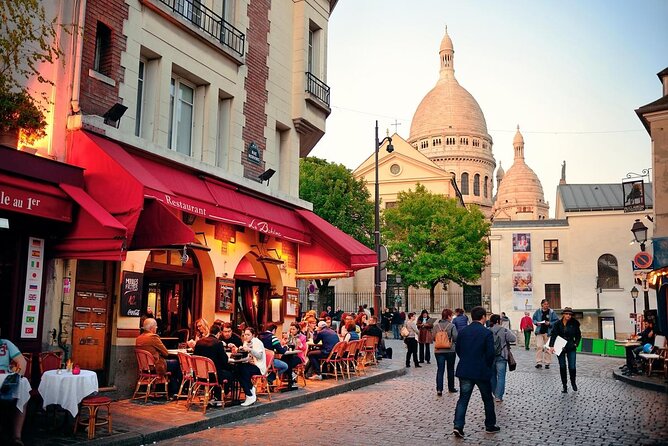
- A puzzle walk through Montmartre: Children answer riddles at Sacré-Cœur, Place du Tertre, Le Bateau-Lavoir, and other landmarks.
- Two levels of play: An adult version works for older children, while a version for smaller children is also available.
- A guide who stays involved: Hosts such as Jules, Jeanne, Sasha, and William Morris have been praised for patience, flexibility, and fun game-leading.
- More than sightseeing: Activities touch on history, painting, architecture, arithmetic, language, and careful observation.
- A good family pace: The walk lasts about two hours and ends near Place Émile Goudeau.
- One practical warning: Montmartre is hilly, and some puzzles may challenge younger children.
Turning Montmartre into a family game

Montmartre is full of visual treats, but it can be hard for children to appreciate them on a standard walking tour. The streets rise and fall, the landmarks compete for attention, and adults often spend more time reading plaques than young children care to spend standing still.
This experience changes the task. Your children receive questions and educational games connected to the places you visit. Their job is to notice details, solve clues, and work out answers while your host explains what you are seeing.
The game was developed with help from a mother of three who is also a teacher. That detail matters because the activity is not simply an adult puzzle placed in front of children. Its stated goals include building skills in history, painting, architecture, arithmetic, language, and observation, all in a light format.
You should think of this as a guided neighborhood walk with a puzzle layer, not a traditional escape room. There is no enclosed room and no dramatic timed escape. The setting is Montmartre itself, with the streets and landmarks providing the clues.
More Montmartre walks and visits:
- Montmartre Hidden Gems and Scenic Highlights Walking Tour
★ 5.0 · 2,684 reviews - Montmartre Hill French Gourmet Food and Wine Tasting Walking Tour
★ 5.0 · 2,588 reviews - Paris: Montmartre Cheese, Wine & Pastry Guided Walking Tour
★ 4.8 · 2,255 reviews
Starting above Rue Foyatier
The meeting point is at the upper station of the Montmartre funicular, at 7 Rue Foyatier. This is a useful starting place because the funicular brings you up the steepest part of the hill, saving younger legs for the game itself.
You will meet your host near the funicular station, then begin around the Sacré-Cœur area. Make sure your family knows the exact meeting point before setting out. One person had trouble locating the guide, so arriving with the address open on your phone is sensible.
The host is not only there to hand out puzzles. The guide explains the neighborhood in small stories and fun facts, answers questions, and deals with practical problems along the way. The guide may also take free photographs of your family, which is a useful extra in a district where everyone wants a picture but not always a picture taken by a stranger.
The tour has a mobile ticket, and confirmation is provided when you book. It is listed for a maximum of 100 participants, though the family-focused nature of the activity means you should check how your specific departure is arranged if group size matters to you.
Sacré-Cœur: a grand first clue
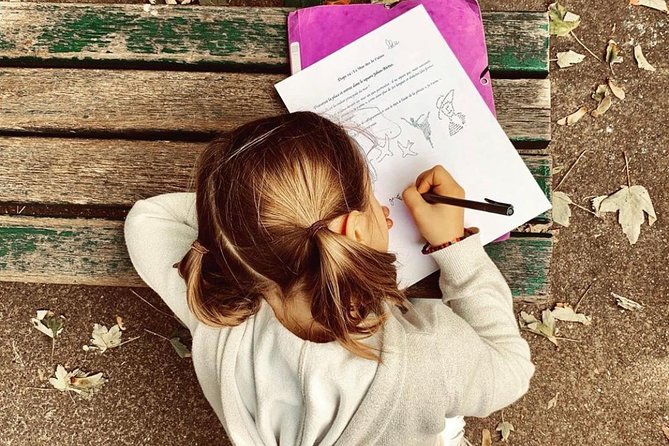
The Basilique du Sacré-Cœur de Montmartre gives the game an impressive opening. From the upper hill, the basilica is hard to miss, and children get an immediate visual landmark to study.
Here, they answer a riddle about the building. The stop is listed at about 10 minutes, so do not expect a full visit inside the basilica. One important point is that the activity takes you to the basilica but does not include going up to or inside it.
That limitation may disappoint families hoping to combine the puzzle with a detailed church visit. On the other hand, keeping the stop brief helps the game maintain its pace. You get the outside view and a clue, then move into the streets where children can keep working.
If you want to visit Sacré-Cœur inside, plan that separately and allow extra time. This activity is built around Montmartre’s public spaces rather than an interior tour.
The streets of Montmartre become the puzzle board
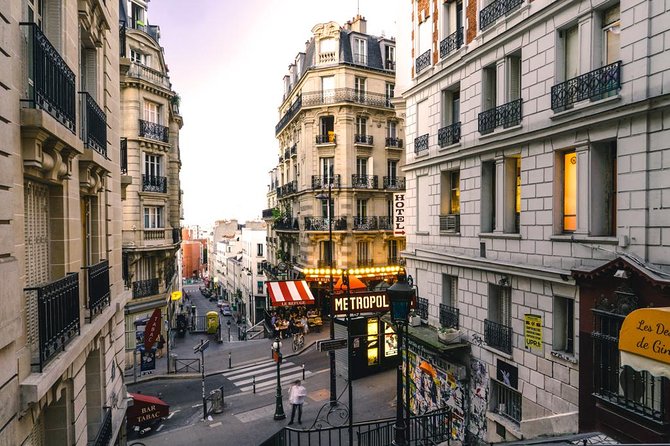
The main portion of the experience is the walk through Montmartre. Over roughly two hours, your children answer riddles or complete learning games based on what they see.
This is where the experience earns its price for many families. You are not paying only for a route between famous places. You are paying for a guide who turns ordinary details into prompts. A doorway, statue, sign, studio, or square becomes something children must examine rather than pass without notice.
The format also gives adults room to enjoy the neighborhood. You can listen to the local stories, take in the views, and help when a clue needs another pair of eyes. The strongest family experiences are often the ones where parents and children solve something together, and this walk is designed for that kind of shared time.
The educational goals are broad. A question may involve a bit of arithmetic, a word, an architectural feature, or a painting reference. The level can vary, so families with children of different ages may need to work as a team.
The age guidance begins at 3, but that does not mean every child from age 3 will handle the same material. A younger child may need an adult to read clues and explain the task. Older children can take more control, while parents can help without taking over.
More escape games and treasure hunts:
- Who Killed Victor ? Escape Game at Père Lachaise Cemetery
★ 4.8 · 258 reviews - Escape game in Montmartre
★ 5.0 · 247 reviews - Escape Hunt Paris, Escape Game
★ 4.5 · 122 reviews - Escape game on the Île de la Cité
★ 5.0 · 112 reviews
Au Lapin Agile and Montmartre’s artistic past

Au Lapin Agile is presented as one of Paris’s oldest cabarets. The stop takes about 10 minutes, with another riddle or educational game tied to the place.
This is a useful pause in the route because it shows a different side of Montmartre. The neighborhood is not only Sacré-Cœur and souvenir shops. Its identity also comes from artists, performers, writers, and the informal creative life that grew around these streets.
The activity keeps the stop short. You should expect to discover the exterior and use it as a clue point, not sit down for a cabaret performance. The game gives children a reason to connect a real place with the area’s artistic story, even if the history lesson remains fairly light.
If your family wants a long, detailed account of Montmartre’s cabaret culture, this will not replace a specialist history tour. Its strength is keeping children involved as you move.
Le Mur des Je t’aime and the pleasure of looking closely

Le Mur des Je t’aime, or the Wall of Love, provides a more modern and visually direct stop. The work is easy to appreciate as a family, and the children answer questions or complete a game about what they see.
This kind of landmark suits the puzzle format well. Children do not need a long lecture to begin looking at the wall. They can search for details, compare words, and discuss what the artwork is trying to express.
The stop is listed at about 10 minutes. That is enough for a clue and a quick look, but not a long art lesson. I like this balance for a family walk because attention spans can fade quickly when every stop becomes a formal talk.
The activity’s use of language here also connects with its wider teaching goals. Children are asked to use observation and language, not simply memorize dates. Adults may find themselves noticing details they would otherwise pass by.
Place du Tertre: a classic Montmartre scene

Place du Tertre is one of the district’s most recognizable squares. You will see the charming setting while the children work on another question or game based on what is around them.
This stop is a good test of the activity’s method. The square can feel visually crowded, with artists, visitors, buildings, and café life competing for your attention. A riddle gives your children a small task and helps them focus on the square as a place, not just a photo stop.
Do not expect a long pause at every landmark. The listed time is about 10 minutes, and the experience works best when the group keeps moving. The host’s role is important here: a good guide can keep the children on track while adding a short explanation that adults will appreciate.
The area can also be busy, so keep young children close while they study clues. The game encourages looking around, but children should not wander off while concentrating on an answer.
Le Bateau-Lavoir and Picasso’s studio

Le Bateau-Lavoir is linked with the studio where Picasso and others developed cubism. The children answer questions or complete an educational game about the place.
This is one of the most valuable stops for families interested in art. Rather than placing cubism in a museum room, the game connects it to a real building in the neighborhood. Children may not grasp the full story in 10 minutes, but they can begin to understand that major art movements grew from actual rooms, friendships, and working communities.
The activity does not promise a museum-style art lecture, and you should not expect one. Its aim is to make the place memorable. A short clue about Picasso may stay with a child longer than a page of information delivered without participation.
Parents who want more context can use the stop as a starting point and talk about cubism later. The experience gives you the location and the prompt, then leaves room for further discovery.
Le Passe-Muraille and a playful final challenge
Le Passe-Muraille is a famous statue connected to a character who can pass through walls. The children complete another riddle or educational game about it.
This is a fitting kind of landmark for a family puzzle walk. The statue is unusual, easy to spot, and naturally invites questions. It also gives the route a playful finish before the group reaches Place Émile Goudeau.
The activity’s route ends at 14 Rue Ravignan. That endpoint is close to Le Bateau-Lavoir and Place Émile Goudeau, giving you a clear place to continue your own Montmartre visit afterward.
The listed stops include Sacré-Cœur, Au Lapin Agile, Le Mur des Je t’aime, Place du Tertre, Le Bateau-Lavoir, and Le Passe-Muraille. Some stops are brief, while the general Montmartre walk takes most of the two-hour session. The result is a neighborhood tour with several focused clue points rather than a series of long guided talks.
What the guides add to the experience
The host can make or break a game like this. The guide needs to explain the rules, judge when to offer help, keep the group moving, and speak to adults without losing the children.
The available guide feedback points to several hosts by name, including Jules, Sasha, Jeanne, Églantine, and William Morris. Families have especially valued patience, flexibility, and a friendly game-master approach. Jeanne was praised for making the puzzle experience fun while sharing information about the area. Églantine led a walk that suited children aged 7 and 9, while William Morris was singled out as a strong game master.
These details suggest a personal experience rather than a self-guided worksheet. Your guide stays with you, explains the district, and helps when a clue causes trouble. The host can also assist with practical needs, including finding a toilet during the walk.
The guide’s background as a photographer is another useful touch. Free family photos mean you do not have to choose between taking pictures and appearing in them.
Still, do not expect every guide or departure to feel identical. One family found the explanations too light, and another found some riddles tedious. The game depends on the match between the children, the guide, and the chosen difficulty.
Age levels, puzzle difficulty, and family fit
The activity is designed for children from age 3 through the teen years. That is a wide range, so the format must be adjusted to suit the group.
For very young children, the value is in spotting things, answering simple prompts, and joining the walk. An adult may need to read the material aloud and guide the child toward an answer. A problem with cursive printing was reported for the younger booklet, so check the writing format at the start if your child is still learning to read.
Children around 7 to 9 may find the younger version a good match. One family with children aged 7 and 9 found the level appropriate. Older children can use the adult version, and one family with children aged 9 and 11 enjoyed that format.
The caution is clear: some puzzles may be too difficult for children under 10. That does not make the activity unsuitable for younger children, but it means you should not expect a preschooler to solve every clue alone.
Teens who like riddles, escape rooms, and puzzle solving may find the activity more engaging than a standard walking tour. Children who dislike reading, group questions, or walking uphill may be less enthusiastic.
Price, timing, and physical demands
The price is $41.86 per person, and the experience lasts about two hours. That is not the cheapest way to see Montmartre, especially when the main landmarks are viewed from public streets and the basilica interior is not included.
The value rests in the guide-led game. If you would otherwise pay for a family walking tour and still need to invent ways to keep children occupied, the combined format may make sense. You get local explanation, puzzle materials, help along the route, and family photos.
If your children are too young to use the clues or your family prefers to wander at its own pace, the price may feel high. One French-language assessment described the moment as enjoyable but a little expensive, which is a fair way to view it.
The walk requires a moderate level of physical fitness. Montmartre is hilly, and although the funicular helps at the start, you still need to walk through the district. Comfortable shoes and water are practical choices, even though those details are not listed as formal requirements.
The experience generally books about 22 days ahead, so do not leave it until the last minute if you want a particular day. Free cancellation is available up to 24 hours before the start time. Within 24 hours, you receive no refund, and bad weather can lead to a new date or a full refund.
Who should choose this Montmartre experience
I would choose this for a family that wants children to take part in Paris rather than simply follow adults from one sight to the next. It suits parents who enjoy solving clues together and who want a little local context without a long lecture.
It is especially useful for:
- Families with children aged roughly 7 to 11 who enjoy puzzles
- Teens who like escape rooms and riddles
- Parents seeking a different way to see Montmartre
- Families who value a guide’s help with practical needs
- Visitors who want free group photographs during the walk
I would think twice if your main goal is a detailed account of Montmartre’s history, a visit inside Sacré-Cœur, or a fully self-paced outing. I would also ask about the puzzle level before setting out with children under 10.
Should you book it?
Book this if you want Montmartre to feel like a shared family activity. The best parts are the child-focused clues, the chance to connect art and architecture with real places, and the guide’s ability to keep the walk friendly and practical.
Skip it if you want a serious history tour or if your children are unlikely to enjoy riddles. At $41.86 per person, the game needs to be the point of the outing, not just an add-on to sightseeing.
For the right family, it is a smart way to give children ownership of a Paris neighborhood. Let them solve, let the host help, and accept that the educational material may work better for some ages than others.
FAQ
Where does the Montmartre escape game start?
It starts at the upper station of the Montmartre funicular, at 7 Rue Foyatier, 75018 Paris, France.
Where does the experience finish?
The walk ends at Place Émile Goudeau, 14 Rue Ravignan, 75018 Paris, France.
How long does the activity last?
The experience lasts approximately two hours.
What is the price?
The price is $41.86 per person.
What age can children join?
The activity is suitable for children starting at age 3 and also for teens.
Is there more than one difficulty or format?
Yes. A version for smaller children is available, and an adult version can suit older children and families.
Do you visit inside Sacré-Cœur Basilica?
No. You see the magnificent basilica and answer a riddle about it, but the experience does not include going up to or inside the basilica.
Which Montmartre sights are included?
The route includes Sacré-Cœur, Montmartre streets, Au Lapin Agile, Le Mur des Je t’aime, Place du Tertre, Le Bateau-Lavoir, and Le Passe-Muraille.
Can the guide take family photos?
Yes. The guide is also a photographer and can take photographs of your family free of charge.
What happens if the weather is poor?
The experience requires good weather. If it is canceled because of poor weather, you can be offered another date or a full refund.
Can I cancel for a refund?
You can cancel at least 24 hours before the start time for a full refund. Cancellations or changes made less than 24 hours before the start time are not refunded or accepted.
Newest additions around Paris
- Family escape Game with kids and teens on the Île de la Cité★ 4.5 · 11 reviews
- Private Photoshoot with the Iconic Eiffel Tower in Paris★ 5.0 · 11 reviews
- 2-day Private Mont Saint-Michel, 3 Loire Castles, D-Day Express★ 4.5 · 11 reviews
- Paris: Batobus Hop-On Hop-Off Cruise & Landmarks Audio Tour★ 3.0 · 11 reviews
- Paris Revolutionary Walking Tour: Iconic French Sights & Stories★ 5.0 · 11 reviews
- Guided and Private Tour of 3 hours through Paris aboard a Citroën 2cv★ 5.0 · 11 reviews
- Kids in the Kitchen – CrOisSaNtS★ 4.0 · 11 reviews
- Paris: Ghosts and Dark Stories Guided Walking Tour★ 4.1 · 11 reviews
Montmartre & Sacré-Coeur Tours, compared.

Montmartre Hidden Gems and Scenic Highlights Walking Tour
Read our review →
Montmartre Hill French Gourmet Food and Wine Tasting Walking Tour
Read our review →
Montmartre Cheese, Wine & Pastry Guided Walking Tour
Read our review →
Montmartre Highlights Walking Tour with a Local Guide
Read our review →
Sacré-Coeur and Montmartre Tour with Expert Guide
Read our review →
Private Montmartre Food Tour with Wine, Cheese & Pastries
Read our review →
Paris Montmartre Food Tour – A Full French Meal by Do Eat Better
Read our review →
Hidden Montmartre: Paris’ Secret Streets Walking Tour
Read our review →Browse the lists this tour appears in