
Reviewed · PASTRY & MACARON CLASSES
Hands-on Eclair and Choux Making with a Pastry Chef
The best part of this Paris class is that you do not just watch a chef pipe pastry. You make the choux, cook the cream, fill the éclairs, and leave with three full-size treats. It is a practical taste of French pastry, with a sweet reward at the end.
I like the small groups, capped at eight, and the clear step-by-step format. I also like that beginners and children can take part, with past classes including a 9-year-old and a 16th birthday celebration. The main caution is that you may share a workstation and take turns, so this is not always a completely individual cooking class.
In This Review
- Key points at a glance
- What makes this Paris pastry class worthwhile
- Arriving at 7 Rue de Béarn
- Mixing the choux pastry from scratch
- Piping the pastry, where shaky hands are normal
- Baking at 200 degrees Celsius
- Cooking chocolate, vanilla, or coffee pastry cream
- Filling and glazing the éclairs
- The chefs make the difference
- Who should book this class
- Booking, cancellation, and useful planning tips
- Is the $132.75 price fair?
- Should you book the Maison Fleuret éclair class?
- FAQ
- Where does the éclair class begin and end?
- How long does the activity last?
- Is the class offered in English?
- How many people can join the class?
- Do I need previous pastry experience?
- What is included in the price?
Key points at a glance
- Make three éclairs: You pipe, bake, fill, glaze, and take home three regular-size pastries.
- Small English-language class: The group limit is eight, and instruction is given in English.
- Beginner-friendly technique: You learn choux pastry, pastry cream, piping, and chocolate glazing without needing prior baking experience.
- Chefs who teach patiently: Instructors named Millie, Matteo, Mathieu, Alyssa, Clara, and Manel have all led praised sessions.
- Central Paris meeting point: The class begins and ends at 7 Rue de Béarn in the 3rd arrondissement, a short walk from the nearest metro station.
- Plan for a hands-on but shared setup: Some sessions pair participants at one cooking station, which can affect how much individual mixing and piping you do.
What makes this Paris pastry class worthwhile
At $132.75 per person, this is not a cheap pastry stop. You are paying for a two-and-a-half-hour class, a chef-led lesson, ingredients, equipment, coffee or tea, and the chance to produce something you can repeat at home.
The value improves if you enjoy learning how food works rather than simply eating it. An éclair from a Paris pastry shop may cost only a few euros. Here, the pastry itself is just part of the price. You also get instruction in a classic French technique, time in a small group, and a recipe to try after your trip.
I think the class works best as a relaxed morning or afternoon activity between sightseeing stops. It gives you a reason to slow down. Instead of rushing from one monument to the next, you spend time working with butter, eggs, flour, milk, chocolate, and sugar. That makes the result feel more personal than a pastry bought from a display case.
The class has earned a 4.7 rating, with 93 percent of participants recommending it. That high mark reflects the strongest feature of the session: the instructors usually stay close to the work and help you correct mistakes before they ruin the pastry.
More pastry and macaron classes:
- Paris: Montmartre Cheese, Wine & Pastry Guided Walking Tour
★ 4.8 · 2,255 reviews - Paris Croissant Small-Group Baking Class with a Chef
★ 5.0 · 910 reviews - Paris: Macaron Class at Galeries Lafayette
★ 4.3 · 905 reviews
Arriving at 7 Rue de Béarn
You meet at 7 Rue de Béarn, 75003 Paris, and the activity ends at the same place. The meeting point is near public transportation and a short walk from the nearest metro station, so you do not need private transportation.
Give yourself enough time to find the address. A pastry class is not a good place to arrive flustered, especially when the first steps involve heating ingredients and preparing the dough. Confirmation arrives at booking, so keep the meeting details available on your phone.
The address sits in the 3rd arrondissement, a useful setting for a food-focused outing. You can combine the class with a walk before or after, but the class itself is the main event. Do not expect a sightseeing tour or a guided neighborhood walk.
The room may feel more functional than polished. One participant found the setting small and somewhat dull, while others liked the laid-back atmosphere and close attention. That contrast matters. You are coming for the pastry lesson, not for an ornate dining room.
Mixing the choux pastry from scratch
The class begins with the base of both éclairs and other choux pastries. You heat water, butter, and salt in a saucepan until the butter melts. Then you add the flour and stir until the dough pulls away from the sides of the pan.
This stage looks simple, but it is where careful timing and steady mixing matter. The dough needs to come together properly before you add the eggs. Your chef demonstrates the texture to look for, then helps you judge the mixture as you work.
The eggs go in one at a time. You mix thoroughly between additions, which teaches an important pastry lesson: the dough changes gradually, and you should not rush the process. The finished mixture needs to be smooth enough to pipe but firm enough to hold its shape.
This is a good class for beginners because the chef breaks the recipe into clear jobs. You are not expected to know what pâte à choux should look like before you arrive. You learn by seeing the mixture at each stage and comparing your bowl with the chef’s example.
Ingredients are premeasured, which keeps the class moving and lets you focus on technique. That also means you are not practicing the full preparation and measuring process from your own kitchen. Still, for a first lesson, this is a fair trade. You get more time for mixing, piping, and questions.
Piping the pastry, where shaky hands are normal
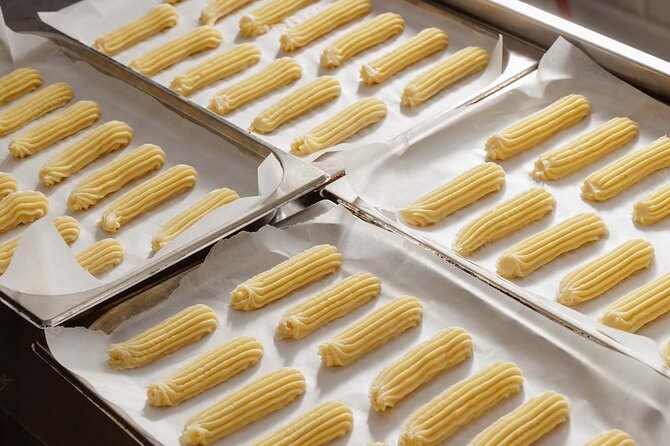
Once the dough is ready, you transfer it to a piping bag fitted with a plain tip. You pipe long strips onto a parchment-lined baking sheet.
Piping is often the most entertaining part of the class because the results can look uneven at first. That is normal. Your hand pressure, speed, and angle all affect the shape. The chef can show you how to keep the strip steady and how to leave enough room between pieces.
Do not worry if your éclairs are not perfectly identical. The class is designed for beginners, and the finished pastries can still look good and taste excellent even when the piping is not professional. One participant with shaky piping was still pleased with the pretty, delicious result.
The main practical point is that hands-on does not always mean one complete station per person. If your group has an uneven number, you may be paired with someone else. Some participants liked sharing, since it made the class more social. One person felt the arrangement reduced individual cooking time.
If you want to do every step alone, ask about the workstation setup before booking. If you are traveling with a partner, child, or friend, sharing can work well. It gives you a chance to watch another person’s technique and divide the tasks.
A few more Paris ideas to compare
- Fragonard Paris: Mini Perfume Workshop
★ 4.5 · 1,924 reviews - Paris Cooking Class and Lunch with Wine plus Market Visit Option
★ 5.0 · 1,024 reviews - Paris: 2-Hour Perfume Creation Workshop
★ 4.8 · 731 reviews - Paris: French Croissant Baking Class with a Chef
★ 4.9 · 712 reviews
Baking at 200 degrees Celsius
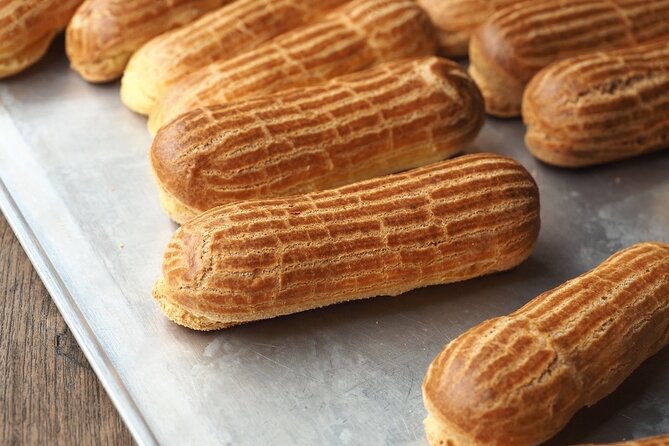
The piped dough goes into a preheated oven at 200 degrees Celsius for about 20 to 25 minutes. You wait for the éclairs to become golden and crisp.
This pause helps make the class feel unhurried. While the pastry bakes, the chef can explain what the oven is doing and prepare the next part of the recipe. The timing also gives you a chance to chat with the small group.
Choux pastry depends on structure. The steam produced inside the dough helps it puff, creating the hollow center that later holds pastry cream. That is why the baking stage is more than a simple wait. You are learning why a light, crisp shell can support a creamy filling.
The class does not promise that every piece will bake perfectly. Oven results can vary, and first-time piping may produce different shapes. The format gives the chef a chance to monitor the process and help the group understand what a finished shell should look like.
Cooking chocolate, vanilla, or coffee pastry cream
While the shells cool, you prepare the filling. Milk is heated in a saucepan. In a bowl, you whisk egg yolks, sugar, flour, and cornstarch.
The hot milk is poured into the egg mixture while you stir constantly. Then the mixture returns to the saucepan and cooks over low heat until it thickens. This is the part where close attention matters most. Keep stirring and follow the chef’s instructions so the cream stays smooth.
The filling options include chocolate, vanilla, coffee, and other variations. The exact choice may depend on the class setup, but the lesson shows how a basic pastry cream can take on different flavors.
I like this section because it connects the pastry shell with the finished dessert. You are not simply given a prepared filling. You see how eggs, dairy, sugar, flour, and cornstarch become a thick cream that can be piped into the éclair.
For families, this is also a useful division of tasks. A younger baker can help whisk or pipe with supervision, while an adult handles the hotter steps. The class has worked well for children, but remember that this is a real kitchen lesson involving an oven and heated ingredients.
Filling and glazing the éclairs
When the shells have cooled, you cut them in half and fill them with pastry cream using a piping bag. The cooled pastry matters. If you fill it too soon, the heat can soften the cream and affect the texture.
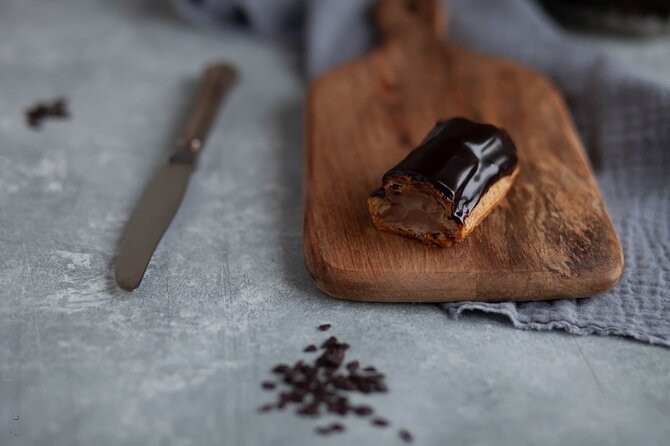
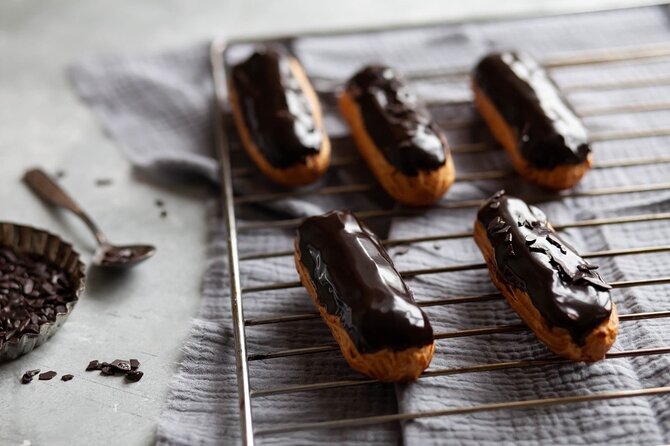
The final step is the chocolate glaze. Dark chocolate is melted with butter until smooth. You dip the top of each éclair into the glaze, creating a dark, glossy finish.
The use of dark chocolate rather than a very sweet sugar icing will appeal to people who prefer a more balanced dessert. One participant specifically liked the chocolate finish despite not usually enjoying éclairs.
You should leave with three regular-size éclairs, not just a single sample. That makes the price easier to accept, especially if you plan to share them or save one for later. They are packed to take away, so bring a little care to the journey afterward.
Coffee or tea is included in the booking details. The practical experience may vary, and one participant expected a sit-down coffee break that did not happen. I would treat the drink as a possible accompaniment, not the central feature of the class.
The chefs make the difference
The instructor can shape the whole session. Names that have been praised include Millie, Matteo, Mathieu, Alyssa, Clara, and Manel. You cannot choose a particular chef unless the provider confirms it, but the pattern is clear: patient explanations and friendly correction are more important here than theatrical presentation.
Matteo was praised for slowing down and explaining each stage to everyone. Mathieu was noted for watching each person closely and helping achieve the right result. Millie’s clear English and warm energy made her class especially welcoming.
Clara was also appreciated for offering suggestions about Parisian sweets beyond the class. That sort of local food advice can add value, especially if you want to turn the pastry lesson into a wider food day.
Not every session will have the same personality. One participant found the chef’s instructions good but the presentation somewhat distracted and low-key. Another thought the instructor was effective but not especially lively. If you want a polished culinary show, this may feel modest. If you want direct help with your dough, that modest approach may suit you well.
Who should book this class
I would recommend it to first-time bakers, families with older children, couples, and solo visitors who enjoy meeting people through food. The small group makes it easier to ask questions than in a large demonstration.
It also suits anyone who loves éclairs but wants to understand the work behind them. You learn several useful pastry skills in one session: making choux dough, controlling egg additions, piping, cooking pastry cream, and finishing with chocolate.
The class is less suitable for someone who wants a private lesson or a fully individual workstation. It may also disappoint if your main goal is to eat pastries in a café setting. You make the treats and usually take them away rather than sitting down for a formal tasting.
English is offered, and service animals are allowed. The group maximum is eight, but the actual number may be smaller. One session had only six participants, while another consisted of a family of four and one other couple. That small scale is one of the strongest reasons to choose this class over a larger cooking demonstration.
Booking, cancellation, and useful planning tips
The activity is often booked about 45 days ahead, so reserve early if your Paris dates are fixed. Confirmation is provided at booking, and the ticket is mobile.
You can cancel for a full refund up to 24 hours before the start time. Changes or cancellations inside that 24-hour window are not accepted for a refund. There have also been isolated last-minute cancellations caused by an instructor illness, so keep your schedule flexible if this class is tied to a tight departure or cruise connection.
The class lasts about two hours and 30 minutes. Add time before the start to reach Rue de Béarn and time afterward to carry your pastries carefully. Since the class ends where it begins, you can plan your next stop from the same part of Paris.
Bring your phone if the recipe is supplied by a scan or digital link. The recipe is given in metric measurements, so American bakers should be ready to convert grams and Celsius at home. If you prefer a paper recipe, ask during the class rather than assuming one will be handed out.
Is the $132.75 price fair?
The answer depends on what you want from a Paris food activity. If you only want dessert, the price is high. If you want a guided lesson, several finished pastries, a small group, and a recipe you can repeat at home, it is more reasonable.
The class gives you enough pastry to make the result feel substantial. Three éclairs are a useful takeaway, and the method is practical rather than purely decorative. You also avoid paying for private transportation, since the meeting point is near the metro.
I would not book it for the coffee or tea alone, and I would not expect a luxury cooking studio. I would book it for patient, close instruction and the chance to make a classic French pastry with your own hands.
Should you book the Maison Fleuret éclair class?
Book this class if you want an approachable Paris food lesson with a tasty result and you are happy to share a workstation if needed. It is especially good for families, beginners, and anyone who wants to bring a little French baking home.
Skip it if you need a private setup, a formal café tasting, or a guaranteed chef and schedule with no possibility of changes. For most visitors who value participation over polish, the combination of small groups, clear English instruction, and three finished éclairs makes this a strong pick.
FAQ
Where does the éclair class begin and end?
The class begins at 7 Rue de Béarn, 75003 Paris, France, and ends back at the same meeting point.
How long does the activity last?
The class lasts approximately two hours and 30 minutes.
Is the class offered in English?
Yes. The experience is offered in English.
How many people can join the class?
The maximum group size is eight participants.
Do I need previous pastry experience?
No. The class is beginner-friendly and does not require previous pastry experience.
What is included in the price?
Coffee and/or tea are included. Private transportation is not included.
Newest additions around Paris
- Family escape Game with kids and teens on the Île de la Cité★ 4.5 · 11 reviews
- Private Photoshoot with the Iconic Eiffel Tower in Paris★ 5.0 · 11 reviews
- 2-day Private Mont Saint-Michel, 3 Loire Castles, D-Day Express★ 4.5 · 11 reviews
- Paris: Batobus Hop-On Hop-Off Cruise & Landmarks Audio Tour★ 3.0 · 11 reviews
- Paris Revolutionary Walking Tour: Iconic French Sights & Stories★ 5.0 · 11 reviews
- Guided and Private Tour of 3 hours through Paris aboard a Citroën 2cv★ 5.0 · 11 reviews
- Kids in the Kitchen – CrOisSaNtS★ 4.0 · 11 reviews
- Paris: Ghosts and Dark Stories Guided Walking Tour★ 4.1 · 11 reviews
Pastry & Macaron Classes, compared.
Montmartre Cheese, Wine & Pastry Guided Walking Tour
Read our review →
Paris Croissant Small-Group Baking Class with a Chef
Read our review →
Paris Cooking Class: Learn How to Make Macarons
Read our review →
A Morning in Paris Food Tour: Croissants, Baguettes & Chocolate
Read our review →
Paris Chocolate, Macaron & Pastry Food Tour: 10 Gourmet Tastings
Read our review →Browse the lists this tour appears in