Reviewed · GUIDED
Paris: Roland-Garros Stadium Guided Backstage Tour
Roland-Garros is more than a tennis stadium. It is a working sports venue with a sense of ceremony, and this 90-minute backstage tour lets you follow the route taken by champions before they step onto the red clay. The best moment is the walk through the players’ corridor toward Philippe Chatrier Court.
I like the access to areas normally closed during the French Open, especially the presidential tribune and media rooms. I also like the human stories, from Rafael Nadal’s 14 French Open titles to the Four Musketeers of French tennis. The main caution is that the group can be large, and some people have found it hard to hear every word.
In This Review
- Key points to know before booking
- Why Roland-Garros feels different from a normal stadium tour
- Starting at Avenue Gordon-Bennett
- The players’ corridor and the walk to the clay
- Philippe Chatrier Court and its retractable roof
- The presidential tribune, media rooms, and trophy displays
- From Nadal and Graf to the Four Musketeers
- Group size, language, and the pace of the visit
- Is $24 good value for 90 minutes?
- Who will enjoy this most?
- Should you book the Roland-Garros tour?
- FAQ
- Where does the Roland-Garros Stadium tour begin?
- How long does the tour last?
- What language is the tour offered in?
- Does the tour include entry to Roland-Garros?
- Can I see Philippe Chatrier Court?
- Will I visit the locker rooms?
- Is the stadium tour wheelchair accessible?
- Can I visit the stadium shop?
- Can I cancel the booking?
Key points to know before booking

- Walk the players’ route: Follow the corridor leading toward the clay court, one of the tour’s most atmospheric moments.
- See Philippe Chatrier Court: Admire the stadium’s central court and its retractable roof from an unobstructed position.
- Hear tennis history: Learn about Nadal, Steffi Graf, Björn Borg, Chris Evert, and France’s Four Musketeers.
- Visit restricted areas: The route can include the presidential tribune, locker rooms, media rooms, and trophy displays, though access can change.
- Choose your language: Tours are offered in English, French, and Spanish.
- Pay $24 for 90 minutes: That is a fair price for anyone curious about the French Open, not only devoted tennis followers.
Why Roland-Garros feels different from a normal stadium tour
Many major sports venues are vast concrete bowls built around spectacle. Roland-Garros feels more intimate. Its identity comes from clay, tennis tradition, and the particular drama of the French Open, where long rallies and patient point construction matter as much as raw power.
The tour gives you a better sense of that character than a simple photograph outside the gates. You are not just looking at a court from a public entrance. You are hearing how the venue developed, learning about the players who shaped the tournament, and moving through spaces designed for the people who compete and work there.
That distinction matters if you watch the French Open on television. Broadcast coverage shows the match, the crowd, and the court. It does not show the route players take before the match, the places used by journalists, or the formal seating reserved for important tournament figures.
You also do not need to know every Grand Slam winner to enjoy the visit. The guide explains the setting through stories and anecdotes, so the tour works for a casual sports fan as well as someone who has watched Roland-Garros for decades.
A few more Paris ideas to compare
- Paris: Louvre Guided Tour with Reserved Access & Boat Cruise
★ 4.3 · 16,353 reviews - Louvre Museum Masterpieces Guided Tour with Access
★ 4.5 · 12,023 reviews - Louvre Museum – Exclusive Guided Tour (Entry Included)
★ 5.0 · 6,296 reviews
Starting at Avenue Gordon-Bennett
The meeting point is inside the Grande Boutique on Avenue Gordon-Bennett, at Gate 36. Give yourself enough time to find the correct entrance. One earlier booking found the digital meeting instructions unclear, and another older account referred to a different gate, so I would follow the current confirmation carefully and ask staff at the boutique if needed.
The shop is open from 9:30 AM to 6:30 PM, making it useful before or after the tour. You can browse for souvenirs at either end of your visit, and one booking included a 10 percent shop discount after the tour.
The experience provider is Cultival. A live guide leads the group rather than sending you through the building with an audio device. That makes a difference here because the stadium’s appeal comes partly from details that are easy to miss: a plaque, a corridor, a seat, or a story tied to a particular champion.
Guides have included Mathieu, Amir, Lionel, Aida, and others. The strongest guiding style described in the available feedback is friendly, lively, and willing to answer questions. Lionel, in particular, was praised for his enthusiasm and detailed knowledge of the players and venue. Amir was also singled out for sharing plenty of information about what happens during the French Open.
The players’ corridor and the walk to the clay
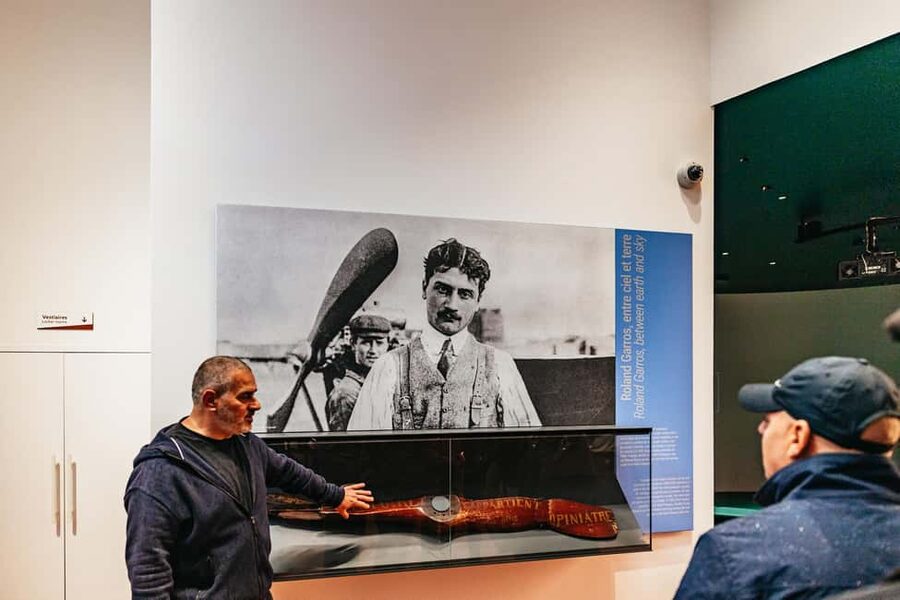
The corridor leading toward the court is the emotional center of the tour. It gives you a physical sense of the transition players make, from the private side of the stadium to the public arena.
That walk may sound simple, but it changes how you see a televised match. Players do not appear on court by magic. They wait, prepare, and move through a controlled backstage world before stepping into the noise and sunlight. Walking the same route lets you picture Nadal, Graf, Borg, or Evert making that passage before a major match.
Access has varied at times. Some bookings included the locker rooms, while another visit could not enter them because of renovation work. The stadium also warns that current activities may close certain areas on the day of your tour. Think of the corridor as a key part of the visit, but treat locker rooms and other interior spaces as possible rather than guaranteed.
When access is available, the locker area adds a personal layer to the tour. Seeing famous names connected with particular lockers can be more memorable than looking at another row of stadium seats. It turns the venue from an abstract institution into a workplace used by real athletes.
Philippe Chatrier Court and its retractable roof
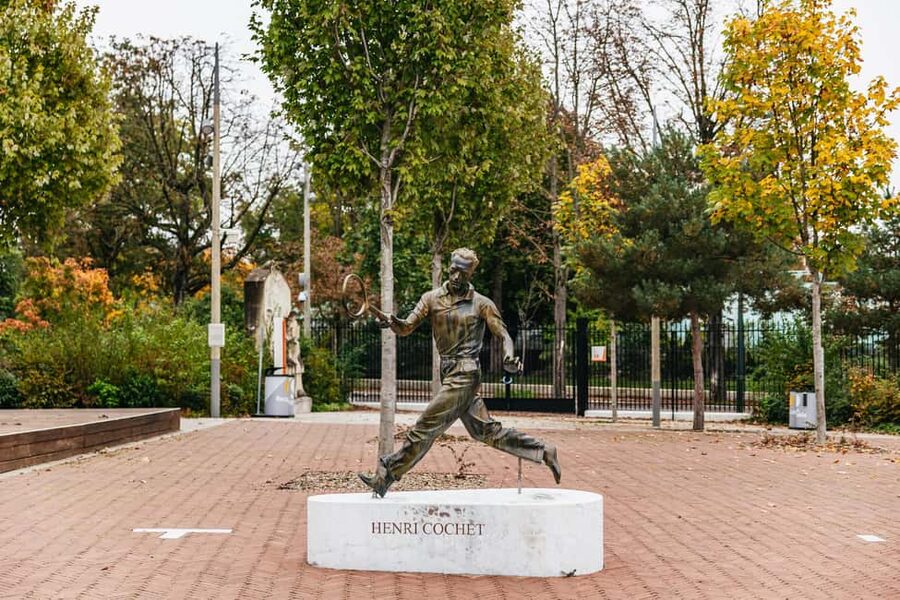
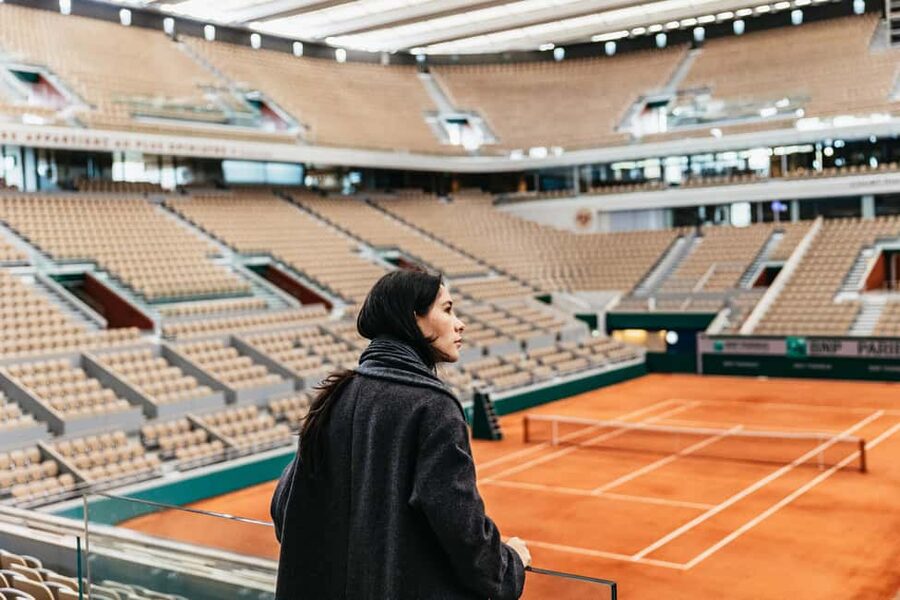
The main court is Court Philippe-Chatrier, the centerpiece of Roland-Garros. The tour includes a guided visit here, giving you time to take in the court, seating, and surrounding city views.
The court’s retractable roof is a major part of the modern venue. It allows play to continue in poor weather and has changed how the tournament handles rain and scheduling. The guide explains the design and technology, helping you see the roof as more than an engineering feature above the stands.
The view from inside the stadium is one of the tour’s most reliable pleasures. You get an unobstructed look across the clay courts and toward the city around Roland-Garros. It is a calmer view than the packed tournament setting, when every seat may be occupied and the central court is focused entirely on competition.
The condition of the court can vary. One visit found no clay on the main court, which slightly reduced the visual impact but did not ruin the tour. If you are hoping for the exact tournament look, remember that Roland-Garros is also an active venue outside the French Open. Courts may be prepared differently, repaired, or used for other purposes.
You should have opportunities for photographs, especially around the central court. The guide controls the pace, so keep your camera ready, but listen as well. The stories connected to the court are the reason this visit has more value than a quick photo stop.
A different way to spend the day in Paris:
- Paris: Louvre Museum Timed-Entrance Ticket
★ 4.6 · 71,977 reviews - Disneyland® Paris 1-Day Ticket
★ 4.6 · 49,412 reviews - Paris: Versailles Palace and Gardens Full Access Ticket
★ 4.6 · 41,579 reviews - Paris: Arc de Triomphe Rooftop Tickets
★ 4.6 · 34,264 reviews
The presidential tribune, media rooms, and trophy displays
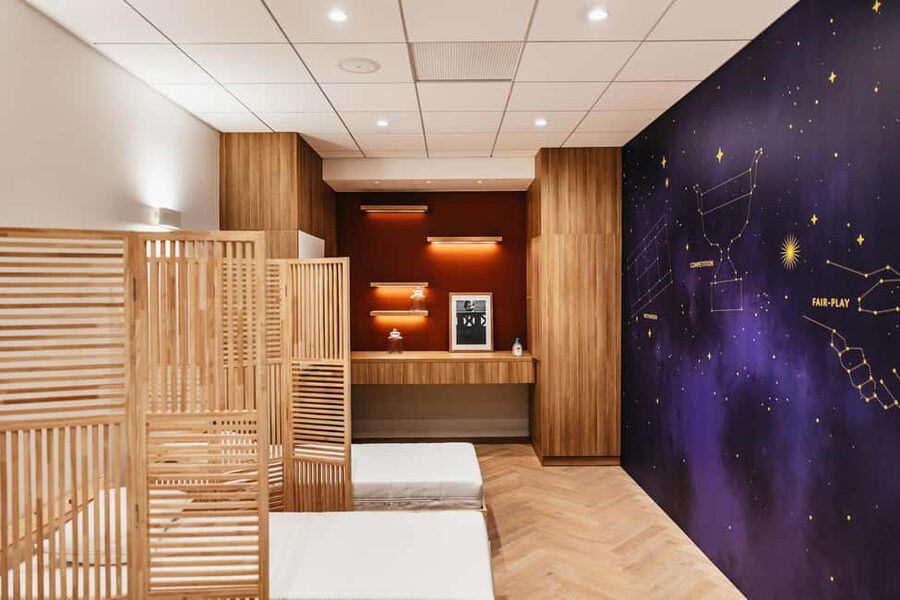
The presidential tribune offers a different view of the stadium. Instead of experiencing Roland-Garros as a regular spectator, you see one of the areas associated with official guests and major tournament occasions.
The media room is another enjoyable stop. A few guides have used it for mock interviews, allowing the group to play along rather than simply look at an empty room. It is a small touch, but it helps explain how the French Open is presented to the world after a match.
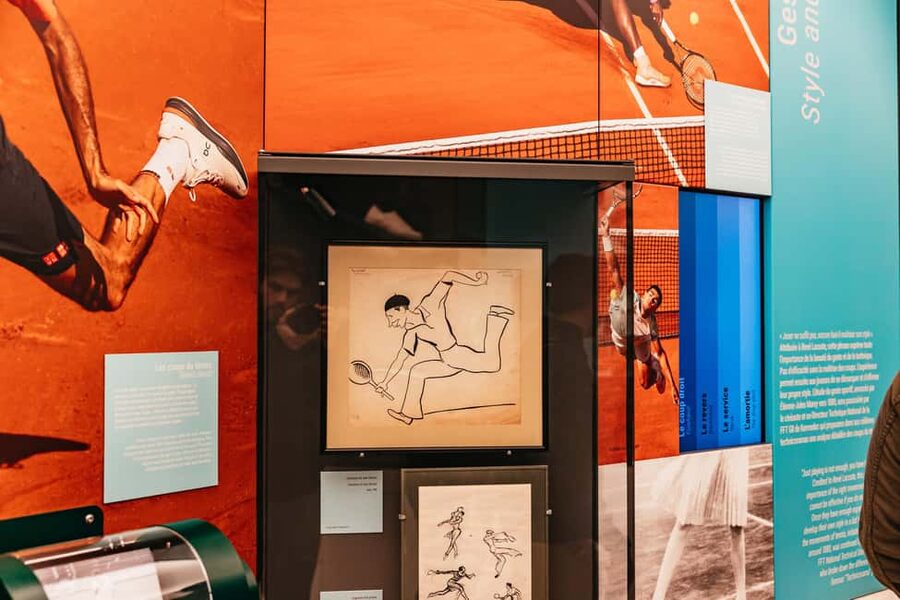
The tour can also include areas connected with press operations and trophy displays behind glass. These spaces show that a Grand Slam is not only about the players on court. It is also a large event involving broadcasting, interviews, officials, sponsors, and ceremony.
Do not expect unlimited time at every display. One visitor wanted longer in the museum area to read more information about the exhibits. The 90-minute format requires the guide to keep moving, especially when the group is large.
From Nadal and Graf to the Four Musketeers
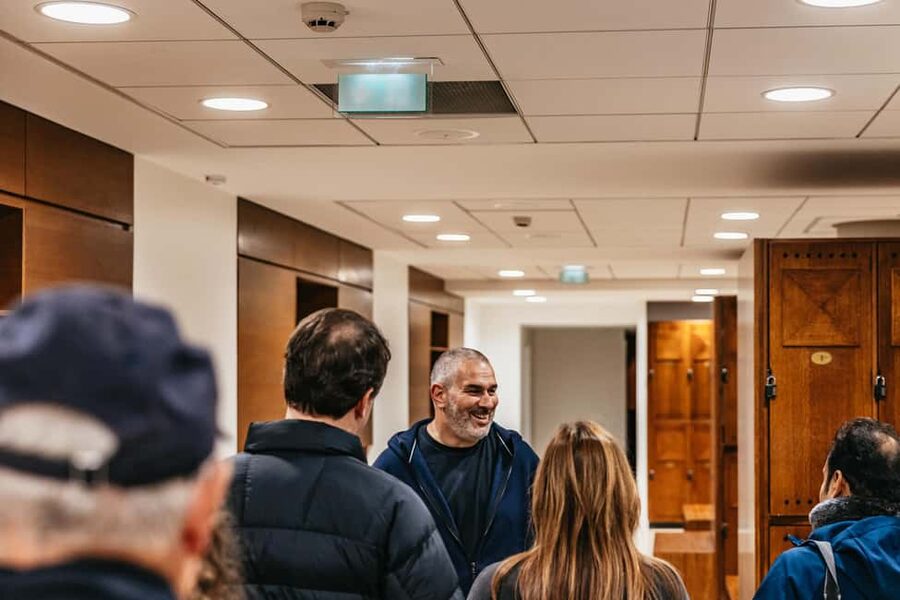
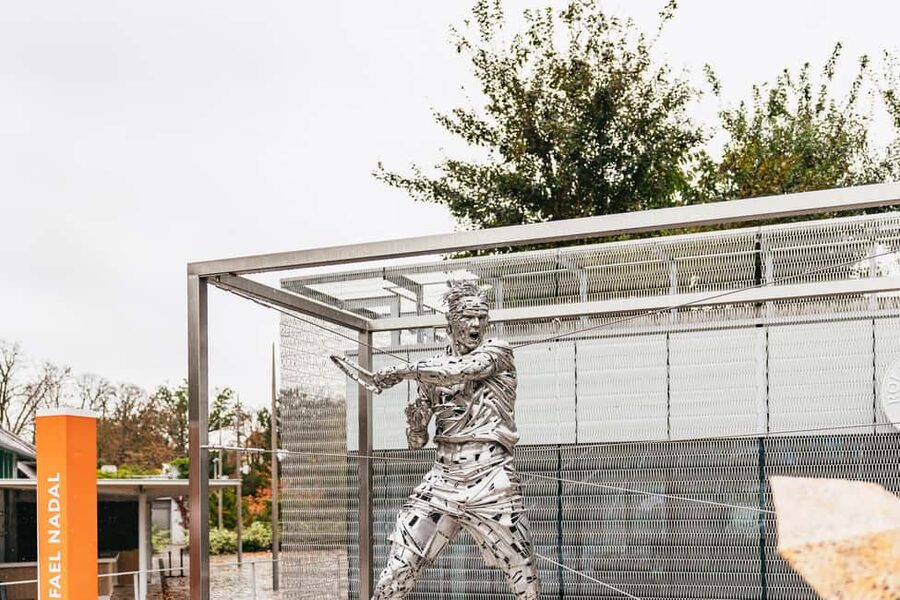
The tennis stories give the building its meaning. Rafael Nadal is an obvious focus because of his record at Roland-Garros, where he won 14 French Open titles. The venue includes tributes connected with him, including a plaque and an exhibition that visitors have found especially moving.
For many fans, seeing that plaque inside Philippe Chatrier Court is a highlight. It marks the connection between one player and one tournament in a way that statistics on a television screen cannot quite match.
The guide also discusses Steffi Graf, Björn Borg, and Chris Evert, all major names in French Open history. These stories help place the stadium in a wider tennis story rather than making the visit only about its most recent champion.
French tennis receives special attention through the Four Musketeers: Jean Borotra, Jacques Brugnon, Henri Cochet, and René Lacoste. They helped establish France’s place in international tennis and gave the tournament an early group of national heroes.
You do not need to memorize their records before arriving. The guide provides the context, and the best anecdotes make the names easier to remember. If you follow tennis closely, you will likely appreciate the extra detail. If you do not, the stories still explain why this particular stadium matters to France.
Group size, language, and the pace of the visit
Tours are offered in English, French, and Spanish. Your booking language matters, so check it before paying. A past group booked in French but included many English speakers, and the guide split the group to make the visit work better. That was a generous solution, but it should not be treated as a standard arrangement.
Some visitors have found a French guide’s English difficult to follow at times, though patient repetition helped. Others praised guides for clear English and lively conversation. The practical lesson is simple: if you miss a detail, ask the guide to repeat it.
Group size is the main recurring weakness. A large group can make it harder to hear at the next stop, especially when people arrive at different times. One useful improvement would be for the guide to wait until everyone gathers before beginning the next explanation.
The tour is not a silent museum visit. You move from place to place, listen to commentary, and ask questions when the guide pauses. The experience improves if you stay close enough to hear and avoid wandering behind the group.
The venue is wheelchair accessible. One guide helped a visitor who needed elevators, and the route can accommodate that need. Since stadium access can change with ongoing activities, it is still sensible to confirm any particular mobility requirement when booking.
Is $24 good value for 90 minutes?
At $24 per person, this is a strong-value outing for a tennis fan. Entry includes the guide and stadium admission, and the price is modest compared with many major Paris attractions.
The value comes from access. You are paying to enter working areas that are not part of an ordinary public visit, including the presidential tribune, player route, media spaces, and possibly locker rooms. You also receive explanation and context instead of simply walking around an empty stadium.
The tour is less compelling if you only want to see clay courts from the seats. In that case, the 90-minute format may feel longer than necessary. But if you care about the French Open, player stories, or the architecture of Philippe Chatrier Court, the price is easy to justify.
The flexible booking terms help. You can reserve now and pay later, and cancellation is free up to 24 hours before the scheduled visit for a full refund. That is useful when your Paris plans are still shifting.
Who will enjoy this most?
I would put this near the top of the list for anyone who watches the French Open. It is particularly worthwhile if you are unlikely to attend the tournament itself but want to understand the venue and feel its connection with the champions.
It also suits a tennis fan visiting Paris with family. You do not have to follow every match, and the stories about famous names, French tennis, and the stadium’s design give nonexperts enough to enjoy.
The tour may not suit you if you dislike guided visits, large groups, or fixed pacing. It also may disappoint if your main goal is guaranteed access to every backstage room. Locker rooms and some other areas can be unavailable because of renovations or stadium activity.
If you have extra time, the park opposite the stadium and the Simonne Mathieu Court are worth considering as a separate addition, based on the experience of one visitor. They are not part of the 90-minute route, so do not count on seeing them during the guided visit.
Should you book the Roland-Garros tour?
Book it if tennis has a place in your Paris plans. The players’ corridor, Philippe Chatrier Court, Nadal tribute, and behind-the-scenes rooms give you the feeling of entering the tournament’s private side.
I would also book it if you are only mildly interested in tennis but enjoy sports venues, architecture, and French cultural history. The guide’s stories make the stadium accessible beyond the match itself.
Before confirming, check the language, meeting point, and current access notes. Arrive at the Grande Boutique inside Gate 36, stay near the guide, and expect that some rooms may be closed. With those limits in mind, $24 buys a memorable and unusually personal look at one of Paris’s most important sporting addresses.
FAQ
Where does the Roland-Garros Stadium tour begin?
The meeting point is inside the Grande Boutique on Avenue Gordon-Bennett, at Gate 36.
How long does the tour last?
The guided visit lasts 90 minutes, or one and a half hours.
What language is the tour offered in?
Live guided tours are available in English, French, and Spanish.
Does the tour include entry to Roland-Garros?
Yes. The entrance fee and tour guide are included.
Can I see Philippe Chatrier Court?
Yes. The tour includes a guided visit to Philippe-Chatrier Court, including its retractable roof and views across the clay courts and surrounding cityscape.
Will I visit the locker rooms?
Locker room access can vary. Some visits include them, but areas may be closed because of renovations or stadium activities.
Is the stadium tour wheelchair accessible?
Yes, the activity is listed as wheelchair accessible.
Can I visit the stadium shop?
Yes. The shop can be visited before or after the tour and is open from 9:30 AM to 6:30 PM.
Can I cancel the booking?
You can cancel up to 24 hours before the tour for a full refund. You can also reserve now and pay later.
Newest additions around Paris
- Family escape Game with kids and teens on the Île de la Cité★ 4.5 · 11 reviews
- Private Photoshoot with the Iconic Eiffel Tower in Paris★ 5.0 · 11 reviews
- 2-day Private Mont Saint-Michel, 3 Loire Castles, D-Day Express★ 4.5 · 11 reviews
- Paris: Batobus Hop-On Hop-Off Cruise & Landmarks Audio Tour★ 3.0 · 11 reviews
- Paris Revolutionary Walking Tour: Iconic French Sights & Stories★ 5.0 · 11 reviews
- Guided and Private Tour of 3 hours through Paris aboard a Citroën 2cv★ 5.0 · 11 reviews
- Kids in the Kitchen – CrOisSaNtS★ 4.0 · 11 reviews
- Segway tour Capital sites★ 5.0 · 11 reviews
Guided, compared.
Louvre Guided Tour with Reserved Access & Boat Cruise
Read our review →
Louvre Museum Masterpieces Guided Tour with Access
Read our review →
Louvre Museum – Exclusive Guided Tour (Entry Included)
Read our review →
Skip-the-Line Guided Palace Tour and Full Access
Read our review →
Louvre Priority Access with Mona Lisa Escort or Guided Option
Read our review →
Louvre Museum: Skip-the-Line Small Group Guided Tour
Read our review →