Reviewed · GUIDED
Paris Private Guided Tour in a Vintage Open Top French Car
Paris looks especially good from the back seat of a classic open-top Citroën. Benjamin drives you through grand avenues, tight Montmartre lanes, and past the Eiffel Tower while sharing stories about the city. You get a private car, a private guide, and a route shaped around your group rather than a fixed bus schedule.
I like the photo-friendly car, which draws smiles and gives you an unusually stylish way to see the city. I also like the personal route planning: you can tell Benjamin what you have already seen, where you want to end, or which sights matter most. The main catch is traffic. Two hours can cover a lot, but a major road closure or jam can sharply reduce what you see.
In This Review
- Key points at a glance
- Why the Citroën DS changes the sightseeing
- A private route with Benjamin at the wheel
- Champs-Élysées, the presidential quarter, and the Arc de Triomphe
- Les Invalides, Pont Alexandre III, and Place de la Concorde
- The Seine, Louvre, Tuileries, and Musée d’Orsay
- Montmartre’s lanes, cafés, and artists’ addresses
- Sacré-Cœur and the best photo moments
- What two hours really gives you
- Price, group size, and comfort
- Pickup, drop-off, and traffic limits
- Who will enjoy this most
- Should you book the Citroën tour?
- FAQ
- How long is the Paris vintage car tour?
- How many people can join the private tour?
- How much does the tour cost?
- Is the tour offered in English?
- Which major Paris sights are included?
- Can I be picked up and dropped off at my hotel?
- Are children allowed on the tour?
- What happens if the weather is poor?
Key points at a glance
- A 1970s Citroën DS: The open roof, comfortable seats, heating, and generous legroom make the car part of the experience, not just the transportation.
- Private touring for up to four: The $361.74 fee covers the group, so the value improves considerably when four people share it.
- Benjamin’s local guidance: Expect live English commentary, historical background, route adjustments, and practical suggestions for the rest of your Paris stay.
- A broad two-hour overview: The route links the Champs-Élysées, Eiffel Tower, Louvre, major Seine bridges, Opéra, and Montmartre.
- Useful photo stops: The tour includes short stops at major sights, including the Eiffel Tower, Arc de Triomphe, Champs-Élysées, Montmartre, and Sacré-Cœur.
- Traffic is the real variable: Midday departures between 10 a.m. and 4 p.m. are suggested to reduce congestion, but Paris traffic can still change the plan.
Why the Citroën DS changes the sightseeing
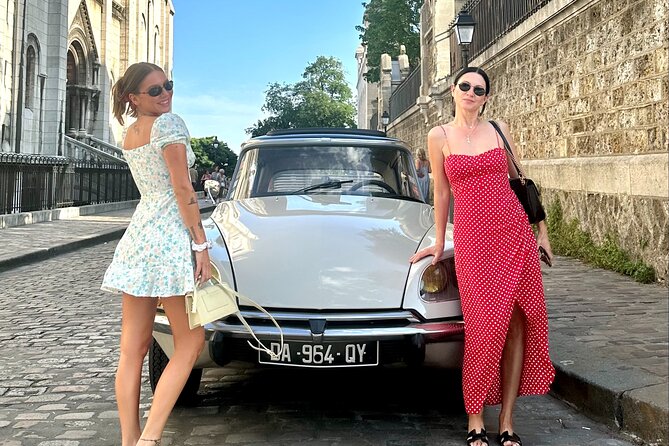
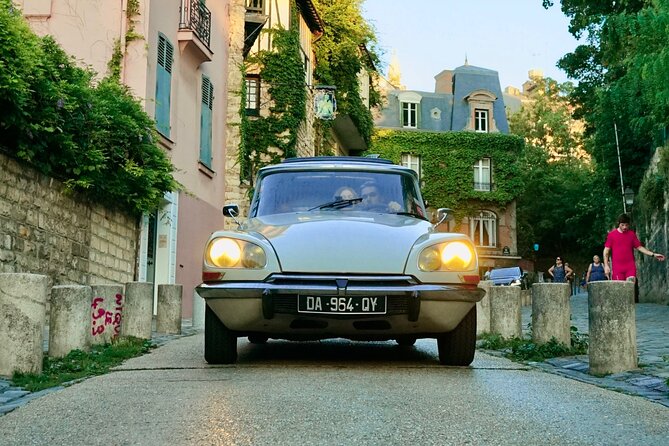
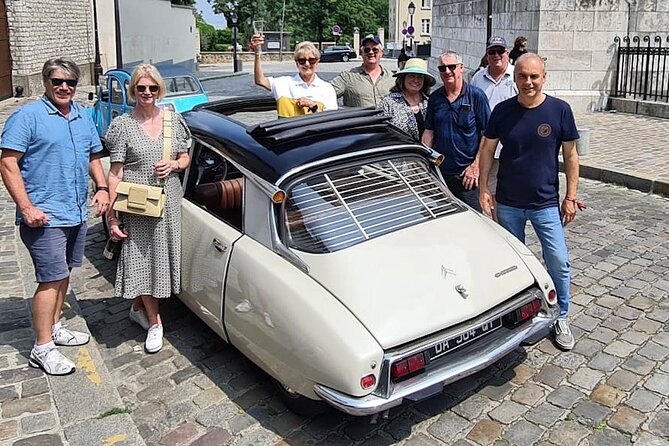
A standard vehicle gets you from one sight to another. This Citroën DS makes the journey part of the show. Its open roof gives you clear views of façades, monuments, and the sky above Paris, while the classic shape attracts attention at stoplights and along the street.
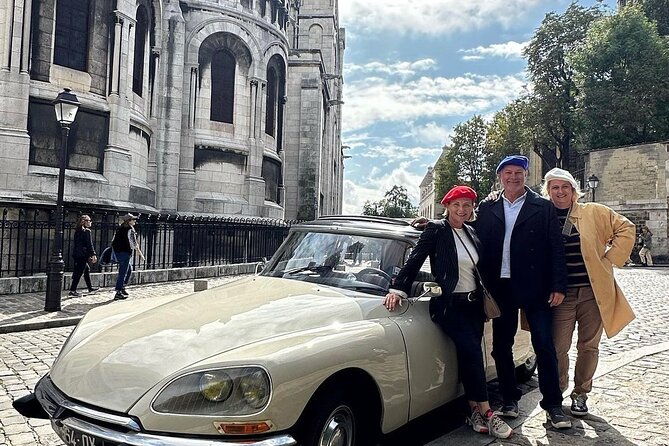
The car is a 1970s open-top Citroën, described in the experience details as having heating, comfortable seats, and plenty of legroom. That combination matters. An antique car can look wonderful in photographs but feel cramped in practice. Here, the available information points to a vehicle designed for a relaxed ride, with room for up to four passengers.
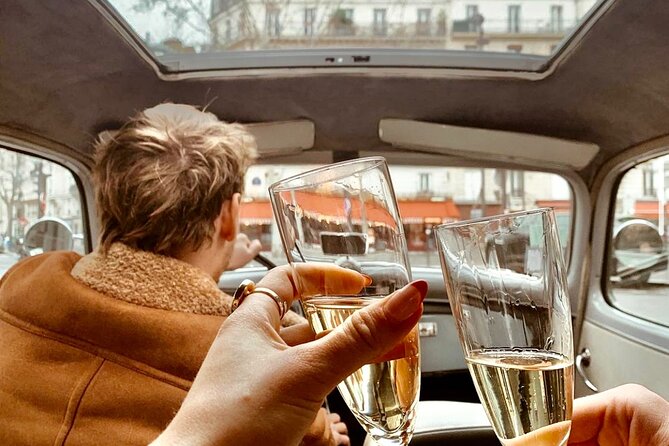
The roof is particularly useful for sightseeing and photos. You do not need to lean across a window or fight reflections from glass. Several stops let you get out for pictures, and Benjamin may also take photos for you. This is a good reason to keep your camera ready, but remember that the car is not a sightseeing platform with a guaranteed view at every moment. Paris traffic, trees, buildings, and passing buses will sometimes block the scene.
The car also makes this a social experience. People may look, smile, or take pictures as you pass. If you want to move through Paris unnoticed, use the Métro. If you enjoy a little old-fashioned theater, the Citroën is a fine choice.
A few more Paris ideas to compare
- Paris: Private Photoshoot at the Eiffel Tower
★ 4.7 · 2,636 reviews - Top Private Cruises in Paris with French Champagne and surprises
★ 5.0 · 1,553 reviews - Private Paris Airport Arrival Transfer – CDG & ORLY Airports
★ 4.5 · 1,119 reviews
A private route with Benjamin at the wheel
Benjamin is the guide and owner-operator of this small independent company. His role combines driving, storytelling, route planning, and local advice. He speaks English and provides live commentary as you travel between monuments.
That personal approach is the tour’s strongest feature. You can explain which sights you have already visited and which ones you still want to see. Benjamin can then arrange the route to make the most of your two hours. You can also tell him your preferred drop-off point within the permitted pickup zone, allowing the tour to end somewhere useful rather than simply returning to the start.
The commentary covers Parisian monuments, architecture, history, and culture. The experience is not an extended museum lecture. It is more like an introduction to the city while you are moving through it. Benjamin also gives tips for the rest of your vacation, which can be valuable early in a Paris stay when you are still deciding how to spend your museum, food, and neighborhood time.
A few reviews identify other guides on individual departures, including Alain and a guide whose name was uncertainly recorded as Dove. The provider identifies Benjamin as the main guide, but a replacement may be arranged if he cannot conduct a particular tour. If having Benjamin specifically matters to you, confirm that after booking.
Champs-Élysées, the presidential quarter, and the Arc de Triomphe
The route begins around the Champs-Élysées, Paris’s grand ceremonial avenue. You see the broad boulevard, luxury storefronts, and the monumental axis that links the Arc de Triomphe with the Tuileries and Louvre area.
A short stop here is useful for orientation and photographs. The Élysée Palace, the French president’s official residence, is also part of the surrounding city story. You will not be touring the palace, but passing through this district gives you a sense of how political power, retail prestige, and national ceremony share the same streets.
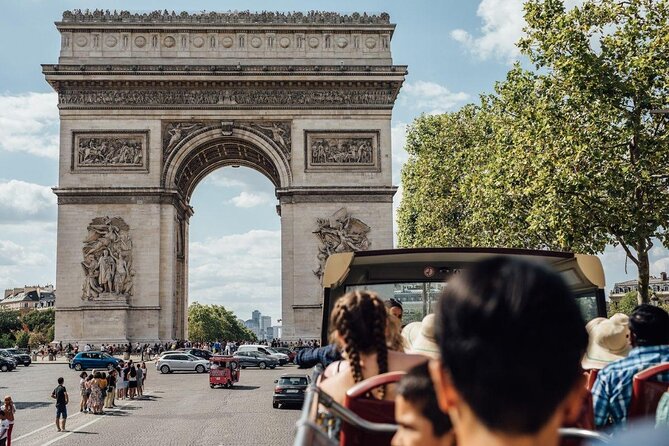
The Arc de Triomphe receives its own stop of about 15 minutes. It honors France’s military heroes and sits at the center of one of the city’s most complicated traffic circles. From the car, you get a clear sense of its role in the city plan. On foot, you can take photographs, but this is not a visit to the monument’s interior or rooftop.
The wide avenues here are impressive, but traffic can be slow. That is one reason a private car is helpful: Benjamin can adjust the route, explain what you are passing, and sometimes use smaller streets instead of leaving you stuck on a major boulevard.
Les Invalides, Pont Alexandre III, and Place de la Concorde
As the car crosses central Paris, you pass Les Invalides, recognizable by its golden dome. The complex is closely linked with French military history and contains Napoleon Bonaparte’s tomb. The tour gives you context from the road, not a full indoor visit, so plan a separate visit if you want the museums or tomb.
Pont Alexandre III is one of the most photogenic bridges over the Seine. Its ornate lamps, sculptures, and gilded details provide a sharp contrast to the restrained stonework of many other Paris bridges. The car lets you see the bridge as part of the river corridor, and you may stop nearby for views.
At Place de la Concorde, the ancient Luxor Obelisk shares the square with fountains, statues, and broad views toward the Tuileries and Champs-Élysées. This single location connects ancient Egypt, the French monarchy, the Revolution, and modern Paris. It is a good example of the kind of historical layering that makes live commentary useful.
You also pass the Palais Bourbon, home of France’s National Assembly, and La Madeleine, whose massive neoclassical design resembles a classical temple. These are drive-by sights rather than long visits, but they help you understand the scale and variety of central Paris.
A different way to spend the day in Paris:
- Paris: Louvre Museum Timed-Entrance Ticket
★ 4.6 · 71,977 reviews - Disneyland® Paris 1-Day Ticket
★ 4.6 · 49,412 reviews - Paris: Versailles Palace and Gardens Full Access Ticket
★ 4.6 · 41,579 reviews - Paris: Arc de Triomphe Rooftop Tickets
★ 4.6 · 34,264 reviews
The Seine, Louvre, Tuileries, and Musée d’Orsay
The middle section of the route brings you through the great central sights along the Seine. You may pass the Tuileries Gardens, the Louvre, Musée d’Orsay, Pont de la Concorde, and other bridges that frame the river.
The Tuileries are especially useful to note for later. This formal garden runs between the Louvre and Place de la Concorde, making it one of the easiest places to combine a museum visit with a pleasant walk. The tour will not replace time on foot in the gardens, but it shows you how the major sights fit together.
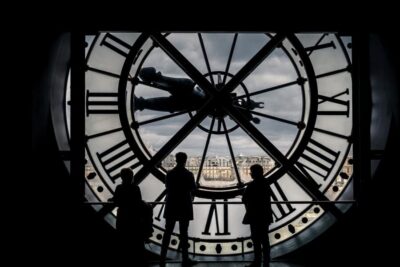
The Louvre is too large for a meaningful visit during a two-hour driving tour. You see the museum complex and its glass pyramid from outside, then decide if you want to return for several hours or a focused visit. The same is true of Musée d’Orsay, housed in a former railway station and known for Impressionist and Post-Impressionist art.
This is where you need to keep expectations realistic. The car tour gives you an efficient overview, not admission to museums or time to study their collections. If you have only one day in Paris, the drive can help you choose which major museum deserves your limited time.
Place Vendôme and the Opéra Garnier add another side of Paris. Place Vendôme is associated with luxury boutiques and the Vendôme Column, while Opéra Garnier is famous for its ornate architecture and artistic history. You also pass La Trinité, a church with neo-Renaissance design, before the route heads toward Pigalle and Montmartre.
Montmartre’s lanes, cafés, and artists’ addresses
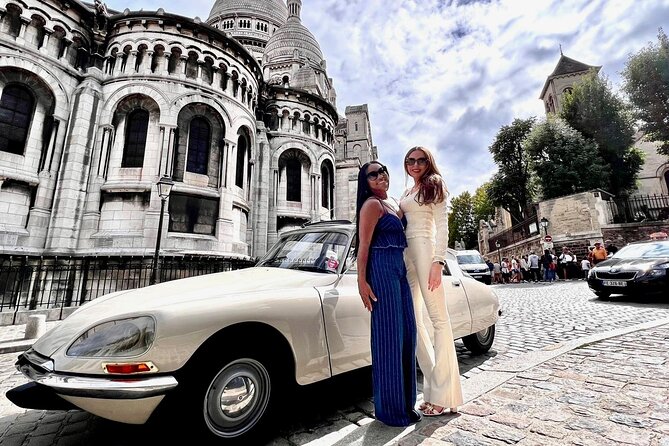
Montmartre is the part of the tour where the small car earns its keep. The hill’s narrow lanes and steep streets are awkward for large vehicles. A compact classic Citroën can reach corners and viewpoints that would be difficult for a bus.
You may pass Pigalle, the former cabaret district, before climbing into Montmartre. The neighborhood’s artistic associations come into view around Place du Tertre, where painters work among cafés and old buildings. This area can feel crowded and commercial, but it remains one of the easiest places to sense Montmartre’s long connection with artists.
The Montmartre stairs and Rue de l’Abreuvoir offer some of the most attractive street scenes on the route. Rue de l’Abreuvoir has a village-like appearance, with old houses and a winding profile that feels far removed from the grand avenues below.
The route also includes several small points of interest:
- Le Chat Noir recalls the cabaret culture that brought artists and writers together.
- La Maison Rose is a pink café associated with Montmartre’s artistic past.
- Rue Lepic includes the Café des 2 Moulins, known from the film Amélie, as well as old windmill references.
- The Moulin de la Galette recalls the area’s former windmills and dance-hall culture.
- Clos Montmartre is a small working vineyard, an unusual reminder that this hill was once outside central Paris.
- Saint-Pierre de Montmartre provides a quieter religious and medieval counterpoint.
- The Wall of I Love You presents the words Je t’aime in more than 300 languages.
- The former home associated with Van Gogh links the streets to one of the artists who lived and worked in this district.
Not every point receives a stop. Many are viewed from the car, so the value comes from seeing a wide range of places and hearing what makes them worth a later walk. If you want to sit at a café, visit a church interior, or browse the square, plan extra time after the tour.
Sacré-Cœur and the best photo moments
The Basilique du Sacré-Cœur is the main Montmartre stop, with roughly 15 minutes allocated for the visit. Its white domes rise above the hill, and the steps below provide wide views over Paris.
That time is enough for photographs and a quick look around, but not for a leisurely exploration of Montmartre or the basilica. The hill can also involve stairs and uneven streets, so wear shoes you can comfortably use on inclines.
The Eiffel Tower receives another important photo stop. Rue de l’Université, near the tower, offers a more intimate street setting than the enormous open spaces around the monument. The tower itself is seen from outside, and the route may include a particularly good viewpoint selected by Benjamin.
A short photo stop is one of the tour’s practical strengths. You can see a lot from a moving car, but photographs are far better when the driver pulls over and gives you a few minutes. Do not expect a long stop at every landmark. The tour’s goal is broad coverage, not extended sightseeing at each location.
What two hours really gives you
Two hours is enough to get your bearings quickly. You can connect the western monuments, central riverfront, grand squares, and Montmartre without spending the day navigating buses or the Métro.
It is not enough to fully visit all the places named along the route. The Champs-Élysées, Arc de Triomphe, Eiffel Tower, Montmartre, and Sacré-Cœur receive the clearest stop time. The Louvre, Musée d’Orsay, Grand Palais, Petit Palais, Madeleine, Opéra Garnier, Pont Alexandre III, and many smaller sites are generally part of the drive and commentary.
I would use this tour at the start of a Paris visit. It gives you a mental map, shows you neighborhoods you may otherwise miss, and helps you decide where to return on foot. It also works well at the end of a short stay when you want one last sweep of the city without another day of walking.
The suggested departure window is between 10 a.m. and 4 p.m., partly to avoid the worst traffic. An evening or sunset ride can be beautiful, and one such departure was described as especially memorable, but traffic and weather become less predictable. Confirm the timing that suits your priorities.
Price, group size, and comfort
The price is $361.74 per group of up to four people. Four passengers pay about $90.44 each, which is fair for a private two-hour experience with a guide, driver, car, bottled water, and pickup or drop-off within the service area.
For two people, the cost works out to about $180.87 each. That is a much larger spend than a regular sightseeing bus or self-guided walk, so the value depends on what you want. You are paying for privacy, a distinctive vehicle, flexible routing, live commentary, and the ability to cover distant districts quickly.
The car has heating, so winter is possible, and the experience includes bottled water. Still, it depends on good weather. Rain can lead to a rescheduled tour or a full refund, and even a dry day may feel cool in an open car. Bring a layer, especially if you book outside the warmest months.
Children under 10 are not allowed because the back seats do not have seat belts. Service animals are allowed, and the tour is near public transportation, but the supplied information does not promise wheelchair accessibility. Ask before booking if mobility support is important for your group.
Pickup, drop-off, and traffic limits
Pickup and drop-off are available at many locations in Paris, but not every arrondissement is covered. Service excludes the 3rd, 4th, 10th, 11th, 12th, 19th, and 20th arrondissements, including Le Marais, Bastille, République, and Gare du Nord.
If your hotel is outside the pickup zone, you can arrange a meeting point. The listed options are in front of Hôtel Crillon at 10 Place de la Concorde or in front of the Panthéon at Place du Panthéon. Contact the provider after booking if your hotel is not clearly covered.
Traffic deserves special attention. One unusually difficult departure was delayed by about an hour during preparations for the Paris Olympics, when major routes were closed. That is an extreme example, but it shows the risk of scheduling this tour tightly before a train, flight, or timed museum entry.
The private format helps because Benjamin can reroute and, when possible, use smaller streets. It cannot eliminate traffic. Leave a generous buffer after the tour.
Who will enjoy this most
I recommend this for first-time visitors who want a fast orientation, couples looking for a memorable ride, families with children aged 10 and older, and small groups celebrating a special occasion. It is also useful for returning visitors who want Benjamin to focus on neighborhoods or viewpoints they missed before.
It suits you less if your main goal is entering museums, spending an hour at the Eiffel Tower, or lingering at every café. It is also not ideal if you dislike attention, since the car attracts looks and photographs.
The experience is particularly good for anyone who finds a full day of walking tiring. You still get out for photos and short visits, but the car carries you between districts and handles the long gaps between Montmartre, the Louvre, and the western monuments.
Should you book the Citroën tour?
Book it if you want a stylish, private introduction to Paris and value a guide who can adjust the route to your interests. Benjamin’s driving, English commentary, photo help, and practical tips turn a simple sightseeing loop into a useful first look at the city.
Do not book it expecting a series of full monument visits. You will see many places from the car, with short stops at key points. Traffic is the one serious risk, so avoid placing an important reservation immediately afterward.
For four people, the group price is strongest. For two, it is a splurge, but the vintage Citroën, privacy, and efficient coverage make it a distinctive alternative to a standard city tour.
FAQ
How long is the Paris vintage car tour?
The tour lasts approximately two hours.
How many people can join the private tour?
Up to four passengers can participate for the single group price.
How much does the tour cost?
The listed price is $361.74 per group of up to four people.
Is the tour offered in English?
Yes. Live commentary is offered in English.
Which major Paris sights are included?
The route includes the Champs-Élysées, Arc de Triomphe, Eiffel Tower, Montmartre, Sacré-Cœur, Louvre, Tuileries Gardens, Musée d’Orsay, Place de la Concorde, Pont Alexandre III, Place Vendôme, Opéra Garnier, and other landmarks.
Can I be picked up and dropped off at my hotel?
Pickup and drop-off are available at locations within the service zone in Paris. The service excludes the 3rd, 4th, 10th, 11th, 12th, 19th, and 20th arrondissements, as well as Le Marais, Bastille, République, and Gare du Nord.
Are children allowed on the tour?
Children under 10 are not allowed because the back seats do not have seat belts.
What happens if the weather is poor?
The experience requires good weather. If it is canceled because of poor weather, you will be offered another date or a full refund. You can also cancel for a full refund up to 24 hours before the start time.
Newest additions around Paris
- Private Photoshoot with the Iconic Eiffel Tower in Paris★ 5.0 · 11 reviews
- Family escape Game with kids and teens on the Île de la Cité★ 4.5 · 11 reviews
- 2-day Private Mont Saint-Michel, 3 Loire Castles, D-Day Express★ 4.5 · 11 reviews
- Paris: Batobus Hop-On Hop-Off Cruise & Landmarks Audio Tour★ 3.0 · 11 reviews
- Paris Revolutionary Walking Tour: Iconic French Sights & Stories★ 5.0 · 11 reviews
- Guided and Private Tour of 3 hours through Paris aboard a Citroën 2cv★ 5.0 · 11 reviews
- Kids in the Kitchen – CrOisSaNtS★ 4.0 · 11 reviews
- Paris: Ghosts and Dark Stories Guided Walking Tour★ 4.1 · 11 reviews
Guided, compared.
Louvre Guided Tour with Reserved Access & Boat Cruise
Read our review →
Louvre Museum Masterpieces Guided Tour with Access
Read our review →
Louvre Museum – Exclusive Guided Tour (Entry Included)
Read our review →
Skip-the-Line Guided Palace Tour and Full Access
Read our review →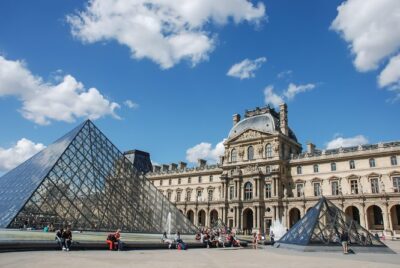
Louvre Priority Access with Mona Lisa Escort or Guided Option
Read our review →
Louvre Museum: Skip-the-Line Small Group Guided Tour
Read our review →