
Reviewed · SEINE RIVER CRUISES
Paris: Cruise on The Canal Saint Martin and The Seine River
The unusual part comes first: you cruise through Canal Saint-Martin, pass through working locks, and enter a long tunnel beneath the Bastille area before reaching the Seine. It is part sightseeing trip, part lesson in how Paris moved water, goods, and people.
I like the contrast between the quiet, tree-lined canal and the grand river views. I also like the ending at Île de la Cité, where you can walk straight toward Sainte-Chapelle, the Latin Quarter, or the Right Bank. The main drawback is that the tunnel takes a substantial part of the two hours, and the boat can feel crowded or hard to hear when people gather on the upper deck.
In This Review
- Key points to know before boarding
- Why this canal-to-Seine route is different
- Starting at Canal Saint-Martin near Quai de Valmy
- Watching the locks rise and fall
- The long tunnel beneath the Bastille area
- Port de l’Arsenal and the change to the Seine
- Île Saint-Louis and the first Seine views
- Notre-Dame, the Louvre, and the Musée d’Orsay
- Pont Alexandre III, Les Invalides, and the Eiffel Tower
- Commentary, sound, and the onboard atmosphere
- Seats, heat, drinks, and comfort
- Planning the start and finish
- Who should book this cruise
- Should you book it?
- FAQ
- How long is the Canal Saint-Martin and Seine cruise?
- Where does the cruise start?
- Where does the cruise end?
- Is the tour offered in English?
- What landmarks can I see from the boat?
- Does the boat pass through locks?
- Does the cruise go underground?
- How many people can join the cruise?
- Is public transportation available near the meeting points?
- Can I cancel for a full refund?
- What happens if bad weather cancels the cruise?
Key points to know before boarding
- The route is more unusual than a standard Seine cruise: You pass through locks and a long underground canal before reaching the famous river views.
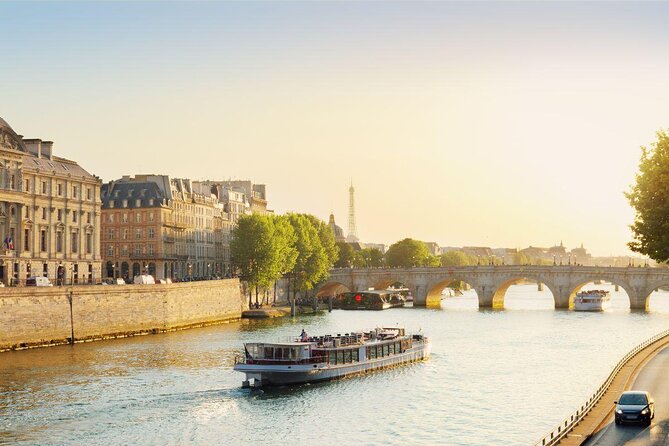
- The best open-air sights come later: Notre-Dame, the Louvre, the Musée d’Orsay, Pont Alexandre III, Les Invalides, and the Eiffel Tower appear during the Seine portion.
- Bilingual commentary can be useful but uneven: Guides speak in French and English, though timing, sound quality, and crowd noise can make parts difficult to follow.
- Arrive early for an upper-deck seat: The boat can fill well before departure, and the top deck offers the clearest photos.
- This is not a small private outing: The stated maximum is 100 people, so expect a shared boat rather than an intimate cruise.
- The route ends in a prime central location: You finish opposite 19 Quai de l’Horloge on Île de la Cité, near Pont Neuf.
Why this canal-to-Seine route is different
At about $42.05 per person, this cruise costs more than some simple one-hour Seine rides. You are paying for a longer route and a more varied experience, not just a loop past the usual monuments.
A standard river cruise gives you the postcard Paris: stone bridges, grand museums, and the Eiffel Tower. This trip adds the working side of the city. You see how Canal Saint-Martin changes level, watch lock gates open and close, and travel below the streets in a vaulted passage near Bastille.
That extra material is the reason I would choose this cruise over a basic Seine ride if you have already seen Paris from the river, or if you want something with a little more substance. If your only goal is two hours of open-air monument views, the underground section may feel like time taken away from the sights you came to see.
The experience lasts about two hours and is offered with a mobile ticket. It is near public transportation at both ends, but the start and finish are not the same place. That matters when planning your day.
More Seine cruises to compare:
- Paris: Seine Cruise & Crepe Tasting near the Eiffel Tower
★ 4.4 · 11,231 reviews - Paris: Seine River Panoramic Views Dinner Cruise
★ 4.3 · 10,611 reviews - Paris: Eiffel Tower Access by Elevator & Seine River Cruise
★ 4.6 · 7,329 reviews
Starting at Canal Saint-Martin near Quai de Valmy
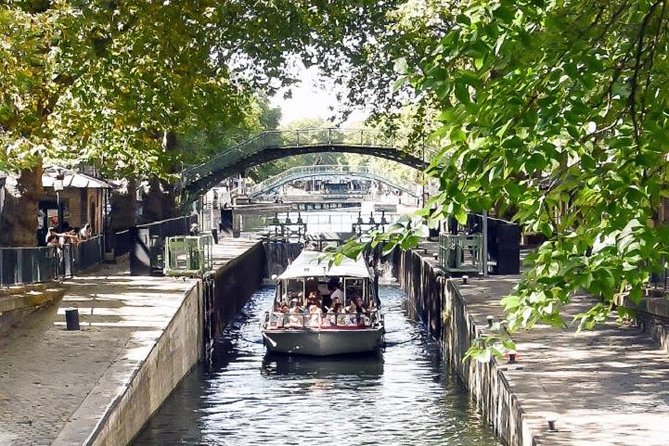
The cruise begins at 73 Quai de Valmy in the 10th arrondissement. This is a more local-feeling starting point than the usual Seine docks, with the canal edged by trees, iron footbridges, cafés, and waterside terraces.
The early part gives you a look at a Paris neighborhood instead of a parade of major monuments. The famous Hôtel du Nord is one of the points highlighted along the canal. Your guide explains that the waterway was built to bring fresh water into Paris, then describes how the area changed from a working district into one of the city’s popular café and boutique neighborhoods.
I like this opening because it gives you a sense of ordinary Paris before the grand sights appear. You see people walking beside the water, crossing the footbridges, and sitting near the canal. It is a calmer introduction than boarding directly beside Notre-Dame or the Eiffel Tower.
Arrive early if sitting outside matters to you. The boat can already be filling 15 minutes before departure, and people tend to gather at the front of the upper deck. A half-hour cushion is more sensible if you want a clear view.
Watching the locks rise and fall
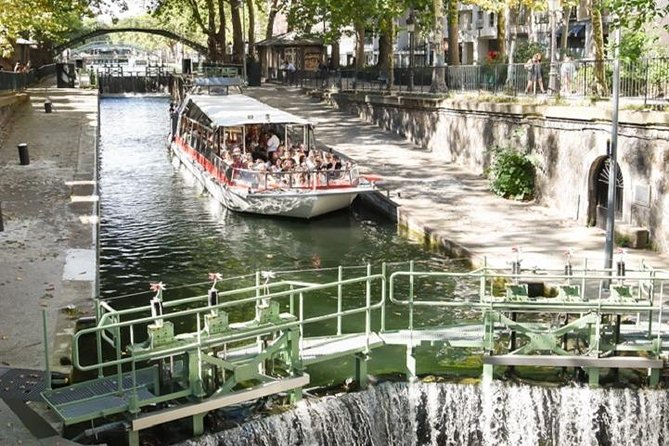
The locks are the mechanical heart of the canal section. The boat enters a chamber, gates close, and the water level changes before the next gates open. One account describes a drop of about six metres, which gives you a sense of the scale involved.
This is not a fast-moving sightseeing stretch. The boat pauses while the lock works, so you have time to watch the water, the gates, and the people along the quays. The scene mixes old industrial buildings with cafés and small shops, a useful reminder that Paris is not only marble façades and famous museums.
The locks are especially good for children and anyone interested in engineering. You can see the process rather than simply hearing that the canal has locks. The captain and guide explain how the system operates and how the canal once served practical transport needs as well as leisure use.
There is one viewing problem. People often stand at the front of the upper deck, making it hard to see the lock chamber clearly. If this is the main reason you booked, move early and keep your position. Otherwise, you may hear the explanation without seeing much of the action.
The route also includes a swing bridge. Road traffic stops briefly while the boat passes, giving you another look at the canal as a working piece of city infrastructure. It is a small moment, but it adds character to the trip.
The long tunnel beneath the Bastille area
After the locks, the boat enters a long underground tunnel beneath the Bastille area. The passage is vaulted and broken by shafts that let in narrow patches of daylight from above.
The change is striking. Street noise fades, the boat moves through near-darkness, and Paris continues above you without being visible. For some people, this is the most memorable section because it feels unlike any ordinary sightseeing cruise. For others, it is simply a long ride in a dim tunnel.
You should choose this tour with that split in mind. The canal and tunnel together take roughly half the experience. If enclosed spaces or quiet stretches make you restless, a one-hour Seine cruise may suit you better. If you like old infrastructure and unusual city views, the tunnel is precisely the reason to book this route.
The tunnel also changes the rhythm of the outing. The first section is slow and observational, while the Seine portion becomes a steady run of recognizable sights. You do not get nonstop landmarks from the moment you board.
A different way to spend the day in Paris:
- Paris: Louvre Museum Timed-Entrance Ticket
★ 4.6 · 71,977 reviews - Disneyland® Paris 1-Day Ticket
★ 4.6 · 49,412 reviews - Paris: Versailles Palace and Gardens Full Access Ticket
★ 4.6 · 41,579 reviews - Paris: Arc de Triomphe Rooftop Tickets
★ 4.6 · 34,264 reviews
Port de l’Arsenal and the change to the Seine
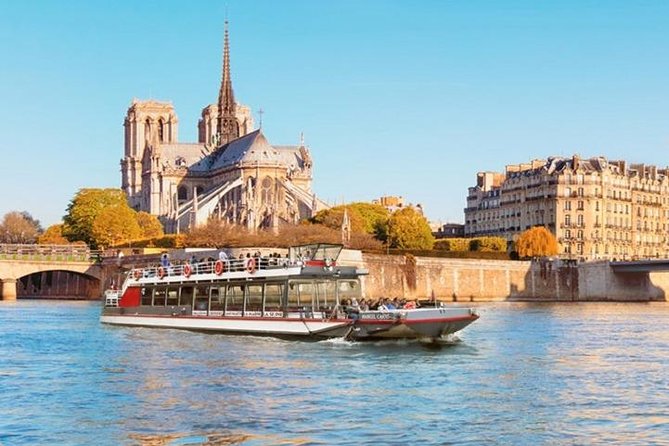
The boat emerges at Port de l’Arsenal, a marina linking Canal Saint-Martin with the Seine. Houseboats and pleasure craft sit in the basin, and the guide explains how a former commercial port became a harbor and garden area.
This is the point where the cruise begins to feel more open. After the low ceiling of the tunnel and the controlled movement through the locks, the marina provides space, boats, and a clear connection to the river ahead.
It is also a useful transition in the story of Paris. The canal began as a practical waterway, the port served commercial work, and both areas now form part of the city’s leisure life. That kind of change is easier to understand from the water than from a quick walk along a pavement.
Île Saint-Louis and the first Seine views
Once the boat joins the Seine, the scenery changes at once. You pass Île Saint-Louis, lined with elegant 17th-century façades, and approach Île de la Cité, the historic center of Paris.
From the river, you see the curve of the water and the bridges in a way that is difficult to grasp on foot. The buildings appear as long, connected façades rather than isolated addresses. This makes the cruise useful early in a Paris visit, since you can get your bearings along the river without walking several miles.
The open deck is the place for photographs. Keep your camera ready as the boat moves, since the best views do not wait for you to frame them. The Eiffel Tower, Notre-Dame, and the bridges are easier to photograph from the water because you are not dealing with traffic, street signs, or crowds at ground level.
Notre-Dame, the Louvre, and the Musée d’Orsay
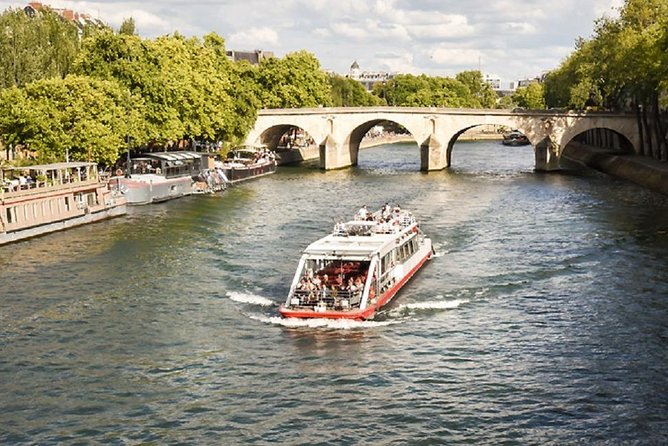
The main Seine route covers many of the sights people expect from a Paris cruise. You pass Notre-Dame Cathedral, the Conciergerie, the Louvre, the Tuileries gardens, and the Musée d’Orsay.
The value here is not entry to any museum or monument. This is an exterior viewing trip, with commentary about architecture, history, and the role each place plays in the city. You will not replace a visit inside the Louvre or Sainte-Chapelle, but you can see how these buildings relate to the river and to one another.
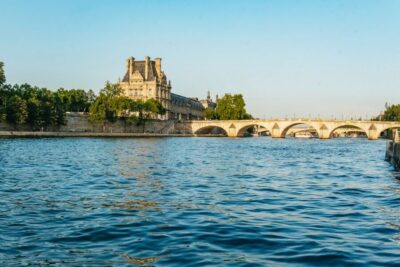
The Louvre is particularly impressive from the water. Its immense river façade stretches a long way, while the domed Institut de France faces it from the Left Bank. Near Pont des Arts, you can see the Louvre, the Institut, and the footbridge in one broad view.
That angle helps explain the scale of central Paris. On foot, the Louvre can feel like a series of separate courtyards and wings. From the boat, the full river frontage becomes clear.
Pont Alexandre III, Les Invalides, and the Eiffel Tower
The passage under Pont Alexandre III is one of the most attractive sections of the river trip. Golden statues and Art Nouveau lamps decorate the bridge, while the glass roof of the Grand Palais appears nearby. Across the river, the golden dome of Les Invalides marks the burial place of Napoleon.
The Eiffel Tower comes later, rising above the Trocadéro and Champ de Mars. If your cruise runs in the evening, the tower may be lit, and at the right time you may see its sparkling display.
This is the moment most people wait for, so expect cameras and a rush toward the best rail-side positions. The upper deck gives you the clearest view, but it can also be hot in August and crowded at the front. There is no promise of a clear, private photo, so take your position early and be prepared to share the view.
The route can also offer smaller visual surprises. One person especially enjoyed photographing the Statue of Liberty with the Eiffel Tower behind it. That is a good example of why a river cruise can reveal combinations you might miss from the street.
Commentary, sound, and the onboard atmosphere
The guide is an important part of this experience because the canal section needs explanation. Guides have included Lea and Ben, and Pasquale has served as captain. The commentary covers the canal’s purpose, the locks, the tunnel, and the major Seine monuments.
The narration is given in French and English. That is helpful for a mixed audience, but it can affect the rhythm. Explanations may feel long when repeated in two languages, and a few people have found that the guide’s comments lag behind the sight the boat has already passed.
Sound is the bigger concern. A busy upper deck, children moving around, and people talking can make it hard to catch every sentence. The boat’s sound system has not always carried clearly, according to the practical experience described for this outing.
I suggest sitting near the guide or speaker if the history matters to you. If you mainly want views, you can treat the commentary as useful background rather than expecting a perfectly delivered lecture. Written information is not supplied as part of the stated offering, so you should not count on a printed guide to fill in missed details.
Seats, heat, drinks, and comfort
The boat has an upper deck and an indoor lower area. The upper deck is best for photographs, but it is exposed to the weather and can become very hot in summer. One August departure was described as especially uncomfortable up top, which is hardly surprising on a sunny Paris afternoon.
A dry seat on the upper deck is not guaranteed. Bring a light layer for cooler weather and consider the indoor area if heat or rain is a concern. You can move between the two areas if space allows, but the most popular outdoor positions go first.
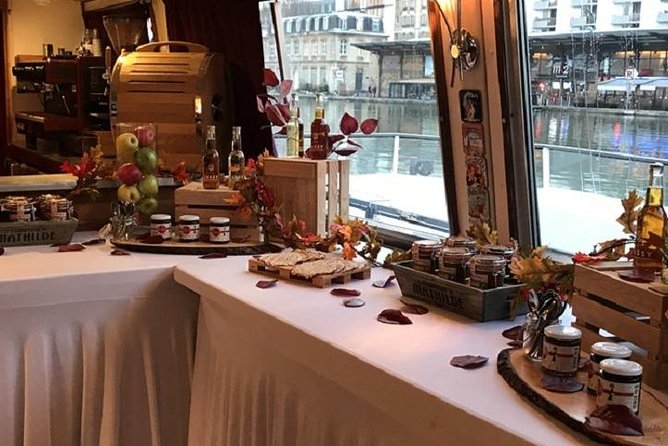
There is a concession stand selling drinks such as soda, wine, beer, and juice. Crepes and snacks have also been provided on some outings, but I would not treat food as the main reason to book. The real value is the route and the sightseeing.
The boat is suitable for most people, but the finish is worth noting. The end point near Quai de l’Horloge can involve steps up to street level, which may be difficult for someone using a walker. If mobility is a concern, ask about the final access before booking rather than assuming a step-free exit.
Planning the start and finish
The beginning is at 73 Quai de Valmy. The boat is across from the meeting point, so look carefully for the correct dock and allow time to find the boarding place. Two people missed the departure after struggling with the address and finding no boat at the expected spot. That kind of problem can ruin an otherwise good outing.
The end is opposite 19 Quai de l’Horloge on Île de la Cité, near Pont Neuf. You finish in a far more central area than where you began, which is useful for continuing your evening.
From there, you can walk toward Sainte-Chapelle, cross to the Right Bank, head into the Latin Quarter, or find a nearby terrace. Do not plan a tight connection with another timed activity immediately after the cruise. River conditions, locks, boarding, and crowd movement can affect the exact finish.
The experience is booked, on average, 23 days ahead, so popular dates may require planning. The mobile ticket is confirmed at booking, and the cruise is offered in English, with bilingual narration during the trip.
Who should book this cruise
I would choose this cruise if you want more than the standard Seine route. It suits first-time visitors who want a broad introduction to Paris, families interested in the locks, and repeat visitors looking for a different view of the city.
It also works well for anyone who wants to reduce walking. In two hours, you see a long stretch of Paris from a seated or standing position, including several UNESCO-listed riverbank sights and the Eiffel Tower.
I would hesitate if you want a small-group experience, perfect audio, or uninterrupted views in the open air. The listed capacity is up to 100 people, and the upper deck may become crowded. If the tunnel sounds boring to you, choose a shorter Seine-only cruise instead.
At $42.05, the price is fair when you value the canal engineering, tunnel, commentary, and full monument route together. It is less compelling if you judge the outing only by open-air time beside the famous sights.
Should you book it?
Book this cruise if the locks and underground canal sound interesting, not merely tolerable. Those features are what separate it from the many boats that simply travel between Notre-Dame and the Eiffel Tower.
You will also get that classic Seine route, plus a central drop-off near Pont Neuf. Just arrive early, aim for the upper deck if you want photographs, protect yourself from summer heat, and sit close enough to hear the bilingual commentary.
If you want only postcard views, select a Seine-only ride. If you want Paris from both its practical canal side and its grand riverfront, this is a worthwhile two-hour outing with unusually good value for the time.
FAQ
How long is the Canal Saint-Martin and Seine cruise?
The cruise lasts approximately two hours.
Where does the cruise start?
It starts at 73 Quai de Valmy, 75010 Paris, France.
Where does the cruise end?
It ends at 19 Quai de l’Horloge, 75001 Paris, opposite the address on Île de la Cité near Pont Neuf.
Is the tour offered in English?
Yes. The cruise is offered in English, and the onboard narration is given in French and English.
What landmarks can I see from the boat?
The route includes Notre-Dame, the Conciergerie, the Louvre, the Tuileries gardens, the Musée d’Orsay, Pont Alexandre III, Les Invalides, and the Eiffel Tower.
Does the boat pass through locks?
Yes. You pass through several Canal Saint-Martin locks and watch the water level rise or fall as the gates operate.
Does the cruise go underground?
Yes. The boat enters a long underground tunnel beneath the Bastille area before reaching Port de l’Arsenal and the Seine.
How many people can join the cruise?
The maximum stated capacity is 100 people. This is a shared boat experience, not a 20-person maximum cruise.
Is public transportation available near the meeting points?
Yes. The start and end points are near public transportation. The end point is near the Pont Neuf subway stop.
Can I cancel for a full refund?
You can cancel up to 24 hours before the experience start time for a full refund. Cancellations or changes made less than 24 hours ahead are not refunded or accepted.
What happens if bad weather cancels the cruise?
If poor weather causes cancellation, you will be offered another date or a full refund. If the minimum number of people is not reached, you will be offered another date or experience, or a full refund.
Newest additions around Paris
- Family escape Game with kids and teens on the Île de la Cité★ 4.5 · 11 reviews
- Private Photoshoot with the Iconic Eiffel Tower in Paris★ 5.0 · 11 reviews
- 2-day Private Mont Saint-Michel, 3 Loire Castles, D-Day Express★ 4.5 · 11 reviews
- Paris: Batobus Hop-On Hop-Off Cruise & Landmarks Audio Tour★ 3.0 · 11 reviews
- Paris Revolutionary Walking Tour: Iconic French Sights & Stories★ 5.0 · 11 reviews
- Guided and Private Tour of 3 hours through Paris aboard a Citroën 2cv★ 5.0 · 11 reviews
- Kids in the Kitchen – CrOisSaNtS★ 4.0 · 11 reviews
- Paris: Ghosts and Dark Stories Guided Walking Tour★ 4.1 · 11 reviews
Seine River Cruises, compared.
Seine Cruise & Crepe Tasting near the Eiffel Tower
Read our review →
Eiffel Tower Access by Elevator & Seine River Cruise
Read our review →
3-Course-Dinner Cruise on the Seine with live music
Read our review →
Bateaux Parisiens Seine River Gourmet Dinner & Sightseeing Cruise
Read our review →
Hop-On Hop-Off Seine Cruise Pass with 9 Stops
Read our review →
3-Course Gourmet Dinner Cruise on Seine River
Read our review →Browse the lists this tour appears in