
Reviewed · CRUISES & BOAT TOURS
Paris: Big Bus Hop-On Hop-Off Tour with Optional Cruise
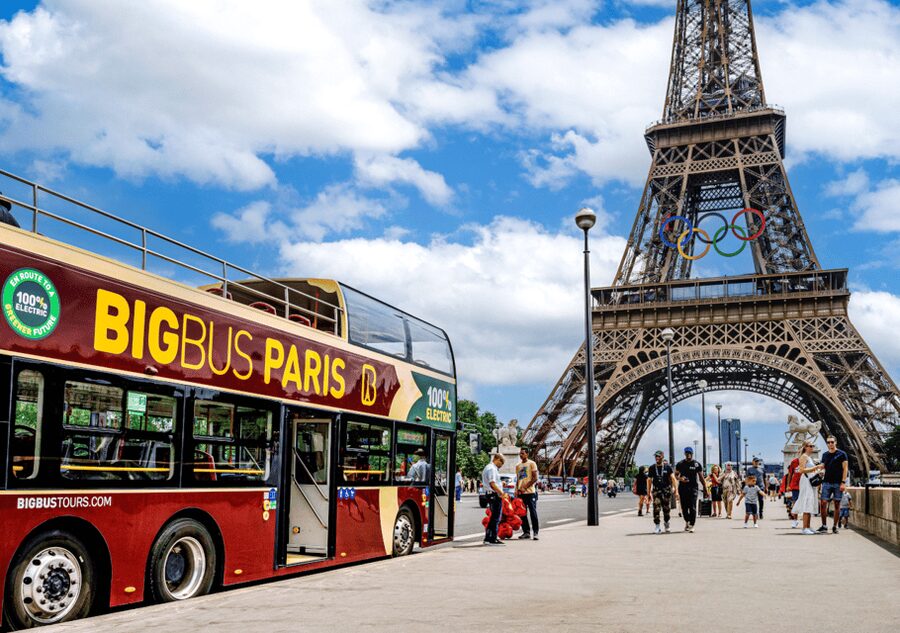
Paris reveals itself wonderfully from the upper deck of a Big Bus. You glide past the Louvre, Notre Dame, the Champs-Élysées, Arc de Triomphe, and Eiffel Tower without wrestling with a map or Metro transfers. The full circuit takes about 2 hours and 15 minutes, giving you a useful first look at the city.
I like the frequent buses, usually every 10 to 20 minutes, and the app that shows stops and buses in real time. I also like the freedom to hop off for a museum, photograph, lunch, or stroll, then continue when you are ready.
The catch is Paris traffic. A short ride can stretch out, and the 24-hour ticket does not mean buses run late into the evening. The open upper deck is also cold in winter, though part of it is covered.
In This Review
- Key points to know before you board
- Seeing Paris without solving the transport puzzle
- The route from the Louvre to Notre Dame
- From the Tuileries to the Arc de Triomphe
- Grand Palais, Petit Palais, and the Eiffel Tower
- Invalides and Opéra Garnier complete the circuit
- How to use the 24-hour and 48-hour tickets
- Is the Seine cruise worth adding?
- Comfort, access, and small practical details
- Who will get the most from this Paris bus tour?
- Should you book the Big Bus Paris tour?
- FAQ
- How long is the complete Big Bus Paris route?
- How often do the buses run?
- Where can I start the tour?
- What major attractions are on the route?
- Is the Seine cruise included?
- Where does the Seine cruise depart?
- How often do the cruises depart?
- What languages are available for the audio guide?
- Is the bus wheelchair accessible?
- Are dogs allowed on the bus?
Key points to know before you board
- The full circuit takes 2 hours and 15 minutes: Use it as a sightseeing ride, not simply as point-to-point transport.
- Buses run every 10 to 20 minutes: The real-time tracking app helps you decide when to return to a stop.
- The route links major sights: You can reach the Louvre, Notre Dame, Musée d’Orsay, Eiffel Tower, Arc de Triomphe, and Opéra Garnier.
- The Seine cruise is optional: It lasts one hour and leaves near the Eiffel Tower, but queues may affect your day.
- A 48-hour pass is easier for serious sightseeing: It gives you more room to hop off without trying to squeeze Paris into one day.
- The upper deck gives the best views: The lower deck is a useful refuge from cold, rain, or strong sun.
Seeing Paris without solving the transport puzzle
At about $43 per person, this is not the cheapest way to move around Paris. The Metro and city buses cost less, and walking remains the best way to experience individual neighborhoods.
But this ticket buys more than transport. It combines a city orientation ride, open-air views, audio commentary, and the ability to stop at many of the sights that first-time visitors already plan to see. For a short stay, that combination can make the price reasonable.
You can choose a 24-hour or 48-hour ticket. I favor the longer option if you want to visit museums or take proper breaks. A one-day pass works best when you mainly want the full circuit plus two or three brief stops.
You do not need to begin at the main office. You can board at any Big Bus stop along the route. The main starting point is at 11 Avenue de l’Opéra, where there is also an information center, but the Louvre, Notre Dame, Musée d’Orsay, Champs-Élysées, Grand Palais, Iéna, Eiffel Tower, and Opéra Garnier stops are often more convenient.
The buses have comfortable seating, Wi-Fi, and multilingual digital commentary. Headphones are supplied, though a few audio jacks may not work perfectly. Bring your own headphones if you have them, but do not count on needing them.
More hop-on hop-off bus tickets:
- Paris: Tootbus Hop-on Hop-off with optional river cruise
★ 4.3 · 11,924 reviews - Paris Big Bus Hop-On Hop-Off Tour with Optional River Cruise
★ 4.0 · 6,534 reviews - Paris: Hop-On Hop-Off Seine Cruise Pass with 9 Stops
★ 4.4 · 5,645 reviews
The route from the Louvre to Notre Dame
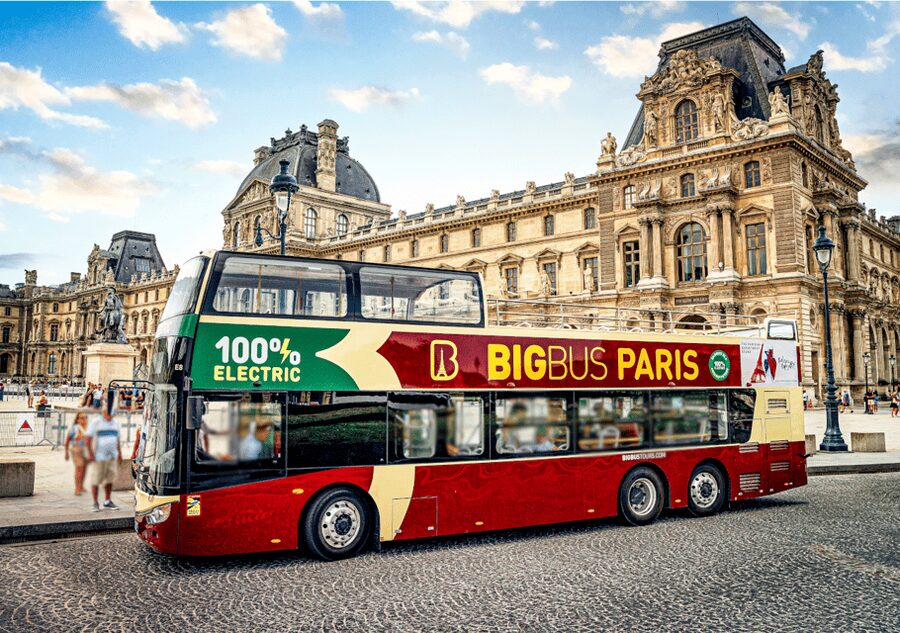
Starting at Louvre-Pyramide gives you an immediate taste of central Paris. The bus passes the Palais-Royal and the Louvre Museum, then moves toward Pont des Arts along the Seine.
The Louvre stop is useful for the museum, but do not expect the bus to deliver you to every entrance. Paris stops can sit a short walk from the attraction itself. That is normal here, and the app and supplied map help you find the exact boarding point again.
Pont des Arts is a fine place to leave the bus for a stroll beside the river. You are close to the Louvre on one side and the Institut de France on the other. The route itself is more useful for orientation than for quick transport, since traffic around the river and central monuments can slow the bus.
The Notre Dame stop puts you near Île de la Cité and the Latin Quarter. From here, you can walk toward the cathedral, the riverbanks, and Rue Lagrange. This is one of the better stops for combining sightseeing with a meal or an unhurried wander.
The bus passes Musée d’Orsay next. Even if you do not enter the museum, the building itself is memorable, a former railway station with a huge clock and a grand riverfront position. If art is on your list, plan plenty of time here. A quick hop off is not enough for a proper visit.
From the Tuileries to the Arc de Triomphe

The route continues past Palais Bourbon and the Tuileries Garden before reaching Place de la Concorde. This stretch gives you some of the most recognizable Paris views from your seat.
The Tuileries is a smart place to pause. You can walk among formal gardens, chairs, fountains, and sculpture, then rejoin the route near a later stop. The bus is especially helpful after a long walk through the gardens, since Paris sightseeing can quietly turn into a full day on your feet.
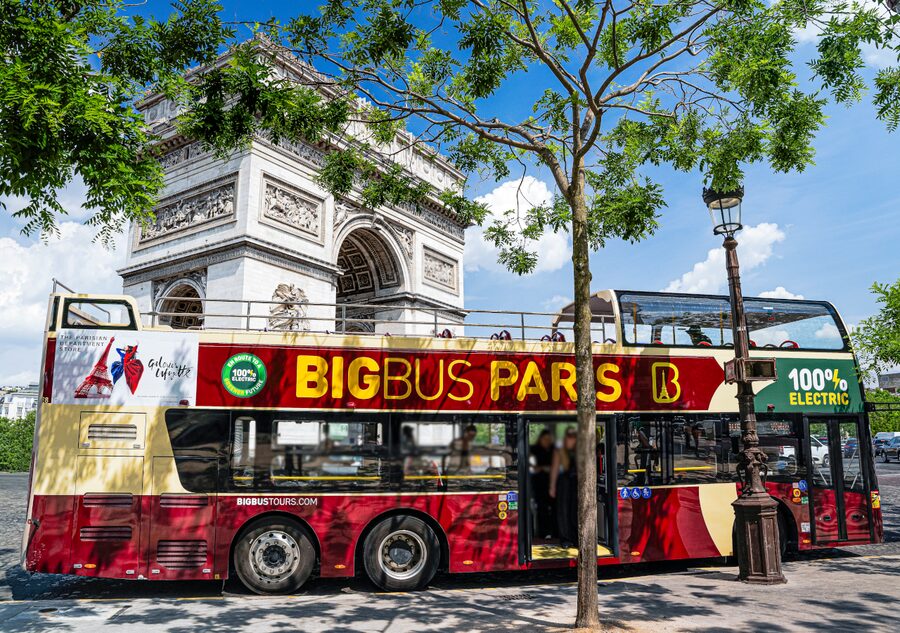
Place de la Concorde connects the Tuileries with the Champs-Élysées. The route then climbs the famous avenue toward the Arc de Triomphe. From the upper deck, this is one of the strongest viewing stretches. You get the broad avenue, grand buildings, and a sense of how Paris was designed around long ceremonial axes.
The Champs-Élysées stop is at 156 Avenue des Champs-Élysées. Use it for shopping, cafés, or a walk toward the Arc de Triomphe. The Arc de Triomphe stop is especially useful if you want to visit the monument, though the busy traffic circle means you should pay attention when crossing and follow the marked pedestrian routes.
One practical point: the bus route does not let you instantly reverse direction. You may need to continue around much of the circuit to reach another stop. That can be frustrating when you are tired or trying to make a timed museum booking. Check the app before hopping off, and allow more time than the map distance suggests.
Grand Palais, Petit Palais, and the Eiffel Tower

After the Champs-Élysées, the bus passes the Grand Palais and Petit Palais on Avenue Winston Churchill. These stops place you near the Seine, the Champs-Élysées gardens, and several impressive exhibition spaces.
The Grand Palais has a vast glass roof that is easy to spot from the bus. The Petit Palais is more intimate in scale and sits across the avenue. Even if you only pause for photographs, this is a rewarding section of the ride because the architecture changes quickly from commercial avenue to monumental public buildings.
The Iéna stop, on Avenue Iéna, serves the area around the Palais de Chaillot and the Trocadéro. I would use this stop for one of the best Eiffel Tower viewpoints. The broad terrace across the river gives you room to frame the tower, and it is often more satisfying for photographs than standing directly beneath it.
The Eiffel Tower stop is at Quai Branly, near Entrance 2. You can leave here for the tower, the Seine, and nearby museums. The Champ de Mars stop on Avenue Joseph Bouvard is another useful choice, especially if you want a longer view across the grassy field toward the tower.
The distinction between the Eiffel Tower and Champ de Mars stops matters. They are close, but not interchangeable if you are meeting someone, carrying luggage, or trying to reach a particular entrance. Check the stop map before you leave the bus.
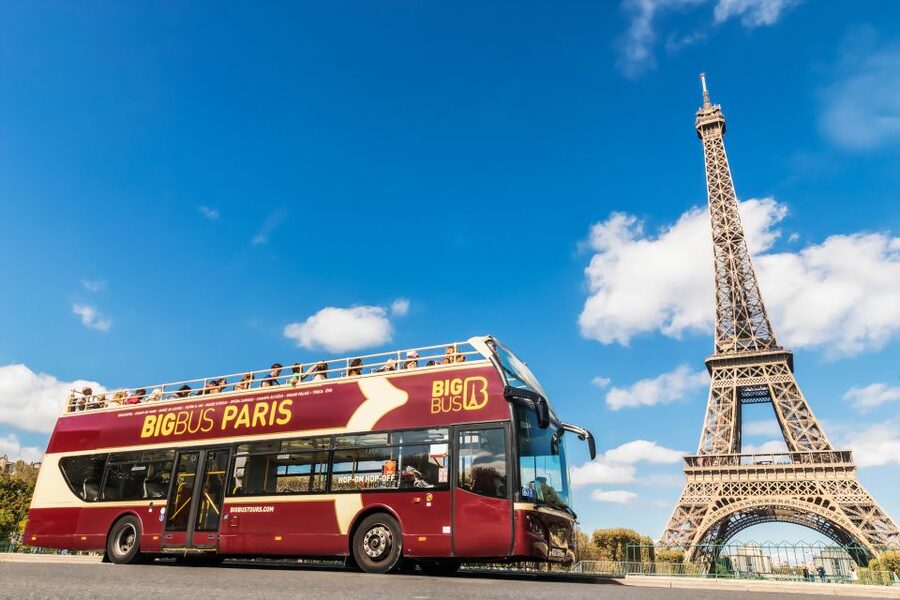
The upper deck is the place to sit for these views. On warm days, it can fill quickly, and a full bus may require you to wait for the next one. The lower level has air conditioning and is far more comfortable during hot weather. In winter, the covered section upstairs and the lower deck can make the difference between enjoying the ride and shivering through it.
A different way to spend the day in Paris:
- Paris: Louvre Museum Timed-Entrance Ticket
★ 4.6 · 71,977 reviews - Disneyland® Paris 1-Day Ticket
★ 4.6 · 49,412 reviews - Paris: Versailles Palace and Gardens Full Access Ticket
★ 4.6 · 41,579 reviews - Paris: Arc de Triomphe Rooftop Tickets
★ 4.6 · 34,264 reviews
Invalides and Opéra Garnier complete the circuit

The route passes École-Militaire and Les Invalides after the Eiffel Tower. Invalides is one of the most useful stops for travelers interested in military history, Napoleon, or grand Parisian architecture.
The golden dome is visible from a distance, and the surrounding esplanade gives you a clear sense of the scale of the complex. You can also use the stop as a break between the Eiffel Tower district and central Paris.
From there, the bus continues past Place Vendôme and Palais Garnier. Place Vendôme is known for its elegant façades and luxury shops, while Opéra Garnier is one of Paris’s great architectural showpieces. The Opéra stop is opposite 15 Rue Scribe, making it handy for the department stores and central shopping streets as well as the opera house.
The circuit returns to 11 Avenue de l’Opéra. Since the full ride lasts roughly 2 hours and 15 minutes, I recommend taking one complete loop before making major plans. You will learn which stops are close to your priorities and which stretches are slowed by traffic.
The route is designed around the major central sights, not every corner of Paris. You will not reach Montmartre, the Canal Saint-Martin, or less central neighborhoods on this circuit. That is not a flaw, but you should pair the bus with walking or public transport if those areas matter to you.
How to use the 24-hour and 48-hour tickets
A 24-hour ticket is enough for a first orientation and a handful of stops. Start early, ride one section, hop off for a major sight, then board again. You can cover a lot in a day, but museum visits need discipline.
A 48-hour ticket costs more, but it changes the pace. You can ride the full circuit on the first day, then use the second day for selected stops. This is particularly useful for the Louvre, Musée d’Orsay, Musée Rodin gardens, and the Eiffel Tower, all of which can take much longer than expected.
The pass is also valuable when your feet need a break. Sit upstairs, plug in the headphones, and let the city move past you. You can still see Paris while resting, instead of spending the afternoon indoors or losing time figuring out a new route.
Do keep an eye on operating hours. The final departure from Stop 1 is listed at 17:30, and buses generally stop running between late afternoon and early evening. A ticket labeled 24 hours does not mean round-the-clock service. If you want an evening activity, plan it separately.
The app is worth downloading before you begin. It shows the route, stop locations, and bus positions in real time. This is especially helpful because some stops are not directly beside the attraction named on the sign.
Is the Seine cruise worth adding?

The optional cruise lasts one hour and is operated by Les Bateaux Parisiens. It leaves from Pontoon No. 3 at Port de la Bourdonnais, close to the Eiffel Tower stop.
From the river, you see Paris from a calmer angle. Bridges, riverside monuments, the Louvre, Musée d’Orsay, Notre Dame, and the Eiffel Tower take on a different shape when you are looking up from the water. Live commentary explains the landmarks along the way.
Cruises depart about every 45 minutes from 10:30 in the morning until 21:00. On weekends, departures are listed every 30 minutes. Those times give you useful flexibility, but the river can still become the slow part of your day if a departure is crowded.
I would add the cruise if you have at least two days or if you want a gentle break from walking. I would be more cautious on a tightly planned one-day visit. One person found the wait too long and skipped it, while another found the cruise easy to locate. The practical lesson is simple: check the next departure before leaving the bus, and do not build your entire day around catching one boat.
For older visitors or anyone with mobility concerns, the cruise also means another transfer and another boarding point. The bus may be easier for covering the sights, while the boat works best as an optional scenic hour rather than essential transport.
Comfort, access, and small practical details
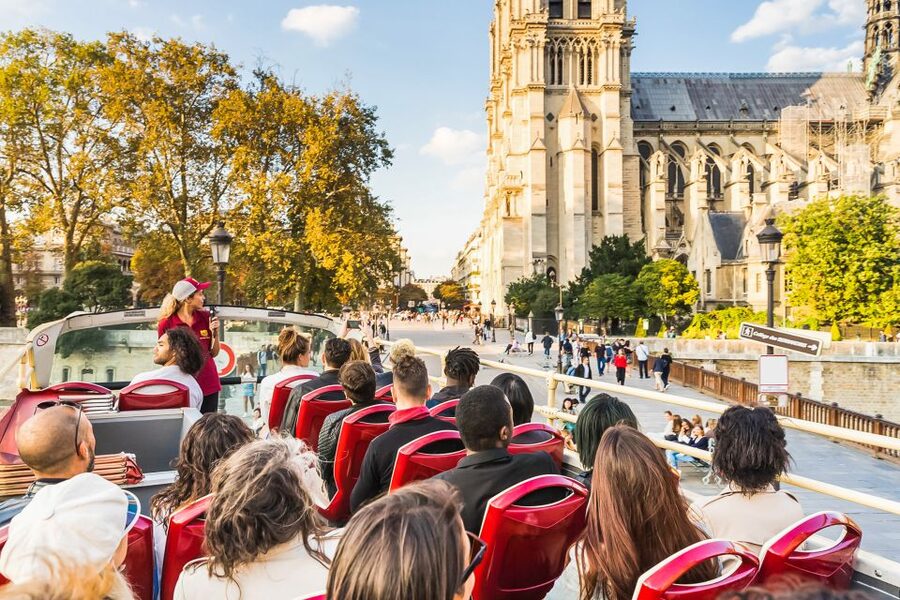
All buses have a ramp for wheelchair access, and the tour is wheelchair accessible. Small dogs are allowed on the lower level only. Those details make the service more useful for families and people who do not want to manage stairs and Metro platforms all day.
The open-top design is the main pleasure, but weather changes the experience. The upper deck has a covered section, yet cold wind can still make a winter ride uncomfortable. Bring an extra layer, even when the forecast looks mild.
In hot weather, the lower level offers air conditioning. That gives you a welcome escape when the upper deck is full or exposed to the sun. Seating can be limited during busy periods, so do not assume you can always claim the front row or the best view.
The recorded commentary is available in Chinese, English, French, German, Italian, Korean, Portuguese, Russian, and Spanish. Drivers speak English, French, German, Italian, Portuguese, and Spanish. The driver is not the main guide, so use the audio system for the detailed explanations.
Traffic is the one problem no bus operator can remove. Paris streets can bring long gaps between stops, especially around the Louvre, Champs-Élysées, and riverfront. The electric buses are quieter and avoid the smell of diesel, which helps when you are sitting on the open deck, but they still share the road with everyone else.
Who will get the most from this Paris bus tour?

I would recommend it most for a first visit, a short break, families, older visitors, and anyone who wants a broad look at Paris before choosing where to spend more time. It is also useful if you dislike underground transport or want a clear route between the major monuments.
It suits you less if your main goal is neighborhood life. The bus shows you the big Paris of monuments and grand avenues, but it cannot replace walking through the Latin Quarter, Montmartre, or the smaller streets around the markets and cafés.
The tour also works well for teenagers. The open deck offers a sense of movement, the route covers familiar landmarks, and hopping off gives everyone a choice without forcing the whole group to follow one museum plan.
For the best use of the ticket, I would ride a complete loop first, then choose two or three stops. Use the bus to rest between long walks, and use the app to avoid standing at a stop when the next bus is still far away.
Should you book the Big Bus Paris tour?
Book it if you want an easy first look at Paris, need to cover major sights quickly, or value flexibility more than the lowest possible transport cost. The frequent buses, clear route, audio commentary, and real-time tracking make the city less demanding to navigate.
Choose the 48-hour ticket if you plan to visit museums or prefer a relaxed pace. Add the Seine cruise if you have spare time and want a one-hour change of scenery, but treat it as an optional extra.
Skip it if you already know Paris well, enjoy walking long distances, or plan to focus on neighborhoods outside the central route. For everyone else, especially on a short first visit, this is a practical way to get oriented and see the city’s headline sights without wearing out your feet.
FAQ
How long is the complete Big Bus Paris route?
The full circuit takes approximately 2 hours and 15 minutes.
How often do the buses run?
Buses depart approximately every 10 to 20 minutes.
Where can I start the tour?
You can begin at any Big Bus stop along the route. The main information center is at 11 Avenue de l’Opéra.
What major attractions are on the route?
The route passes the Louvre, Pont des Arts, Notre Dame, Musée d’Orsay, Tuileries Garden, Place de la Concorde, Champs-Élysées, Arc de Triomphe, Grand Palais, Petit Palais, Palais de Chaillot, Eiffel Tower, Champ de Mars, Les Invalides, Place Vendôme, and Palais Garnier.
Is the Seine cruise included?
The one-hour Seine cruise is included only when you choose the ticket option that includes it.
Where does the Seine cruise depart?
The cruise departs from Pontoon No. 3 at Port de la Bourdonnais, near the Eiffel Tower stop.
How often do the cruises depart?
Cruises depart every 45 minutes from 10:30 to 21:00. On weekends, departures are scheduled every 30 minutes.
What languages are available for the audio guide?
The audio guide is available in Chinese, English, French, German, Italian, Korean, Portuguese, Russian, and Spanish.
Is the bus wheelchair accessible?
Yes. All buses have a ramp for wheelchair access.
Are dogs allowed on the bus?
Small dogs are allowed, but they must remain on the lower level of the bus.
Newest additions around Paris
- Family escape Game with kids and teens on the Île de la Cité★ 4.5 · 11 reviews
- Private Photoshoot with the Iconic Eiffel Tower in Paris★ 5.0 · 11 reviews
- 2-day Private Mont Saint-Michel, 3 Loire Castles, D-Day Express★ 4.5 · 11 reviews
- Paris: Batobus Hop-On Hop-Off Cruise & Landmarks Audio Tour★ 3.0 · 11 reviews
- Paris Revolutionary Walking Tour: Iconic French Sights & Stories★ 5.0 · 11 reviews
- Guided and Private Tour of 3 hours through Paris aboard a Citroën 2cv★ 5.0 · 11 reviews
- Kids in the Kitchen – CrOisSaNtS★ 4.0 · 11 reviews
- Paris: Ghosts and Dark Stories Guided Walking Tour★ 4.1 · 11 reviews
Cruises & Boat Tours, compared.

Louvre Guided Tour with Reserved Access & Boat Cruise
Read our review →
Illuminations River Cruise with Audio Commentary
Read our review →
Tootbus Hop-on Hop-off with optional river cruise
Read our review →
Seine Cruise & Crepe Tasting near the Eiffel Tower
Read our review →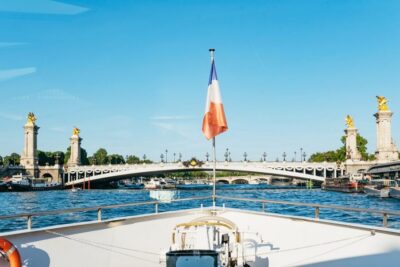

Louvre Museum Entry Ticket With Host and River Cruise
Read our review →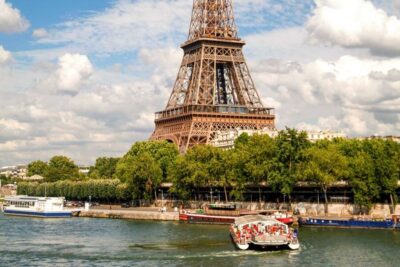
Eiffel Tower Access by Elevator & Seine River Cruise
Read our review →Browse the lists this tour appears in