
Reviewed · OPéRA GARNIER TOURS
Private Art Nouveau and Art Deco tour near Opera
Paris hides some of its finest architecture above eye level. This private walk reveals the floral ironwork, mosaics, stained glass, carved stone, and sweeping domes around Gare Saint-Lazare and Boulevard Haussmann, with guide Solène pointing out details most people pass without seeing.
I like the small-group format, which lets you ask questions and adjust the pace. I also like the stop at Mollard brasserie, where one included drink gives you time to study a wonderfully preserved Art Nouveau interior rather than simply photograph it and move on.
The main limitation is time. Two hours gives you a sharp introduction, not a full lesson in Parisian design, and the tour is much more focused on Art Nouveau than on Art Deco. You’ll also see Palais Garnier from outside only.
In This Review
- Key points to know before booking
- Why this short Paris architecture walk works
- Starting at Gare Saint-Lazare
- Mollard brasserie and the value of a seated stop
- Galeries Lafayette and its famous glass dome
- Printemps, another grand store with a different feel
- The Art Nouveau details most people miss
- Finishing outside Palais Garnier
- What the guide adds
- Who should book this tour
- Should you book the Art Nouveau and Art Deco tour near Opéra?
- FAQ
- Where does the tour begin?
- What time does the tour start?
- Where does the tour end?
- How long is the experience?
- Is the tour private?
- Is a drink included?
- Can I enter Palais Garnier during the tour?
- What language is the tour offered in?
- Can I cancel for a refund?
Key points to know before booking
- Start inside Gare Saint-Lazare: Learn how a major railway station helped shape the architecture and commerce of the surrounding district.
- A drink at Mollard is included: Pause in a traditional brasserie filled with Art Nouveau decoration.
- Look up inside Galeries Lafayette: The famous department store offers a celebrated glass dome, gilded balconies, and less obvious architectural details.
- Printemps adds rooftop views: The route includes another grand department store with a glass dome and upper-level viewpoints.
- This is a private walk: Only your group joins the guide, making questions and conversation easier.
- The tour finishes near Opéra: You end at Palais Garnier on Place de l’Opéra, with the opera house viewed from the exterior.
Why this short Paris architecture walk works
This is not a museum tour with a long row of dates and names. It is a walk through places you may already have planned to visit for shopping, transport, or sightseeing, but with someone helping you read the buildings.
That is the real value. Gare Saint-Lazare is not just a place to catch a train. Galeries Lafayette is not only a department store. Printemps is more than a shopping stop. The guide connects these busy public spaces to the design ideas that shaped modern Paris.
The route covers the 8th and 9th arrondissements, two central districts where grand boulevards, department stores, cafés, railway travel, and public entertainment came together. You get a compact lesson in how Paris changed in the late 19th and early 20th centuries, using the city itself as the classroom.
The private setup matters here. Architectural tours often depend on pointing out small details, and a large group can make that awkward. With only your party, you can stop to ask why a curve, mosaic, balcony, or roof structure matters. If you want to linger over a stained-glass pattern or ask about another Paris building, you have a better chance to do so.
The listed price is $180.23 per person. That is a serious cost for two hours, but it includes a private professional guide and one drink. I see the price making the most sense for a couple, family, or small group that values personal attention and would otherwise struggle to find these upper-level views and interior details alone.
More Opéra Garnier visits:
- Paris: Opera Garnier and Seine River Cruise Tickets
★ 4.5 · 957 reviews - Paris: Palais Garnier Mystery Game with Entry Ticket
★ 4.3 · 400 reviews - Admission ticket Arsène Lupine and the secret of the Opera
★ 4.0 · 242 reviews
Starting at Gare Saint-Lazare
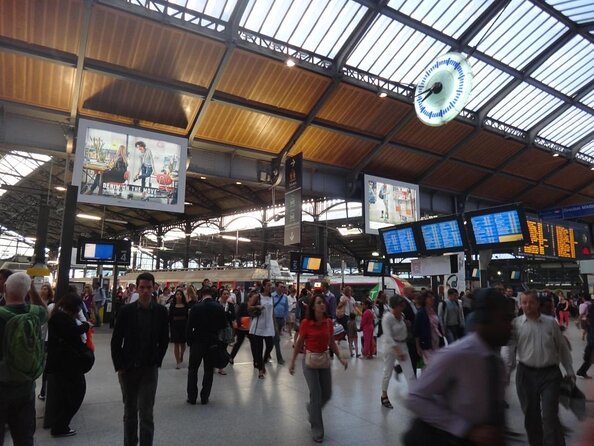
Meet your guide at 3:00 pm outside Gare Saint-Lazare, at 13 Rue d’Amsterdam. The station is easy to reach by public transport, and its location makes a practical starting point for an afternoon in central Paris.
The first half hour is devoted to the station and its role in the area. You will look at the building not simply as a transport hub, but as a force that helped bring movement, commerce, and new architecture to this part of the city.
That context makes the rest of the walk easier to understand. The department stores and grand cafés nearby were not scattered by chance. They belonged to a changing Paris where improved transport brought more people into the center and encouraged large, decorative public buildings.
A station can be a hard place for a guide to control. Trains, announcements, crowds, and changing foot traffic are part of the setting. Still, that noise is also part of the point: you are seeing architecture in the kind of working urban space it was built to serve.
Give yourself enough time to find the meeting point. The tour begins outside the station, not at the opera house, and the end point is several blocks away.
Mollard brasserie and the value of a seated stop
After the station, you stop at an old Art Nouveau brasserie near Gare Saint-Lazare. The brasserie is identified as Mollard, a traditional Parisian address with a striking interior.
One drink is included. The supplied details do not promise a particular beverage, so you should not book this expecting a meal or a full café break. The food and any additional drinks are not included unless specifically stated.
This stop is more important than it may first sound. Art Nouveau is easy to reduce to a list of decorative curves and plant shapes. Inside a brasserie, you can see how the style worked as a complete setting, with decoration surrounding an ordinary Parisian activity.
The stop also gives you a chance to sit and talk. Several visitors found the conversation with Solène especially useful, including practical questions about places to eat and quieter parts of Paris. That kind of local advice can add value beyond the buildings themselves, particularly early in a Paris stay.
Keep in mind that the tour is only about two hours. Thirty minutes at the brasserie leaves time for explanation and observation, but not for a leisurely lunch. If you want a substantial meal, plan it before or after the walk.
Galeries Lafayette and its famous glass dome
From the station area, the route continues toward Boulevard Haussmann and Galeries Lafayette Paris Haussmann. The building is one of the best-known department stores in Paris, but its interior architecture deserves attention even if shopping is not on your list.
The central feature is the great stained-glass dome. From below, it creates a theatrical focal point, framed by balconies and the store’s grand interior. The gilded details and sweeping structure show how retail spaces once competed with theaters and public monuments for visual impact.
The guide’s role here is to direct your eyes. You might otherwise look at the dome, take a photograph, and continue shopping. Instead, you can study how the structure is arranged and learn to notice the less obvious details around it.
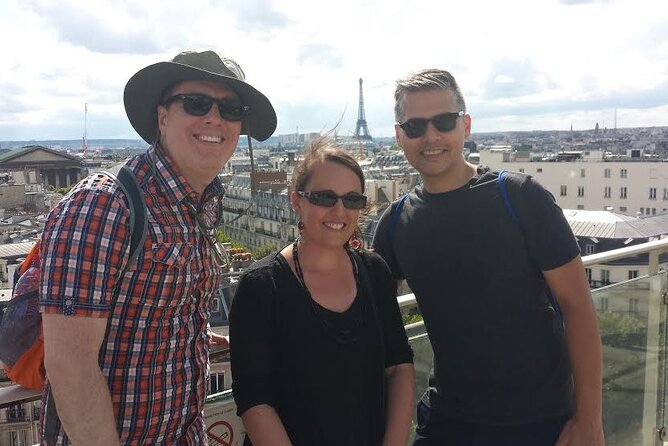
One of the strongest reasons to book this walk is access to viewpoints and upper levels that are easy to miss. The route may take you behind the usual shopping experience to see the dome from different angles, and the upper areas offer city views.
Those views add a welcome change of pace. Rather than looking only at façades from street level, you gain a wider view over Paris and can identify architectural features in the surrounding districts with help from the guide.
Access inside a department store can be affected by opening arrangements or local conditions, and the description does not promise a particular rooftop opening time. Still, the glass dome and interior structure are central parts of the experience.
If shopping is your aim, you can also use the stop to orient yourself. If shopping is not your aim, the architecture gives you a good reason to enter.
A few more Paris ideas to compare
- Paris: Private Photoshoot at the Eiffel Tower
★ 4.7 · 2,636 reviews - Top Private Cruises in Paris with French Champagne and surprises
★ 5.0 · 1,553 reviews - Private Paris Airport Arrival Transfer – CDG & ORLY Airports
★ 4.5 · 1,119 reviews - Paris Private Arrival Transfer from Charles de Gaulle (CDG) or Orly (ORY)
★ 4.0 · 1,084 reviews
Printemps, another grand store with a different feel
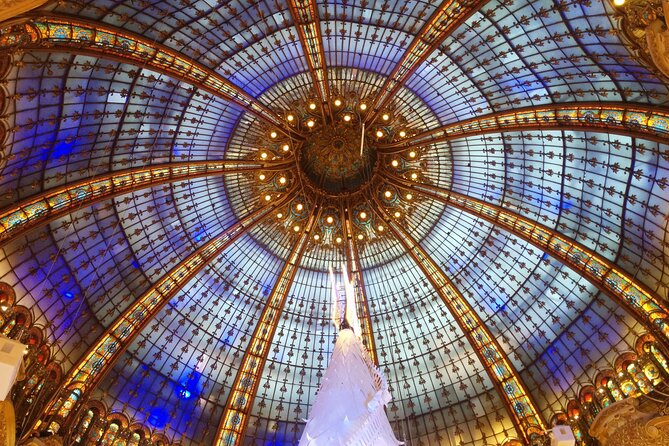
The route then reaches Printemps, another major department store on Boulevard Haussmann. This is not a repeat of Galeries Lafayette. Seeing both buildings helps you compare how large commercial spaces used decorative architecture to attract and impress the public.
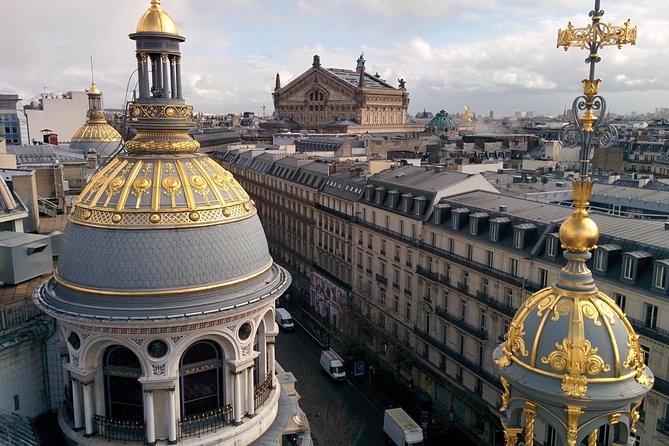
Printemps is presented as an Art Nouveau highlight, with its own glass dome and upper-level viewpoints. You may see details that do not register from the pavement, including roof structures, interior decoration, and the way the building opens toward the city.
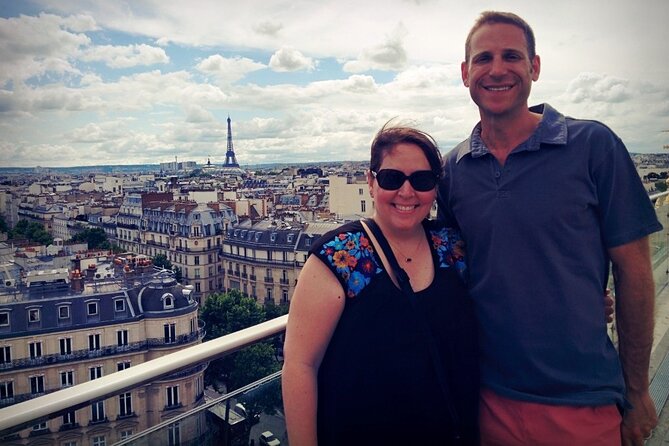
The rooftop areas are one of the walk’s most useful features. Paris has no shortage of famous viewpoints, but these department-store terraces provide a different perspective from the Eiffel Tower or a formal monument. You are looking across the city from buildings that are part of everyday Parisian life.
The guide can also point out architectural landmarks from above. This turns a view into a lesson in orientation. Instead of seeing a general spread of rooftops, you begin to understand how the major buildings fit together.
The route moves through active shopping streets, so expect city traffic and people along the way. This is not a quiet garden walk. Comfortable shoes matter, and you should be ready to walk and stand for much of the two hours, with the brasserie stop providing a break.
The Art Nouveau details most people miss
The tour’s appeal is not just its famous buildings. It is the act of learning where to look.
At street level, the Haussmann area can feel dominated by large façades and shop windows. The guide helps you notice the smaller elements: curved lines, decorative surfaces, patterned tilework, iron details, stained glass, and the relationship between structure and ornament.
The architecture also reflects more than one influence. A good part of the walk involves seeing how railway stations, cafés, stores, banks, and opera houses each adapted fashionable design to their own purpose.
A traditional brasserie uses decoration to create atmosphere. A department store uses a dome and balconies to shape a sense of spectacle. A station has to manage huge flows of people. Palais Garnier turns performance and ceremony into architecture. The contrast between these buildings gives the walk its substance.
One especially unusual feature is a historic bank that remains in use. Its inclusion shows that Art Nouveau is not confined to museums or preserved monuments. Some of the most striking interiors still function as working places, even if you must follow the guide’s instructions about where you can look and stand.
You should not expect a complete academic account of Art Nouveau in Paris. The tour keeps moving, and its strength is local focus. If you want a broad survey of the movement across the whole city, you would need more time and likely a separate museum or architecture tour.
Finishing outside Palais Garnier
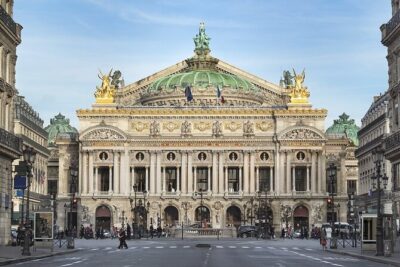
The official end point is Palais Garnier, at Place de l’Opéra. The opera house is viewed from outside, and admission is not included.
That distinction matters. Palais Garnier is one of Paris’s most ornate landmarks, and you may be tempted to assume the tour includes an interior visit. It does not. The guide focuses on the exterior structure and stonework, using the opera house as a fitting finish to the route.
Built in the late 19th century, Palais Garnier represents the grand public face of Paris during the same broad period that produced the station, brasseries, and department stores. Its scale and decoration make a strong final comparison with the more intimate details seen earlier.
Ending here is also practical. You are near the Opéra neighborhood, with easy access to public transport and many later afternoon or evening options. The tour does not include hotel pickup or drop-off, so you make your own way to the starting point and continue independently after the finish.
The route is marketed with both Art Nouveau and Art Deco in mind, but the supplied program is mainly an Art Nouveau walk. If your main goal is 1920s geometric design, confirm the emphasis before booking. If you want floral decoration, glass domes, mosaics, and the grand architecture of the Haussmann district, the focus should suit you well.
What the guide adds
Solène is the guide most clearly associated with this experience. She is described as multilingual, a Paris resident, and the founder of A Journey in Paris. Her strength is not only identifying buildings, but showing how to see them.
That distinction matters on a short walk. A guide can fill two hours with facts, or help you build a habit of looking upward and checking the corners of a room. The strongest part of this experience is the second approach.
The private format lets Solène adapt the conversation to your interests. You can ask about architecture, local food, other areas of Paris, or places away from the busiest routes. The walk remains focused, but it does not have to feel rigid.
The guide’s personal style will always affect the experience. The available feedback is overwhelmingly positive, with a 4.9 rating from 15 reviews and 100 percent recommendation. One person wanted more general background on the Art Nouveau movement, which is a fair warning for anyone seeking a detailed art-history lecture.
I would book this for the guide’s eye and the access to overlooked details, not for a long chronological survey. You are paying for interpretation, conversation, and a route that is difficult to reproduce from a map alone.
Who should book this tour
This walk suits you if you enjoy architecture but do not want to spend half a day in a museum. It also works well for first-time visitors who want to understand the Opéra and Haussmann area before exploring it on their own.
It is a good match for:
- Couples or small families who value a private guide
- Shoppers who want to see the architecture of Galeries Lafayette and Printemps
- Visitors interested in Art Nouveau, stained glass, mosaics, and decorative interiors
- People who want rooftop views without making a famous tower the entire focus
- Anyone who likes local conversation along with historical explanation
You should think twice if you want to enter Palais Garnier, eat a full meal, or cover many neighborhoods in one outing. You should also allow for a moderate level of walking and standing.
The 3:00 pm start is useful for fitting the tour into a full Paris day, but it means you should consider the timing of the department-store and rooftop portions. The experience is booked an average of 40 days ahead, so planning early is sensible if your dates are fixed.
Free cancellation is available until 24 hours before the start time. Changes or cancellations inside that window are not refunded, and the activity requires a minimum number of participants. Confirmation is provided when you book.
Should you book the Art Nouveau and Art Deco tour near Opéra?
Book it if you want Paris to become more readable. The station, brasserie, department stores, bank, rooftops, and opera house form a compact route with plenty to notice, and a private guide makes the details easier to catch.
The strongest reasons are Solène’s personal guidance, the included brasserie drink, and access to the upper levels and city views at Galeries Lafayette and Printemps. Those features turn familiar Paris landmarks into something more personal.
Skip it if your priority is a full Art Deco study, an interior tour of Palais Garnier, or a low-cost group outing. At $180.23 per person, this is a premium two-hour experience, but it can be good value for a small group that wants focused attention and architectural details it would likely miss alone.
FAQ
Where does the tour begin?
The tour begins outside Gare Saint-Lazare at 13 Rue d’Amsterdam, 75008 Paris, France.
What time does the tour start?
The start time is 3:00 pm.
Where does the tour end?
The tour ends at Palais Garnier, also called Opéra Garnier, on Place de l’Opéra in the 9th arrondissement.
How long is the experience?
The walking tour lasts approximately two hours.
Is the tour private?
Yes. Only your group participates in the activity.
Is a drink included?
Yes. One drink at a traditional brasserie is included. Other food and drinks are not included unless specifically stated.
Can I enter Palais Garnier during the tour?
No. Palais Garnier is viewed from the exterior only, and entry is not included.
What language is the tour offered in?
The tour is offered in English.
Can I cancel for a refund?
Yes. You can cancel up to 24 hours before the experience start time for a full refund. Cancellations or changes made less than 24 hours before the start time are not refunded.
Newest additions around Paris
- Private Photoshoot with the Iconic Eiffel Tower in Paris★ 5.0 · 11 reviews
- Family escape Game with kids and teens on the Île de la Cité★ 4.5 · 11 reviews
- 2-day Private Mont Saint-Michel, 3 Loire Castles, D-Day Express★ 4.5 · 11 reviews
- Paris: Batobus Hop-On Hop-Off Cruise & Landmarks Audio Tour★ 3.0 · 11 reviews
- Paris Revolutionary Walking Tour: Iconic French Sights & Stories★ 5.0 · 11 reviews
- Guided and Private Tour of 3 hours through Paris aboard a Citroën 2cv★ 5.0 · 11 reviews
- Kids in the Kitchen – CrOisSaNtS★ 4.0 · 11 reviews
- Paris: Ghosts and Dark Stories Guided Walking Tour★ 4.1 · 11 reviews
Opéra Garnier Tours, compared.
Admission ticket Arsène Lupine and the secret of the Opera
Read our review →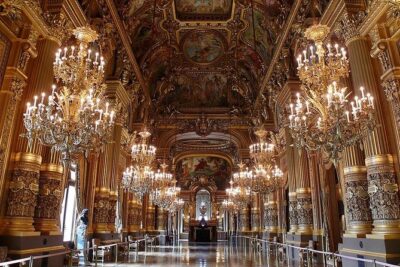
Opera Garnier Mysteries Private Guided Tour with Skip-the-Line Entrance
Read our review →
Area ,Opera, Jewellery,Fashion,Palais Royal walking tour
Read our review →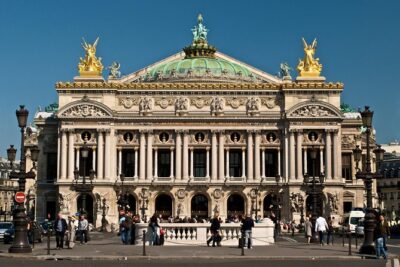
Private Opera Garnier Theater 2-Hour Tour in Paris
Read our review →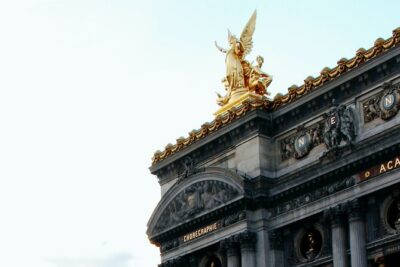
Browse the lists this tour appears in