
Reviewed · LATIN QUARTER & SAINT-GERMAIN TOURS
Paris – Latin Quarter Free Tour in English (Tip-Based)
The most appealing thing about this Latin Quarter walking tour is the range packed into about two hours. You move from medieval lanes to Roman ruins, Gothic churches, famous writers, grand universities, and the Pantheon without paying admission at each stop. It is a quick lesson in how many layers Paris can fit into a few blocks.
I like the tip-based price, which keeps the upfront cost remarkably low, and I like the route’s ending at Place de la Contrescarpe, where you can sit down for food or a drink. The possible drawback is the group size, which can reach 50 people. That is a lot for narrow streets and small church interiors, so your position near the guide may matter.
In This Review
- Key points at a glance
- Why the Latin Quarter makes a fine first Paris walk
- Starting at Fontaine Saint-Michel
- Rue de la Huchette and the narrow streets of Old Paris
- Shakespeare and Company, then Notre-Dame
- Saint-Julien-le-Pauvre and the Salvador Dalí sundial
- Saint-Severin’s Gothic interior
- Roman baths at the Thermes de Lutèce
- Musée de Cluny and the academic heart of Paris
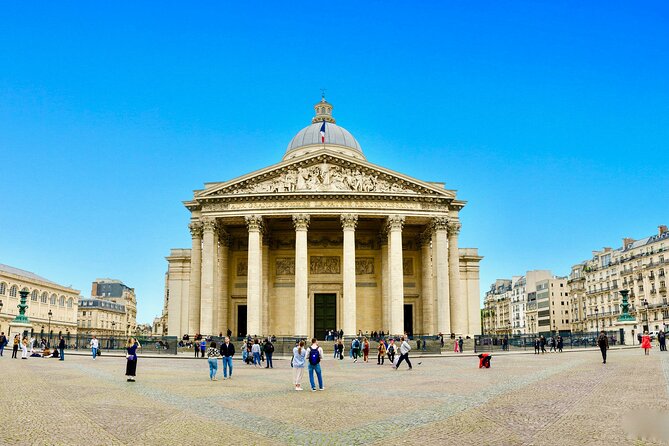
- The Pantheon, the tour’s main event
- Saint-Étienne-du-Mont and Saint Genevieve
- Hemingway’s first Paris home office
- Finishing at Place de la Contrescarpe
- What the tip-based price really means
- Group size, timing, and practical advice
- Who should book this walk
- Should you book the Latin Quarter Free Tour?
- FAQ
- Where does the Latin Quarter tour begin?
- Where does the tour end?
- What time does the tour start?
- How long does the tour last?
- Is the tour conducted in English?
- What is included?
- Are attraction admission tickets included?
- How large can the group be?
- How are tips paid?
- Can I cancel for a refund?
Key points at a glance
- Roman Paris in the Latin Quarter: See the remains of the Thermes de Lutèce, built after Rome established a city here in 52 B.C.
- A strong mix of famous and quiet sights: The route includes Notre-Dame, Shakespeare and Company, Saint-Julien-le-Pauvre, and less celebrated corners of the district.
- A history-heavy finish: The Pantheon and Saint-Étienne-du-Mont bring together French public life, religion, politics, and science.
- English guides with personality: Bruce and Sanna are named guides associated with the experience, and Sanna is praised for her clear, friendly storytelling.
- Useful final stop: The walk ends at Place de la Contrescarpe, surrounded by restaurants, bars, and cafés.
- Bring a payment card for the tip: Contributions are accepted only by card or electronic payment, and VAT is added.
Why the Latin Quarter makes a fine first Paris walk
The Latin Quarter is a smart place to begin learning Paris. It is compact, central, and full of contrasts. You can look at the modern city around Fontaine Saint-Michel, turn into a narrow medieval street, pass a famous English-language bookshop, and then find yourself beside a church built centuries ago.
I like that this route is not just a parade of postcard views. The guide connects buildings to larger changes in Paris. At the fountain, you hear how the city shifted from a medieval town to a modern European capital during the Grand Reconstruction of Paris. That gives the rest of the walk a useful frame.
This is also a good choice if you want orientation without committing half a day. The walk lasts about two hours and begins at 11 a.m. The tour information also describes morning or afternoon options, so check the exact time shown when you book. The route is offered in English and includes a certified expert guide.
More Latin Quarter and Saint-Germain walks:
- Paris Bike Tour Hidden Secrets in the Latin Quarter & Le Marais neighborhoods
★ 5.0 · 766 reviews - Paris: Latin Quarter Guided Pub Crawl to Bars and Clubs
★ 4.3 · 532 reviews - Paris: Old Town & Latin Quarter Guided Walking Tour
★ 5.0 · 404 reviews
Starting at Fontaine Saint-Michel
Meet at Fontaine Saint-Michel on Place Saint-Michel, in the 5th arrondissement. The fountain was built during the major rebuilding of Paris, and its scale makes it easy to spot. It is more than a meeting point: the guide uses it to explain the city’s dramatic change from medieval Paris to the broad, planned capital you see today.
Allow about 10 minutes here. That may sound brief, but it is enough for a clear opening lesson before you head into the older lanes. I find this kind of introduction useful because it helps you notice the difference between wide modern streets and the cramped passages that survive in the Latin Quarter.
Since the maximum group size is 50, arrive early enough to locate the guide and hear the opening talk. A large group can spread out quickly around a fountain or busy square.
Rue de la Huchette and the narrow streets of Old Paris
Rue de la Huchette is one of the district’s oldest streets. The stop is short, around five minutes, but it gives you a direct look at the tight scale of old Paris. The guide tells stories about the city before its grand avenues and major rebuilding projects reshaped daily life.
This is not a stop where you will spend a long time examining one monument. Its value comes from the street itself and from the way the guide explains how people once moved through Paris. Keep your eyes up and pay attention to the width of the lane. In a group, you may need to step aside to let others pass.
Shakespeare and Company, then Notre-Dame
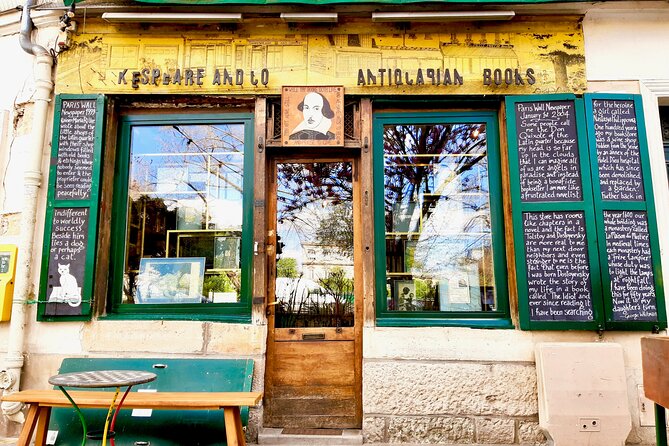
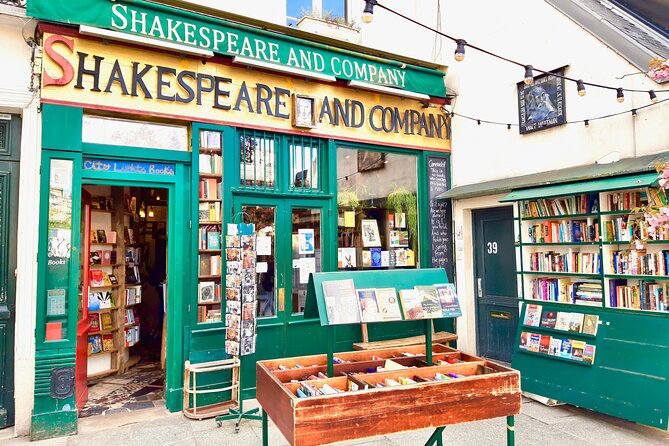
Shakespeare and Company is a famous bookstore with links to the writers of the 1920s and the Lost Generation. Hemingway, James Joyce, and F. Scott Fitzgerald are part of the story here. The tour allows about 10 minutes, enough for an outside introduction and a little context about the English-speaking writers who made Paris part of their creative lives.
I like this stop because it gives the route a literary turn without sending you into a museum. If you want to browse the shop, plan to return after the walk. Two hours is not enough for a proper look at the bookshelves and the many stories associated with the place.
The next stop offers views of Notre-Dame Cathedral. The visit is listed at about five minutes, so think of this as a viewpoint and history talk rather than a full cathedral visit. The cathedral is one of Paris’s defining sights, but this tour keeps moving instead of spending a long stretch inside.
The walk also includes Paris’s oldest tree, said here to date from 1601. Touching its leaves and making a wish is presented as a local tradition. It is a small, playful pause between major monuments, and a reminder that the Latin Quarter’s interest often lies in ordinary details as much as in grand buildings.
A different way to spend the day in Paris:
- Paris: Louvre Museum Timed-Entrance Ticket
★ 4.6 · 71,977 reviews - Disneyland® Paris 1-Day Ticket
★ 4.6 · 49,412 reviews - Paris: Versailles Palace and Gardens Full Access Ticket
★ 4.6 · 41,579 reviews - Paris: Arc de Triomphe Rooftop Tickets
★ 4.6 · 34,264 reviews
Saint-Julien-le-Pauvre and the Salvador Dalí sundial
Saint-Julien-le-Pauvre is one of Paris’s oldest buildings. The modest church once shared the area’s educational importance with Notre-Dame, when the Latin Quarter was becoming a center for learning.
I appreciate the contrast between this church and the enormous buildings later in the route. You get a sense of how Paris’s religious and educational life developed through small institutions as well as major monuments. The stop lasts about 10 minutes.
Next comes a Salvador Dalí sundial. Dalí had a strong connection with the Latin Quarter, and the sundial represents the Camino de Santiago de Compostela. It is an unusual sight, and one that you could easily miss if you were walking alone with your attention fixed on the larger monuments.
The guide’s role matters here. A sundial tied to Dalí and the pilgrimage route needs explanation, since the object itself may not tell the whole story at a glance. Expect another 10-minute stop.
Saint-Severin’s Gothic interior
The 13th-century Church of Saint-Severin is one of the route’s most rewarding interiors. Its vaulted ceilings and palm-shaped columns give it a distinct Gothic character. If the pipe organ is being played, your visit may gain an extra musical moment, though that depends on timing.
The stop is listed at about 10 minutes. That is enough to look carefully without turning the walk into a full church tour. I would keep your voice low and follow the guide’s instructions, since this remains a place of worship rather than a simple sightseeing hall.
Saint-Severin also helps balance the route. You have already seen major public landmarks and literary sites. Here, the emphasis shifts to architecture, religious practice, and the visual drama of a medieval church.
Roman baths at the Thermes de Lutèce
The Thermes de Lutèce bring you back to Roman Paris. Rome invaded the area in 52 B.C. and established a city here, including large public baths. What remains today is part of that much bigger complex.
I consider this one of the most important stops for understanding the Latin Quarter. Paris is often presented through medieval streets and grand 19th-century avenues, but its story reaches much further back. The Roman baths make that early chapter visible.
The visit is scheduled for about 10 minutes. Do not expect a complete archaeological site visit with a long museum presentation. Instead, you get a compact look at surviving Roman remains and an explanation of what public life once looked like in ancient Paris.
Musée de Cluny and the academic heart of Paris
The Musée de Cluny is now Paris’s Medieval Museum. Its ornate building dates to the 15th century and holds stories from older Paris. The tour allows around five minutes, so the focus is the exterior and the setting rather than an extended museum visit.
If medieval art interests you, note the museum for another day. This walking tour cannot replace time inside its collections. Still, seeing the building in context helps you understand why this part of Paris remained tied to scholarship and old institutions.
The route then reaches La Sorbonne. The university tradition here dates to the 11th century, while the university itself is associated with 1257. It is described as the third-oldest university in the world, and the guide uses it to explain why the Latin Quarter became the center of education and culture in Paris.
This is a good place to listen closely. The building is not just an attractive landmark. It represents the district’s long connection with students, teachers, books, debate, and intellectual life. The stop lasts about 10 minutes.
The Pantheon, the tour’s main event
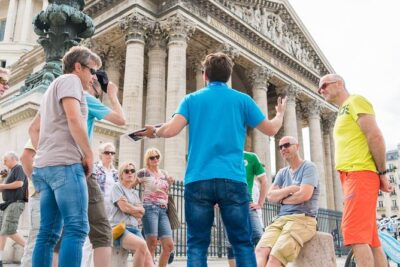
The Pantheon is the route’s grandest stop and receives about 15 minutes. Its name means All the Gods, and its story moves from religious monument to national mausoleum.
Inside are the tombs of major French figures, including Victor Hugo and Marie Curie. That combination gives the building unusual weight. You are not only looking at a large, opulent structure. You are also entering a place that honors writers, scientists, and other central figures in French public life.
The tour does not include admission tickets, so treat this as an exterior visit unless your guide explains otherwise. If you want to go inside the Pantheon, you would need to arrange that separately. The short stop is useful for orientation and history, but it will not give you time to explore the interior at length.
For many people, this is the moment when the tour’s separate themes come together: faith, national identity, science, literature, and the long story of Paris itself.
Saint-Étienne-du-Mont and Saint Genevieve
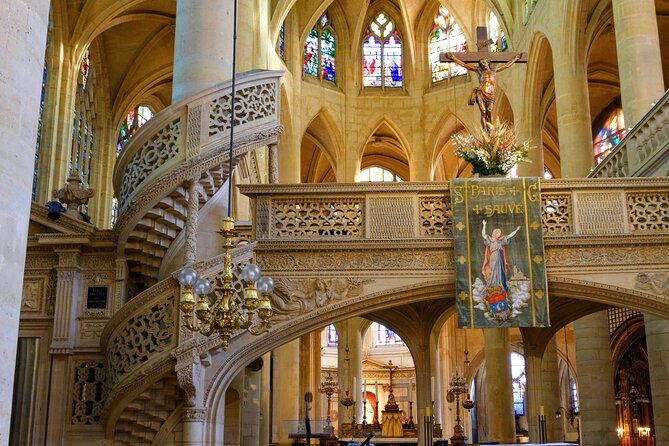
Saint-Étienne-du-Mont is a majestic 15th-century church near the Pantheon. Inside, you can see the tomb and knuckle of Saint Genevieve, the patron saint of Paris. The guide explains her role during the decline of the Roman Empire and the takeover of Paris.
The church is scheduled for about 10 minutes. As with Saint-Severin, remember that a short group visit is a taste, not a complete architectural study. You may have enough time to see the major features and hear the story, but not to linger over every detail.
This stop adds a human figure to the city’s early history. Instead of hearing only about emperors, buildings, and institutions, you learn about a patron saint whose story is tied to Paris at a moment of political and religious change.
Hemingway’s first Paris home office
The route ends its historical sightseeing with Ernest Hemingway’s first home office in Paris. Hemingway loved the Latin Quarter, and the neighborhood helped shape his writing and his memories of the city.
I like placing this stop late in the walk. By then, you have seen the district’s churches, universities, ancient remains, and old streets. Hemingway’s connection shows how the Latin Quarter continued to attract writers long after its medieval and Roman chapters had passed.
The stop lasts about 10 minutes. It is another location best understood through storytelling rather than a formal museum visit. You should not expect access to a private interior unless the guide specifically says otherwise.
Finishing at Place de la Contrescarpe
The final stop is Place de la Contrescarpe, a lively square in the heart of the Latin Quarter. The tour ends here among restaurants, bars, and cafés, which is a practical choice. You can continue the afternoon with a meal or drink without having to cross the city.
I would save this area for lunch or an early afternoon break. Since the route begins at 11 a.m. and lasts about two hours, the ending lines up well with a meal. The square also gives you an easy chance to discuss the tour, look at the map, and decide what to visit next.
The end point is different from the starting point, but both are in the Latin Quarter and near public transportation. That makes the route convenient for continuing elsewhere in central Paris.
What the tip-based price really means
The listed upfront price is $3.62 per group of up to nine people, which is strikingly low for a two-hour guided walk. The real cost is the tip you choose to give at the end. This system can offer good value if you want expert orientation without paying a fixed tour fee.
There are two details you should not overlook. Tips are accepted only by credit card, debit card, or electronic payment, and VAT is added to contributions. Bring a usable payment method and treat the advertised price as a starting charge, not the full expected cost of the experience.
The arrangement also rewards you for deciding what the tour was worth after seeing the route and hearing the guide. Guides named for this experience include Bruce and Sanna. Sanna is described as attentive, pleasant, friendly, and strong at explaining Parisian history and culture. Bruce is praised for making historical stories feel lively.
The 99 percent recommendation rate and 5 out of 5 rating from 269 reviews point to a consistently strong experience, especially in guiding and organization. Still, tip-based tours depend heavily on the individual guide and on how comfortable you are with paying afterward.
Group size, timing, and practical advice
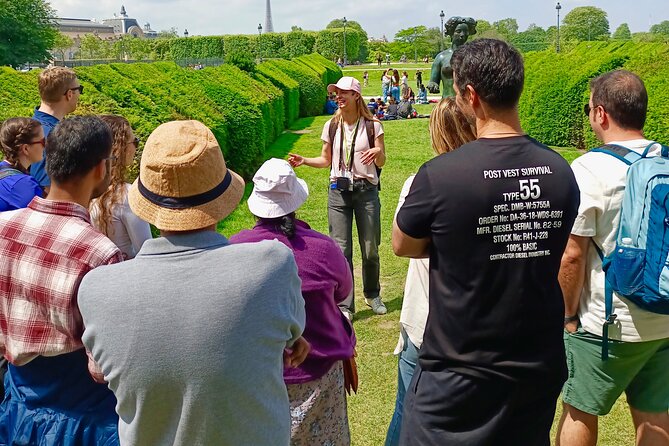
The maximum group size is 50. That is manageable in open squares, but less comfortable in narrow streets such as Rue de la Huchette and inside churches. If you want to hear every explanation, stay close to the guide and avoid drifting toward the back.
The tour is listed at about two hours, though the individual stop times add up to more than that. Treat the overall duration as approximate and avoid scheduling a tight connection immediately afterward. The route has many stops, and the guide may need time to gather the group between them.
Wear shoes suited to walking and old urban streets. The tour is a walking experience from Fontaine Saint-Michel to Place de la Contrescarpe, with no included admissions. Most people can participate, and service animals are allowed.
Confirmation arrives at booking. Free cancellation is available if you cancel at least 24 hours before the start time. Changes or cancellations inside that window are not accepted for a refund.
Who should book this walk
I would choose this tour if you want a broad introduction to the Latin Quarter, especially on your first days in Paris. It suits you if you enjoy history, churches, writers, universities, and city stories more than long museum visits.
It is also a good match for anyone watching the budget. The low upfront charge leaves you in control of the contribution, though you need to remember the card-only tipping rule.
I would be more cautious if you dislike large groups, need a slow pace, or want extended time inside the Pantheon, Musée de Cluny, or Notre-Dame. This route gives you a well-connected overview, not deep visits to each landmark.
Should you book the Latin Quarter Free Tour?
Yes, if your goal is to understand the Latin Quarter quickly and affordably. The route has real variety: Roman baths, medieval churches, Gothic architecture, university life, famous writers, Notre-Dame views, and the Pantheon. The final stop at Place de la Contrescarpe is a useful bonus.
Book it with realistic expectations. You are paying for a guided introduction, not admission to the major monuments, and a group of up to 50 can make some stops feel crowded. Bring a card for the tip, allow a little flexibility around the two-hour estimate, and stay near the guide. For a first look at one of Paris’s most layered districts, this is a strong-value choice.
FAQ
Where does the Latin Quarter tour begin?
It begins at Fontaine Saint-Michel on Place Saint-Michel, 75005 Paris, France.
Where does the tour end?
It ends at Place de la Contrescarpe in the Latin Quarter.
What time does the tour start?
The listed start time is 11:00 a.m. The experience also describes morning or afternoon start options, so check your selected booking time.
How long does the tour last?
The tour lasts approximately two hours.
Is the tour conducted in English?
Yes. English is the offered language.
What is included?
A certified expert guide and a historic, entertaining walking tour are included.
Are attraction admission tickets included?
No admission tickets are included. The listed stops are provided with free admission as part of the walking route, but separate entry to sites such as the Pantheon or Musée de Cluny is not included.
How large can the group be?
The maximum group size is 50 people.
How are tips paid?
Tips are accepted only by credit card, debit card, or electronic payment. VAT is added to contributions.
Can I cancel for a refund?
Yes. You can cancel at least 24 hours before the experience start time for a full refund. Cancellations or changes made less than 24 hours in advance are not accepted.
Newest additions around Paris
- Family escape Game with kids and teens on the Île de la Cité★ 4.5 · 11 reviews
- Private Photoshoot with the Iconic Eiffel Tower in Paris★ 5.0 · 11 reviews
- 2-day Private Mont Saint-Michel, 3 Loire Castles, D-Day Express★ 4.5 · 11 reviews
- Paris: Batobus Hop-On Hop-Off Cruise & Landmarks Audio Tour★ 3.0 · 11 reviews
- Paris Revolutionary Walking Tour: Iconic French Sights & Stories★ 5.0 · 11 reviews
- Guided and Private Tour of 3 hours through Paris aboard a Citroën 2cv★ 5.0 · 11 reviews
- Kids in the Kitchen – CrOisSaNtS★ 4.0 · 11 reviews
- Segway tour Capital sites★ 5.0 · 11 reviews
Latin Quarter & Saint-Germain Tours, compared.
Paris Bike Tour Hidden Secrets in the Latin Quarter & Le Marais neighborhoods
Read our review →
Latin Quarter Guided Pub Crawl to Bars and Clubs
Read our review →
Latin Quarter Paris Guided Walking Tour Semi-Private 12ppl Max
Read our review →
Paris Latin Quarter Food Tour – Full French Meal by Do Eat Better
Read our review →
Saint-Germain The Original Chocolate Tasting Tour with Pastries and Macaron
Read our review →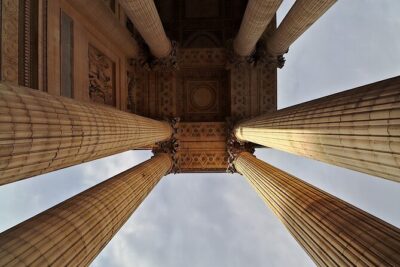
Paris Latin Quarter Walking Tour plus Seine River Cruise Option
Read our review →Browse the lists this tour appears in