
Reviewed · LOUVRE MUSEUM TOURS
Louvre Half-Day Private Tour
The most useful thing about this Louvre tour is its private format. You get a guide for your party alone, with fast-track admission and a route that moves from the palace’s medieval foundations to Greek and Roman sculpture, royal jewels, Italian masters, and French painting. That is a lot of Louvre in two and a half hours.
I like the choice of tour times, which makes this easier to fit around a Paris schedule. I also like the chance to shape the visit around your interests, since the Louvre is too large to cover properly in one short outing. The main caution is timing: the advertised length is about 2 hours 30 minutes, but one booking lasted only two hours.
In This Review
- Key points to know
- Why a private Louvre visit can make sense
- Starting at the Louvre Pyramid and Sully section
- Ancient Greece, Etruria, and Rome
- The Apollo Gallery and the French crown jewels
- The Square Lounge and the Great Gallery
- French Neoclassical and Romantic painting
- What the guides add to the visit
- Price, time, and overall value
- Who should book this Louvre tour
- Should you book it?
- FAQ
- How long does the Louvre private tour last?
- Is admission to the Louvre included?
- Is this a private tour?
- What language is the tour offered in?
- Where does the tour begin?
- Where does the tour end?
- Is transportation included?
- Who can receive free museum admission?
Key points to know
- Private attention: Your party has its own English-speaking guide, rather than joining a large group.
- Fast-track entry: Admission is included, helping you spend more of your limited time inside the museum.
- A smart historical route: The visit begins in the medieval Sully section, then follows the Louvre’s growth into a royal palace and public museum.
- Major masterpieces included: Expect the Venus de Milo, Winged Victory, Mona Lisa, Liberty Leading the People, and other famous works.
- Strong guide feedback: Nabila is praised for warm, clear explanations, while Pierre-Yves is noted for discussing artists, periods, and techniques.
- Watch the clock: The tour is sold as 2 hours 30 minutes, but the actual length may be closer to two hours.
Why a private Louvre visit can make sense
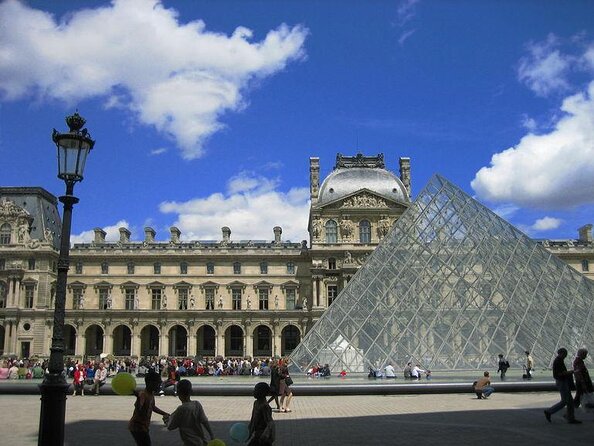
The Louvre is not a museum you casually conquer. It is a former palace with huge galleries, several departments, and enough famous art to fill many days. A private tour gives you a person who can decide what matters most and keep the visit moving.
That matters even more when you have only half a day in Paris. Instead of wandering from one famous object to another, you follow a planned thread: first the building, then ancient sculpture, royal display, Italian painting, and French art. You still see the big names, but you also get the story connecting them.
I especially like the private setup for couples, families, and small groups with different levels of interest. You can ask for more detail about painting, sculpture, palace life, or the museum’s development. The guide can also adjust the emphasis to suit your party, within the limits of the short visit.
This is not the right choice if you want a slow, highly detailed study of one department. It is a highlights tour, and the Louvre’s scale means some rooms will pass quickly. The value comes from focus and explanation, not from seeing everything.
More ways into the Louvre:
- Paris: Louvre Museum Timed-Entrance Ticket
★ 4.6 · 71,977 reviews - Paris: Louvre Guided Tour with Reserved Access & Boat Cruise
★ 4.3 · 16,353 reviews - Louvre Museum Masterpieces Guided Tour with Access
★ 4.5 · 12,023 reviews
Starting at the Louvre Pyramid and Sully section
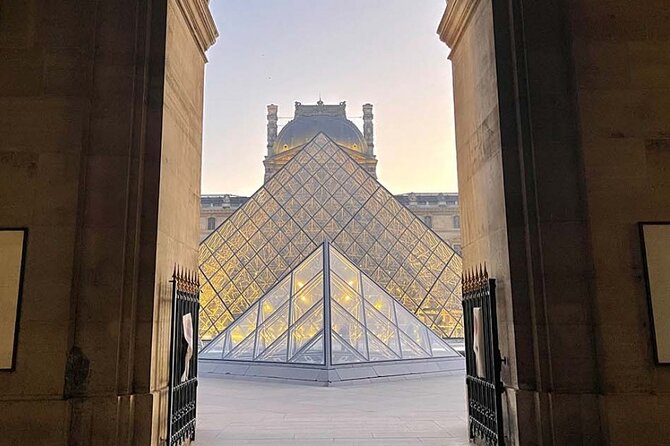
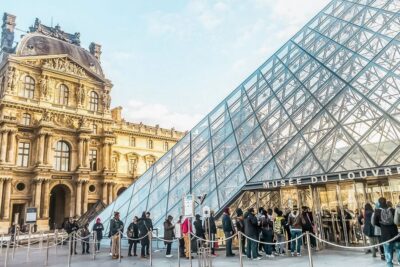
The meeting point is the Louvre Pyramid, and the tour begins by entering through the Sully medieval section. This is a strong way to start because it introduces the building before throwing you into its famous paintings.
The medieval area helps you understand that the Louvre was not built as one neat museum from the beginning. Its identity grew over time, from an earlier fortress and palace complex into the enormous royal residence and art museum you see today. Looking at the foundations and older remains gives the building a physical story.
I find this opening especially useful because many first-time visitors treat the Louvre as a container for art. Here, you begin by seeing the Louvre itself as part of the subject. The guide can explain how its construction changed and how different additions shaped the palace.
The Sully entrance also provides a logical starting point for the route. You are not simply racing toward the Mona Lisa. You first get a sense of place, which makes the later royal rooms and grand galleries easier to read.
Ancient Greece, Etruria, and Rome
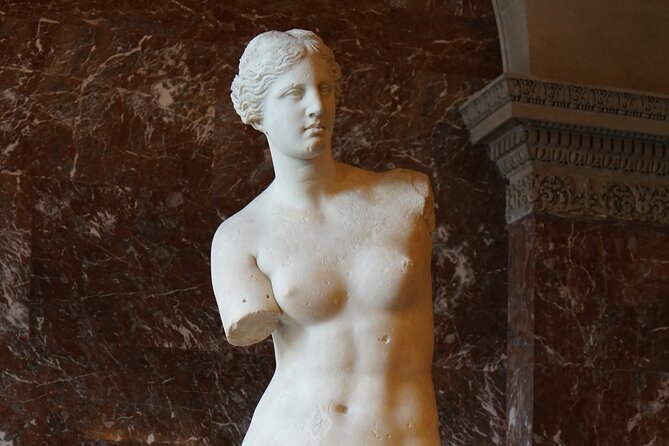
The next major section focuses on antiquities, including ancient Greek, Etruscan, and Roman sculpture. This is where you encounter two of the Louvre’s most recognizable works: the Venus de Milo and the Winged Victory of Samothrace.
The Venus de Milo is famous partly because of its missing arms and partly because of its calm, idealized form. A guide can help you look beyond the postcard image and notice the pose, balance, and way the sculpture was made to be seen. You may find that the work becomes more interesting once you stop treating it as a quick photo stop.
Winged Victory offers a different effect. Positioned dramatically on the Daru staircase, it suggests movement, wind, and arrival even though the figure has lost its head and arms. Its placement is part of the experience, and a guide can point out how the sculpture and setting work together.
The ancient collections add variety to a painting-heavy route. You move from stone bodies and fragments to the grand interior spaces of the palace, then onward to royal treasures and Renaissance art. That change of medium helps keep a short tour lively.
The drawback is simple: ancient art could occupy an entire visit. If sculpture is your main interest, tell the guide at the beginning. The route is customizable, but the schedule is not long enough for every important room.
The Apollo Gallery and the French crown jewels
The Apollo Gallery brings you into a more theatrical part of the Louvre. Its ceiling decoration and ornate setting frame the French crown jewels, connecting art with monarchy, ceremony, and power.
This stop is valuable because it shows another side of the museum. The Louvre is not only a collection of independent masterpieces. It also reflects the tastes and ambitions of French rulers. The jewels make that point in a direct way, with objects designed to signal wealth and authority.
You can expect the guide to place the gallery in the larger story of the palace and its royal occupants. That context gives the room more meaning than a quick look at glittering objects. It also prepares you for the grand scale of the galleries that follow.
Because this is a highlight-focused visit, the time here will likely be controlled. If royal history and decorative arts matter more to you than Italian painting, say so when discussing your preferences. The private format gives you a better chance of receiving that emphasis than a fixed large-group route.
A few more Paris ideas to compare
- From Paris: Giverny, Monet’s House, & Gardens Half-Day Trip
★ 4.5 · 2,174 reviews - Giverny & Monet’s House Audio Guided Half-day Tour from Paris
★ 4.0 · 379 reviews - From Paris: Versailles Palace Small Group Half-Day Tour
★ 4.4 · 163 reviews - Giverny and Monet’s Garden Half-Day Trip from Paris
★ 4.5 · 123 reviews
The Square Lounge and the Great Gallery
The route then moves through the Square Lounge and the Great Gallery, where you encounter major Italian works. This is one of the busiest parts of the tour in terms of names and artistic periods, so a guide is particularly helpful.
The collection includes Giotto’s Saint Francis Receiving the Stigmata, along with works connected to Botticelli, Fra Angelico, Mantegna, Raphael, Caravaggio, Veronese, Titian, and Leonardo da Vinci. You are not just looking at a series of celebrated labels. You are moving through the development of Italian painting, from earlier religious works to the drama, realism, and technical changes of later periods.
Raphael’s Belle Jardinière offers a chance to consider balance, grace, and the polished style associated with the High Renaissance. Caravaggio’s Death of the Virgin brings a sharper and more human approach to a religious subject. Veronese’s Wedding at Cana fills the wall with scale, ceremony, and detail.
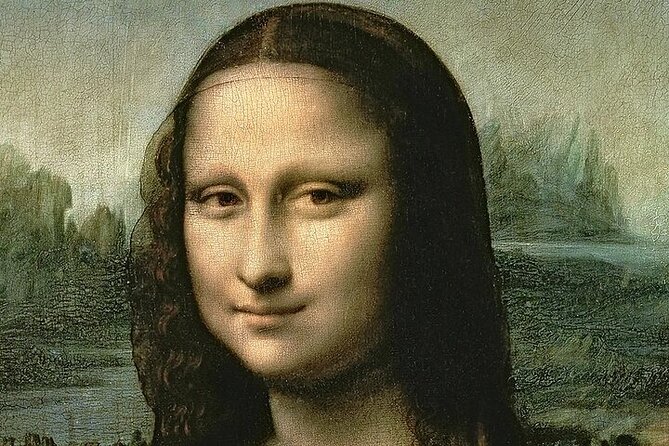
Leonardo’s Saint John the Baptist and the Mona Lisa are likely to draw the greatest crowds and attention. The private guide cannot change how many people gather around a famous painting, but can help you make better use of the moment. You can hear the explanation, identify key details, and move on without losing the larger shape of the visit.
The Mona Lisa is a small painting with a very large reputation. It is wise to expect a busy viewing area rather than a quiet private encounter. The value of the guide here is not extra access to the painting. It is the informed explanation and the ability to keep this one work from swallowing the entire tour.
French Neoclassical and Romantic painting
The final listed section turns to French Neoclassical and Romantic works. This gives the tour a clear national and chronological finish after the Italian galleries.
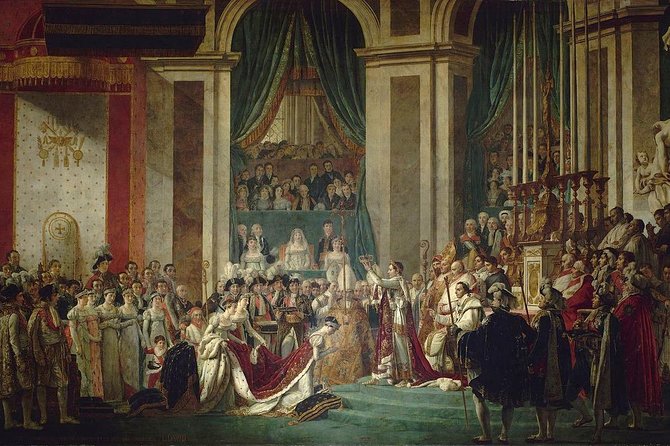
Jacques-Louis David’s Coronation of Napoleon presents power on a monumental scale. The painting rewards a guided look because there are many figures, gestures, costumes, and political signals to sort through. It is not simply a large ceremony scene. It was made to shape how viewers understood Napoleon and the event.
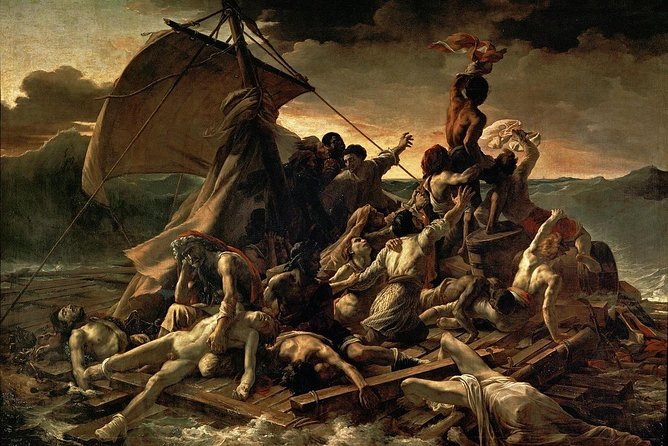
Géricault’s Raft of the Medusa brings a darker emotional force. The painting’s suffering, composition, and political background make it one of the most striking works in the Louvre. It also shows how French Romantic painting could use drama and human distress to confront the viewer.
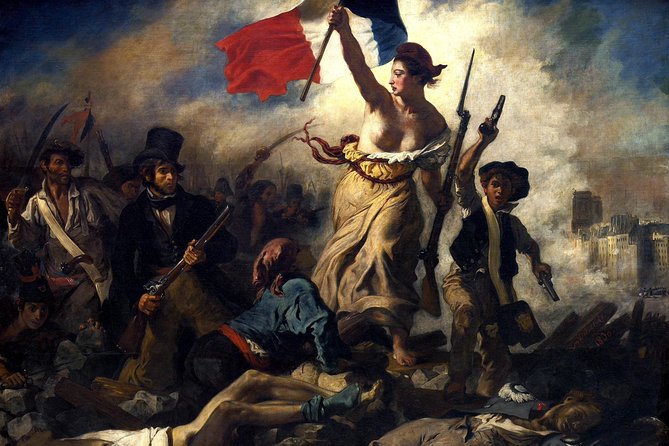
Delacroix’s Liberty Leading the People closes the route with another image that is instantly recognizable. Its raised flag and figures have become symbols far beyond the original painting. A guide can help separate the familiar modern symbol from the work’s specific political and artistic setting.
This final group gives you a satisfying end point: from medieval foundations to monarchy, ancient sculpture, Renaissance painting, and revolutionary-era France. It also makes clear why the Louvre feels less like one collection than a long record of changing power, taste, and artistic ambition.
What the guides add to the visit
Two named guides receive especially strong praise in the available feedback. Nabila is described as personable and clear, with an ability to explain both the objects and the museum itself. Pierre-Yves is singled out for discussing the artist, period, artistic methods, and the Louvre’s story.
Those details matter because a short museum visit can easily become a march through famous names. You need a guide who can explain why a work matters without turning every stop into a lecture. The information supplied here suggests that the strongest part of this experience is the human explanation, not just the route.
Since the tour is private, use the guide actively. Before entering, mention the art you care about most and how much background you want. If you are traveling with children or with someone who is new to art museums, ask for clear visual details and shorter explanations. If you are an art enthusiast, request more attention to technique and artistic periods.
The tour is offered in English. That makes the guide’s communication style especially important, and the comments about Nabila and Pierre-Yves point to guides who can explain complex subjects in an approachable way.
Price, time, and overall value
The listed price is $360.88 per person. That is a serious cost, so the value depends heavily on your group size and your priorities.
For one or two people, a private visit can feel expensive compared with general museum admission. For a larger party, group discounts may improve the calculation, especially since the price includes a private guide, admission, and fast-track tickets. You are paying for planning, interpretation, and time saved, not merely entry to the museum.
The 2 hour 30 minute length is well suited to a first visit when you want the main works without spending a full day indoors. It is long enough to create a coherent route, but short enough to fit beside other Paris plans. You will not see the whole Louvre, and no honest short tour can promise that.
One practical point deserves attention. A booking party reported that its visit lasted two hours rather than the advertised two and a half. That may not ruin the experience, but it does reduce the value at this price. Keep the scheduled length in mind and ask about timing if the extra 30 minutes matter to your plans.
The tour begins and ends at the Louvre Pyramid. Transportation is not included, so you need to make your own way there and arrange your onward plans. The museum is near public transportation, which makes the meeting point practical, but the tour itself does not provide a ride.
Who should book this Louvre tour
I would consider this tour a good match for a first-time Louvre visitor who wants the major works explained in a clear order. It also suits a family or small group that prefers a private pace and does not want to be tied to strangers.
It is useful for people with limited time in Paris. The route covers the building’s medieval origins, ancient sculpture, royal decoration, Italian painting, and major French canvases. That range gives you a sound introduction without asking you to spend an entire day in the museum.
Art lovers should book only if they are comfortable with a highlights route. You can request adjustments, but the available time still limits how much detail any single department can receive. Someone focused only on ancient Rome, French Romanticism, or decorative arts may prefer a longer specialist visit, though that option is not described here.
The tour can also work for visitors who find the Louvre intimidating. A private guide gives you a clear person to ask, and the route keeps the museum from becoming a maze of corridors and galleries.
Free admission applies to visitors under 17 and to EEA residents under 26 who present valid identification and proof of residency. The tour fee may still be part of your booking cost, so check how the price is handled for eligible participants before paying.
Should you book it?
Book this private Louvre tour if you want the famous works, a clear route, and personal attention without spending a full day inside. The praise for Nabila and Pierre-Yves, along with the 100 percent recommendation rate from 14 ratings, points to strong guiding as the main reason to choose it.
I would be more cautious if you need a guaranteed full 2 hours 30 minutes or want a slow study of one collection. The price is high, and one experience lasted only two hours. For a focused first look at the Louvre, however, the combination of fast-track admission, private guidance, and a customizable route gives you a practical way to meet the museum’s biggest stars.
FAQ
How long does the Louvre private tour last?
The scheduled duration is approximately 2 hours 30 minutes. One reported experience lasted two hours, so you should allow flexibility when planning the rest of your day.
Is admission to the Louvre included?
Yes. Admission is included, along with fast-track tickets.
Is this a private tour?
Yes. Only your group participates, and a private guide leads the visit.
What language is the tour offered in?
The tour is offered in English.
Where does the tour begin?
The meeting point is the Louvre Pyramid at 75001 Paris, France.
Where does the tour end?
The activity ends back at the meeting point.
Is transportation included?
No. Transportation is not included, so you must make your own way to the Louvre Pyramid.
Who can receive free museum admission?
Visitors under 17 and EEA residents under 26 may receive free admission when they present valid identification and proof of residency.
Newest additions around Paris
- Family escape Game with kids and teens on the Île de la Cité★ 4.5 · 11 reviews
- Private Photoshoot with the Iconic Eiffel Tower in Paris★ 5.0 · 11 reviews
- 2-day Private Mont Saint-Michel, 3 Loire Castles, D-Day Express★ 4.5 · 11 reviews
- Paris: Batobus Hop-On Hop-Off Cruise & Landmarks Audio Tour★ 3.0 · 11 reviews
- Paris Revolutionary Walking Tour: Iconic French Sights & Stories★ 5.0 · 11 reviews
- Guided and Private Tour of 3 hours through Paris aboard a Citroën 2cv★ 5.0 · 11 reviews
- Kids in the Kitchen – CrOisSaNtS★ 4.0 · 11 reviews
- Paris: Ghosts and Dark Stories Guided Walking Tour★ 4.1 · 11 reviews
Louvre Museum Tours, compared.
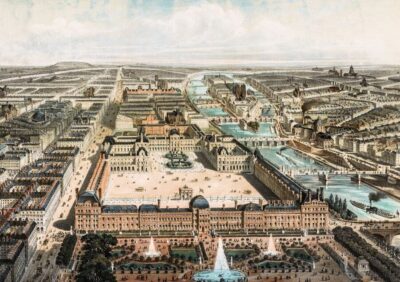
Louvre Guided Tour with Reserved Access & Boat Cruise
Read our review →
Louvre Museum Masterpieces Guided Tour with Access
Read our review →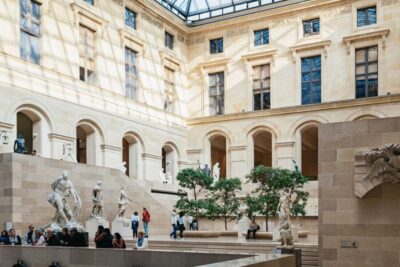
Louvre Museum Entry Ticket With Host and River Cruise
Read our review →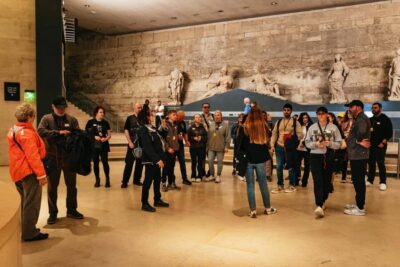
Priority Access Louvre with Host -Direct to Mona Lisa
Read our review →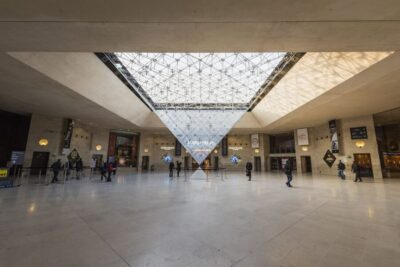
Mona Lisa & Louvre Masterpieces Tour with Reserved Access
Read our review →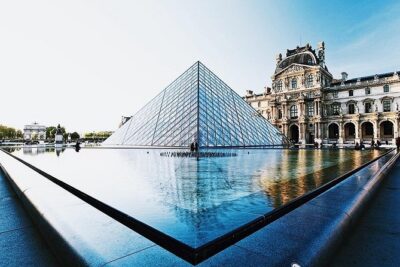
Louvre Museum – Exclusive Guided Tour (Entry Included)
Read our review →
Louvre Reserved Ticket and River Cruise Combo
Read our review →Browse the lists this tour appears in