
Reviewed · CYCLING TOURS
Bike Paris treasures with a live guide – Families & Friends
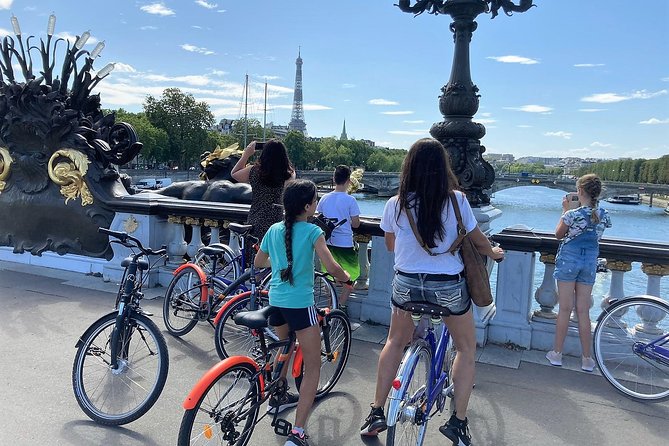
Paris makes far more sense from a bicycle seat. In three hours, you can link Notre-Dame, the Louvre, the Seine, Saint-Germain, the Champs-Elysées, and grand royal squares without spending the whole morning underground or on foot. I especially like the small maximum of 12 people and the easy, mostly flat pace, which lets families stay together while the guide fills in the stories.
The main caution is that Paris can close roads for festivals, races, construction, or major events. Guides such as Romeo and Igor have adjusted routes well, but your exact path may change. Also note the firm age and height rules: this tour is for people over 13 who are at least 150 centimeters tall.
In This Review
- Key points to know before you book
- Why biking is a smart way to meet Paris
- Starting at Hôtel de Ville
- Notre-Dame and the medieval heart of Paris
- The Louvre, from fortress to museum
- Musée d’Orsay and the world of Impressionism
- The Seine, Grand Palais, and Invalides
- Place de la Concorde and the Champs-Elysées
- The Conciergerie and Saint-Germain-des-Prés
- What the guides add to the ride
- Family comfort, age rules, and cycling conditions
- Is $53.10 a fair price?
- Who should book this Paris bike tour?
- Should you book it?
- FAQ
- How long does the Paris bike tour last?
- Where does the tour start and finish?
- What is included in the price?
- Are museum admission tickets included?
- Is the tour suitable for children?
- What happens if I need to cancel?
Key points to know before you book
- A three-hour city primer: Cover many central Paris sights on the same morning, then return later for the places you want to explore inside.
- A small English-speaking group: The tour has a maximum of 12 participants, with one guide leading the ride.
- Easy bikes, gentle route: The route is suitable for all fitness levels, and several riders found e-bikes unnecessary.
- Strong guides make the difference: Igor, Romeo, Luca, Frederic, Lorenzo, Mark, and others are praised for history, humor, safety, and local suggestions.
- A practical family outing: Teenagers and mixed-ability families can keep up, but the official minimum is over 13 years old and 150 centimeters tall.
- Good value for a first morning: At $53.10 per person, the tour is less about entering museums and more about getting a useful orientation to Paris.
Why biking is a smart way to meet Paris
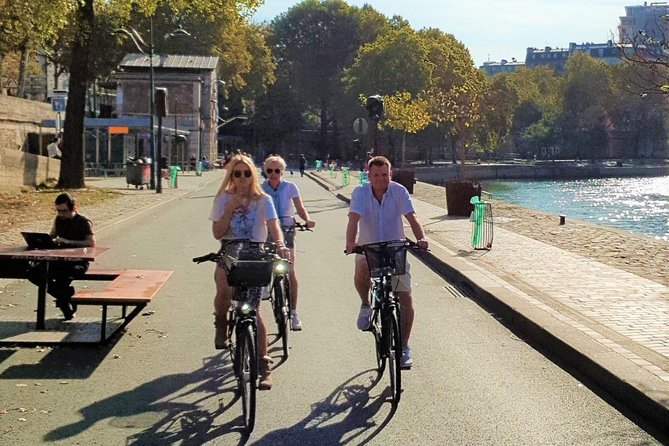
Paris is compact around the Seine, but its famous sights are spread across several neighborhoods. The Louvre, Notre-Dame, the Invalides, the Champs-Elysées, and Saint-Germain are close enough to connect by bicycle, yet far enough apart to make a walking tour tiring.
A bike gives you a better sense of the city’s shape. You move along the river, cross between the Left and Right Banks, and see how royal squares, former palaces, museums, churches, and cafés fit together. You also avoid the stop-start rhythm of a coach.
This is not a sporty ride. The route is described as mild and suitable for all fitness levels. The bikes are lightweight and comfortable, and helmets are supplied. Helmets are not mandatory for people over 12, though I would still wear one.
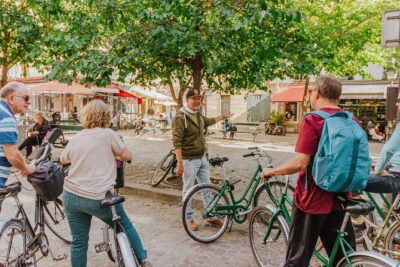
The group size matters. Twelve is small enough for a guide to notice a nervous rider, answer questions, and keep the group together. Romeo has adjusted his pace for families with different abilities, while another guide helped a less-confident young cyclist stay comfortable. That kind of attention is worth more than a rushed ride with a large crowd.
A few more Paris ideas to compare
- Versailles Palace Bike Tour with Market & Marie-Antoinette hamlet
★ 5.0 · 2,680 reviews - Paris: Charming Nooks and Crannies Bike Tour
★ 4.8 · 2,585 reviews - From Paris: Versailles Bike Tour w/ Palace, Gardens, & Picnic
★ 5.0 · 2,150 reviews
Starting at Hôtel de Ville
The meeting point is at the SAEMES parking area, 7 Place de l’Hôtel de Ville, in the 4th arrondissement. You should arrive 10 minutes early. The tour begins 10 minutes after its official start time in any case, and late arrivals do not receive a refund.
That policy is strict, so plan your route to the meeting point carefully. The location is near public transportation, which makes it practical for an early start. Once the bikes are handed out, the guide provides the basic direction for the ride.
Bring water, especially in summer. A cap, sunglasses, and sun cream are also sensible. Dress for the forecast, since this activity requires good weather. Rain ponchos have been offered during wet rides, but you should not count on warm or dry conditions.
Notre-Dame and the medieval heart of Paris
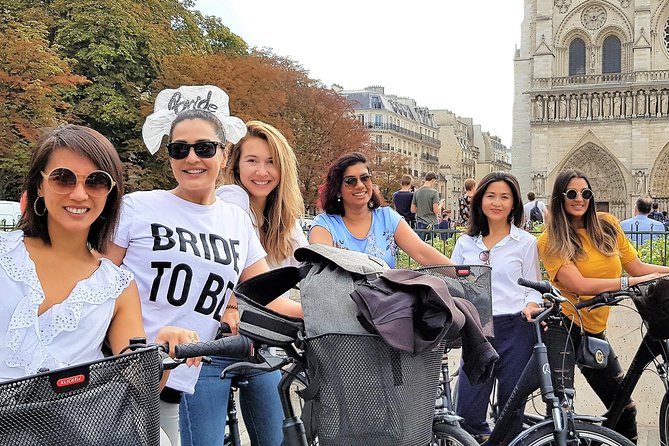
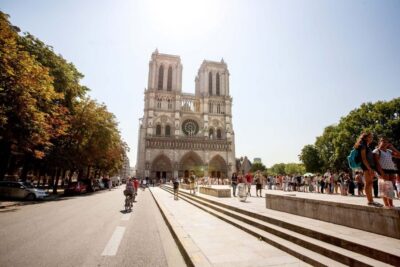
The first listed stop is Notre-Dame de Paris. From outside, you can study the cathedral’s famous gargoyles and chimeras, as well as the grand Gothic design that has shaped the image of Paris for centuries.
The stop is brief, about five minutes, so treat it as an introduction rather than a cathedral visit. Admission is not included, and the bike tour does not replace time inside the building. Its value is location and context: you begin among the oldest parts of Paris, close to the Seine and the medieval center of the city.
A guide can explain how the cathedral relates to the surrounding island and the river, giving you a better starting point for a later visit. If Notre-Dame is a major priority, plan a separate visit with more time.
The Louvre, from fortress to museum
The ride then passes the Louvre, described as a 2,106-foot-long museum that began as a fortress in 1190 during the time of the Crusades. That change from defensive stronghold to royal palace to museum is one of the clearest examples of Paris evolving over time.
You stop for about five minutes, so you will not enter the museum. Admission is not included. Still, seeing the immense exterior by bike is useful because the Louvre can feel confusing when approached only through its entrance queues and galleries.
One especially memorable possibility is riding through the Louvre courtyard. That is not guaranteed on every departure, but it has been part of the experience for some groups. It gives you a striking view of the museum’s scale and symmetry without committing half a day to the interior.
Use this stop to decide what you want to return for. The Louvre cannot be covered properly in a short visit, and this tour wisely treats it as a landmark and orientation point rather than pretending otherwise.
A different way to spend the day in Paris:
- Paris: Louvre Museum Timed-Entrance Ticket
★ 4.6 · 71,977 reviews - Disneyland® Paris 1-Day Ticket
★ 4.6 · 49,412 reviews - Paris: Versailles Palace and Gardens Full Access Ticket
★ 4.6 · 41,579 reviews - Paris: Arc de Triomphe Rooftop Tickets
★ 4.6 · 34,264 reviews
Musée d’Orsay and the world of Impressionism
Across the river, the Musée d’Orsay appears as the tour’s Impressionist stop. Its collections include works associated with Van Gogh, Manet, Renoir, Monet, Gauguin, and Picasso.
Again, the five-minute stop is for an outside view and a guide’s explanation. No museum admission is included. That makes the stop particularly useful for first-time visitors who are deciding how to divide limited museum time.
The building itself is part of the appeal. It occupies a former railway station, so its large clock and Beaux-Arts setting are easy to recognize from the riverfront. You may want to return later for the paintings, especially if your Paris plans include an art-focused day.
The Seine, Grand Palais, and Invalides
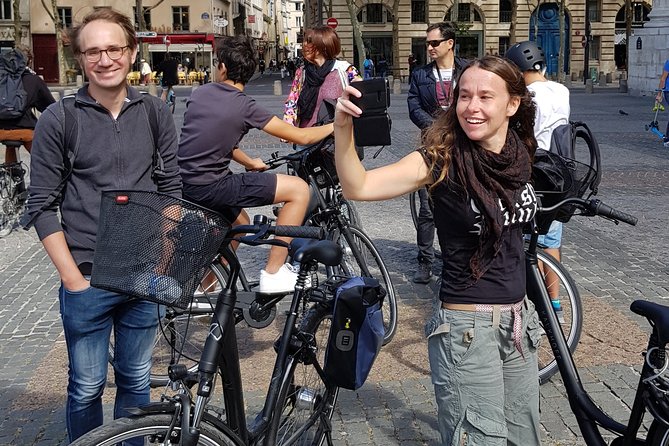
The Seine receives the longest portion of the route, about one hour. This is where the bicycle format earns its keep. You can follow the riverbanks, pause at viewpoints, and watch Paris unfold as a connected city rather than a series of isolated monuments.
The riverbanks are part of the UNESCO heritage designation, and they provide some of the ride’s best views. You may see bridges, monumental facades, and the changing character of the Right and Left Banks. The pace allows time for photographs and short explanations without turning every stop into a formal lecture.
The Grand Palais comes next, with its Belle Epoque iron and steel structure. Its glass roof and broad proportions reflect the period when Paris used architecture and exhibitions to project cultural power. The stop is short, but the building is easy to appreciate from the outside.
At the Invalides, you see the former military complex and the dome associated with Napoleon’s tomb. The tour describes it as one of the Sun King’s highest buildings in Paris. The exterior helps connect royal ambition, French military history, and the monumental scale of central Paris.
These stops are not museum visits. If you want to enter the Musée de l’Armée or see Napoleon’s tomb, set aside separate time and budget.
Place de la Concorde and the Champs-Elysées
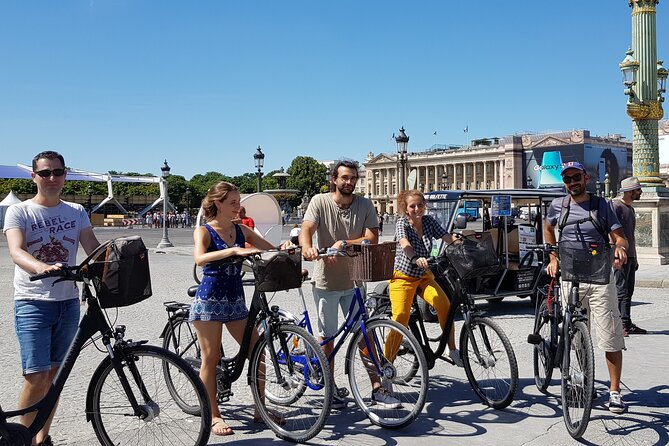
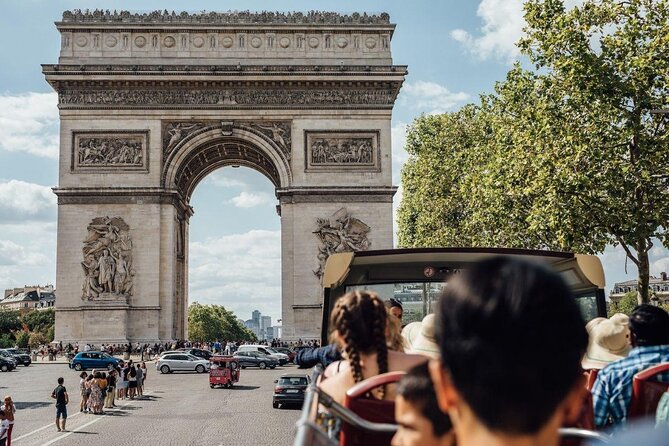
Place de la Concorde adds a darker layer to the grand Paris story. It was the site where Louis XVI and Marie Antoinette were executed during the French Revolution. The square also marks the southern end of the Champs-Elysées, giving you a clear sense of how the ceremonial avenue leads toward the Arc de Triomphe.
The five-minute stop cannot cover the Revolution in detail, but it gives the guide a strong place to explain how political power shifted from monarchy to republic. These short historical talks are one reason the guide matters so much. Without context, the square is simply huge and traffic-heavy. With context, it becomes one of the most charged spaces in the city.
The Champs-Elysées is the famous avenue often called the most beautiful in the world. The phrase is subjective, and the avenue can feel commercial and crowded, but its scale is impressive. By bicycle, you can see its relationship to the surrounding monuments without walking its entire length.
Some guides also include views toward the Eiffel Tower, Alexander III Bridge, or other nearby sights when road conditions allow. These additions are not guaranteed in the fixed stop list, so consider them welcome extras rather than promises.
The Conciergerie and Saint-Germain-des-Prés
On the return through central Paris, the Conciergerie brings you back to the medieval monarchy and the French Revolution. It served as a royal palace during the Middle Ages and later as a court and prison linked to the sentencing of Marie-Antoinette.
The outside stop is brief and admission is not included. Like the Louvre and Musée d’Orsay, it works best as a preview. If Revolutionary history interests you, the Conciergerie deserves a separate interior visit.
Saint-Germain-des-Prés changes the mood. This Left Bank quarter is linked with literary cafés, Ernest Hemingway, F. Scott Fitzgerald, and the postwar jazz scene. It also includes one of Paris’s oldest abbeys, dating back about 1,500 years.
You get about 15 minutes here, longer than at most monuments. That extra time helps the neighborhood feel less like a passing photo stop. Your guide may also suggest places to eat or buy sweets. One family was directed to a chocolate shop with macarons priced at one euro each, then took the treats to Luxembourg Gardens. Food suggestions like this can be more useful than another list of famous restaurants.
What the guides add to the ride
The route is strong, but the guide determines how much you take away. Igor has used visual aids, taken photos at good viewpoints, and spoken several languages. Romeo has a degree in history and is praised for clear explanations, humor, and careful cycling leadership.
Frederic is another guide to look for if available. He has been credited with connecting past events to modern Paris and with adding a stop near the Eiffel Tower when a rider had not yet seen it. Luca has combined historical background with food recommendations, while Mark has kept an unhurried English-speaking ride moving through the city.
Names and availability can change, so you cannot book a particular guide unless the company confirms one. The important point is the style of guiding: expect history, practical suggestions, photo help, and attention to group safety rather than a silent escort.
A small group also gives you a better chance to ask questions. You can ask where to return for a museum, which quarter suits your evening plans, or how to fit the Eiffel Tower into the rest of your day.
Family comfort, age rules, and cycling conditions
The experience is designed for families and friends, but read the restrictions carefully. The official rule says participants must be over 13 and at least 150 centimeters tall. Some past groups included younger children, but you should follow the current stated requirement rather than rely on exceptions.
The route is mostly flat and not strenuous. Teenagers have handled it well, and families with ages ranging from young teens to older adults have found the pace manageable. You still need to feel comfortable riding in an urban setting and following the guide’s instructions.
Road closures can affect the ride. Major events, Olympic preparations, and the final stage of the Tour de France have forced route changes. A good guide can substitute other sights, but you should not book this if seeing one exact street or monument is your only reason for going.
One practical weakness deserves attention. On one occasion, a guide was delayed after an accident and the group waited about 40 minutes without clear communication. That appears to be an unusual problem, but it shows why a working contact number and prompt updates matter. If a delay occurs, ask the staff at the meeting area for help and keep your booking details close at hand.
Is $53.10 a fair price?
At $53.10 per person, the tour is reasonably priced for three hours of bicycle use, a dedicated English-speaking guide, helmets, and a carefully connected route through central Paris. You are paying for orientation and storytelling, not museum entry, food, or a private tour.
The value is highest when you take it early in your Paris stay. You can mark the museums and neighborhoods you want to revisit, learn the city’s basic layout, and get restaurant or pastry advice before spending the rest of your trip on foot.
A private guide would give you more control, but it would cost more. A city bus may cover many of the same sights with less physical effort, yet it will not offer the same close-up feel or easy question-and-answer exchange.
Group discounts may improve the price for larger parties. Free cancellation is available up to 24 hours before the start time. If bad weather cancels the ride, you can choose another date or receive a full refund.
Who should book this Paris bike tour?
I would choose this tour for a first or second day in Paris, especially if you want a broad view before committing to long museum visits. It suits active families with teenagers, friends who enjoy moving through a city, and anyone who finds Paris easier to understand when the river and neighborhoods are connected in one ride.
It is also a good fit if you want history in manageable portions. You get a short explanation at many places instead of one long lecture, with time to keep moving and take photos.
I would skip it if you need wheelchair access, are under the stated age or height limit, dislike cycling in cities, or want long visits inside the Louvre, Notre-Dame, Musée d’Orsay, or Invalides. Those sites require separate planning.
Should you book it?
Book it if you want an efficient, friendly introduction to central Paris and can accept a route that may change with city events. The small group, gentle cycling, and strong guides such as Igor, Romeo, Luca, and Frederic give this experience real value.
Go early in your trip, arrive 10 minutes ahead, check the weather, and wear comfortable clothing. Think of the ride as a city orientation with history and local tips, not as a substitute for Paris’s great museums. For many families, that is exactly the right first taste.
FAQ
How long does the Paris bike tour last?
The tour lasts approximately three hours and ends back at the meeting point.
Where does the tour start and finish?
It starts at the SAEMES parking area at 7 Place de l’Hôtel de Ville, 75004 Paris. The activity finishes at the same meeting point.
What is included in the price?
The price includes use of a lightweight bicycle, one experienced guide, and a helmet. Helmets are not mandatory for people over 12 years old.
Are museum admission tickets included?
No. The tour passes or stops outside places such as Notre-Dame, the Louvre, the Musée d’Orsay, the Invalides, and the Conciergerie. Admission tickets are not included.
Is the tour suitable for children?
The stated requirement is that participants must be over 13 years old and at least 150 centimeters tall. The route is suitable for all fitness levels, but younger children should not be booked under the stated rules.
What happens if I need to cancel?
You can cancel at least 24 hours before the local start time for a full refund. Cancellations or changes made less than 24 hours before the start time are not refunded. If poor weather or an insufficient number of participants cancels the tour, you can receive a full refund or choose another option.
Newest additions around Paris
- Family escape Game with kids and teens on the Île de la Cité★ 4.5 · 11 reviews
- Private Photoshoot with the Iconic Eiffel Tower in Paris★ 5.0 · 11 reviews
- 2-day Private Mont Saint-Michel, 3 Loire Castles, D-Day Express★ 4.5 · 11 reviews
- Paris: Batobus Hop-On Hop-Off Cruise & Landmarks Audio Tour★ 3.0 · 11 reviews
- Paris Revolutionary Walking Tour: Iconic French Sights & Stories★ 5.0 · 11 reviews
- Guided and Private Tour of 3 hours through Paris aboard a Citroën 2cv★ 5.0 · 11 reviews
- Kids in the Kitchen – CrOisSaNtS★ 4.0 · 11 reviews
- Paris: Ghosts and Dark Stories Guided Walking Tour★ 4.1 · 11 reviews
Cycling Tours, compared.
Versailles Palace Bike Tour with Market & Marie-Antoinette hamlet
Read our review →
Versailles Bike Tour w/ Palace, Gardens, & Picnic
Read our review →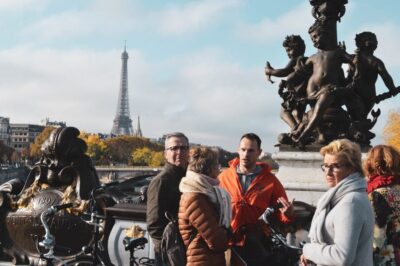
Paris Local Districts and Stories Off the Beaten Track Guided Bike Tour
Read our review →
Highlights of Paris Bike Tour w/ a Local Guide (English or Dutch)
Read our review →Browse the lists this tour appears in