

Reviewed · PARIS
Behind the Scenes of the Roland Garros Stadium
Roland Garros is more than a famous tennis court. It is a working sports complex where players move from the changing rooms through a private corridor toward the red clay, while journalists prepare stories and officials watch from the presidential stand. This tour gives you a look at those usually closed-off spaces, not just a photo stop outside the stadium.
I like the route through the players’ tunnel and the access to the press and changing rooms. I also like the tennis stories, which can bring names such as Rafael Nadal, Roger Federer, Steffi Graf, and Yannick Noah to life. The main drawback is that the meeting point can be confusing, and some parts of the grounds may be closed because of events or stadium activity.
In This Review
- Key points to know before you book
- Why Roland Garros feels different from other stadium tours
- Following the players from the changing rooms to the clay
- Philippe Chatrier Court and the main stadium
- Press rooms, interviews, and the business of the French Open
- The history you can see around the grounds
- What the $25.77 price buys you
- Finding the entrance without losing your start time
- Weather, events, and changing access
- Who will enjoy this tour most
- How to get the best version of the experience
- Should you book Behind the Scenes of Roland Garros?
- FAQ
- How long is the Roland Garros stadium tour?
- What areas are included?
- Is the tour offered in English?
- Where does the tour start and end?
- How early should I arrive?
- Can I cancel for a refund?
Key points to know before you book
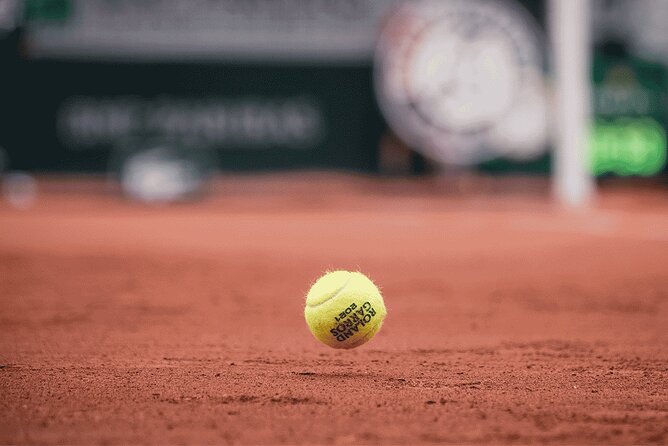
- Walk the players’ route: Follow the corridor from the changing rooms toward the clay court, a highlight for serious tennis fans.
- See Roland Garros beyond the stands: The tour includes press rooms, changing rooms, the presidential stand, court areas, trophies, and player plaques.
- Plan for 90 minutes on foot: Wear comfortable shoes because the tour includes walking and stairs.
- Arrive 15 minutes early: Late arrivals are not accepted, and there is no refund if you miss the start.
- Expect a group of up to 30: The experience is intimate enough to hear the guide, but not a private tour.
- Leave time for the shop: The Roland-Garros boutique is open from 09:30 to 18:30, and some tour arrangements include a 10 percent merchandise discount.
Why Roland Garros feels different from other stadium tours
Many stadium tours show you a grandstand, a locker room, and a few framed photographs. Roland Garros offers something more personal: the route used by players on their way to the court. You can picture the nerves building as a competitor leaves the changing room, walks the corridor, and steps toward the tournament’s red clay.
That connection to the player experience is the heart of the visit. You are not simply looking at a court from a seat. You are seeing the backstage spaces that make the televised event possible.
The tour also puts the French Open into a wider setting. You see where interviews happen, where journalists work, and where important guests sit. These rooms explain how a Grand Slam operates away from the rallying and applause.
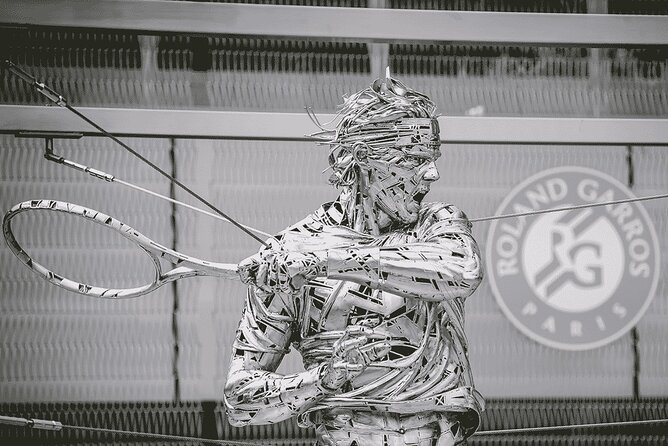
For tennis fans, small details can matter as much as the main rooms. Plaques, trophies, statues, names on stairs, and displays tied to past champions help turn a familiar television event into a real place. Rafael Nadal receives special attention because of his extraordinary record at Roland Garros, so fans making a Nadal pilgrimage should find plenty of personal interest.
More of the most booked days out in Paris:
- Paris: Louvre Museum Timed-Entrance Ticket
★ 4.6 · 71,977 reviews - Disneyland® Paris 1-Day Ticket
★ 4.6 · 49,412 reviews - Paris: Versailles Palace and Gardens Full Access Ticket
★ 4.6 · 41,579 reviews
Following the players from the changing rooms to the clay
The changing rooms are one of the tour’s most appealing stops. This is where you can think about the contrast between the quiet preparation before a match and the noise waiting outside. The exact spaces available can vary, but the tour is designed to show areas normally reserved for players and tournament staff.
From there, the group follows the corridor leading toward the court. This passage is important because it connects the private and public sides of tennis. A player enters as an individual, carrying the pressure of an entire match, then emerges in front of a packed stadium and a worldwide television audience.
The guide uses stories about major champions to give the spaces meaning. You might hear about Nadal, Federer, Graf, or other names linked with the tournament. A strong guide can point out details you would otherwise walk past, including plaques and historical references around the grounds.
The route involves stairs and about an hour and a half of walking. Comfortable shoes are a smart choice. This is not a sit-down museum visit, and you should not expect to move at the pace of a casual stroll through a gallery.
Philippe Chatrier Court and the main stadium
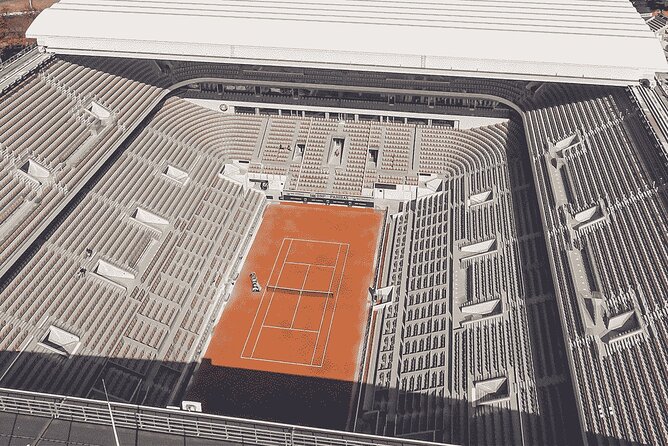
The central court is the visual prize of the visit. Seeing Philippe Chatrier Court without a tournament crowd gives you a different sense of its scale. During the French Open, the court is full of motion, noise, and ceremony. On a tour day, you can pay more attention to the structure, the seating, and the court’s place within the complex.
Access to the court itself can change. One visit included a chance to step onto the clay, but this was not officially part of the tour and should not be expected. On another day, the court was covered with a platform because an event was taking place, and photography was restricted.
That uncertainty is worth understanding before you book. The tour’s value rests on the behind-the-scenes route, not on a guaranteed court-side photo. If you are buying mainly to stand on the clay, you may be disappointed. If you want to understand the stadium and the tournament’s inner workings, the changing rooms, tunnel, press areas, and stories still make the experience worthwhile.
Some smaller stadiums and outer courts may not be included. The standard route centers on the main stadium and its restricted areas. Ask yourself what matters most: the historic center court and player route, or a broad tour of every court on the property. This experience favors the first option.
Press rooms, interviews, and the business of the French Open
The press rooms show a side of tennis that television often compresses into a few seconds. After a match, players face questions, explain tactics, respond to difficult losses, and speak about the tournament. Standing in the interview area helps you picture that process more clearly.
This part is especially useful if you enjoy the culture around tennis, not just the points. Roland Garros is a major media event, and the press spaces explain why the tournament feels larger than the court itself. A guide who knows the site well can add stories about players, journalists, and the routines that take place during the competition.
The tour also visits the presidential stand. You get a sense of how the tournament is presented to important officials and guests, and how different the view can feel from a formal seating area compared with a normal spectator section.
The quality of this section depends heavily on the guide. Several guides have been praised for warmth, humor, and strong tennis knowledge. Lionel, in particular, has been singled out for an interactive style and an ability to make the information lively. Multilingual guides may also adapt when an English group is combined with another language group, though the amount of English attention can vary.
A different way to spend the day in Paris:
- Paris: Arc de Triomphe Rooftop Tickets
★ 4.6 · 34,264 reviews - Paris: Orsay Museum Entry Ticket
★ 4.7 · 25,647 reviews - Paris: Evening River Cruise with Music
★ 4.4 · 22,721 reviews - Paris: Eiffel Tower Entry Ticket with Optional Summit Access
★ 4.4 · 20,035 reviews
The history you can see around the grounds
Roland Garros carries its history in physical details. You might see player names on plaques, statues, trophies, and displays connected with the tournament’s past. These are not just decorations. They give you a way to connect famous matches and champions with the actual rooms and pathways where the tournament takes place.
Rafael Nadal is a major thread. His plaques and tournament record are especially meaningful for fans who know how dominant he was on Paris clay. The tour can feel like a pilgrimage for Nadal supporters, but it is not limited to one player. References to Federer, Graf, and other champions broaden the story.
The most rewarding moments often come when the guide adds context to a name or location. A stairway, plaque, or corridor can seem ordinary until you learn why it matters. This is where an engaging guide earns the price of admission.
Still, the tour is not a full tennis museum visit. It focuses on the stadium and its working areas. If you want a large collection of exhibits, match footage, or a long chronological account of the sport, you may want to pair this with another tennis-related attraction.
What the $25.77 price buys you
At about $25.77 per person, this is a reasonable price for a 90-minute guided visit to a famous Paris sports venue. You are paying for access to areas that ordinary ticket holders do not normally see, along with a guide who can explain the site and its champions.
The value is strongest if you already care about tennis. A casual visitor may enjoy the architecture and the court, but the changing rooms, player corridor, press rooms, and tournament stories mean much more if you know the difference between a first-round match and a final, or if you have followed Nadal’s Paris career.
The price does not include transportation, food, or drinks. That is not a major issue because the tour is short, and the stadium is near public transportation. You will need to make your own way to 1 Av. Gordon Bennett, in Paris’s 16th arrondissement.
A mobile ticket makes the booking simple, and the tour is offered in English. The maximum group size is 30 people. That is small enough for a guide to speak to the group, but you should not expect a private conversation or a personalized route.
The Roland-Garros shop adds a little extra value, particularly if you want official tournament clothing or souvenirs outside the French Open dates. It is open from 09:30 to 18:30. A 10 percent merchandise discount may be available with the tour, so check the current terms before shopping.
Finding the entrance without losing your start time
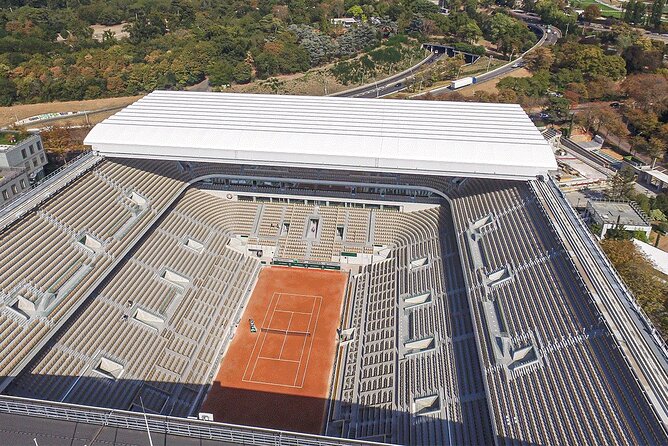
The practical weak spot is the arrival process. The meeting point is listed at 1 Av. Gordon Bennett, and the tour ends at the Roland-Garros boutique at 2 Av. Gordon Bennett. Even with a map, the site can be hard to read from outside.
Some visitors have found Gate 36 unclear, with security staff unable to explain where the tour began. Others were directed to wait in the gift shop lobby. In one case, the guide was nearby but the group did not realize it, which created a poor start.
I would arrive at least 20 to 25 minutes early, even though the official instruction is 15 minutes. Go directly to the Roland-Garros shop or the stated meeting location and show your mobile ticket. If a security guard is unsure, calmly explain that you are joining the guided stadium tour and ask where the group is forming.
Do not cut this close. Latecomers are not accepted, and the cancellation terms do not protect you if you miss the start. You can cancel for a full refund up to 24 hours before the scheduled time, but changes or cancellations inside that period are not accepted.
Use the bathroom before the tour if possible. Facilities may not be available in the boutique after the guide leaves, and returning into the stadium may not be allowed. This is a small point, but it can save an awkward search for a public restroom afterward.
Weather, events, and changing access
The tour takes place inside an active sports venue, not a preserved building frozen in time. Some spaces may be inaccessible on the day of your visit because of events, preparations, or other activity.
That can affect the main court, photography, or particular rooms. A covered court or a restricted area does not necessarily ruin the tour, but it changes what you see. If your schedule is flexible, a quieter non-event day may give you a better chance at the full route.
Weather can also shape the experience. A cold day does not prevent the tour, but you may spend time moving between indoor rooms and outdoor areas. Dress for Paris weather and wear shoes that handle stairs comfortably.
Photography rules may change from one visit to another. Do not assume you can photograph every room or step onto the court. Follow the guide’s instructions, especially around the playing surface and restricted areas.
Who will enjoy this tour most
I would book this first for tennis fans, especially people who follow the French Open, Nadal, Federer, or the history of major tournaments. The player route gives the visit an emotional charge that a normal stadium photo cannot match.
It also suits families with older children who play tennis. Young players may enjoy seeing the locker rooms, press area, trophies, and court more than a standard sightseeing stop. The tour is about 90 minutes, so it is long enough to feel substantial without taking half a day from your Paris plans.
Paris visitors who are curious about how major sporting events work can enjoy it too. You see the media side, the official seating, the player facilities, and the public arena in one compact visit.
I would be more cautious if you are not interested in tennis and mainly want a broad tour of Paris. The stadium has significance because of the sport played there. Without that context, some rooms may feel ordinary.
This may also be a poor choice if stairs are difficult for you or if you need a fully predictable route. Most people can participate, but the tour includes walking and stairs, and access can change because the site remains active.
How to get the best version of the experience
Read about the French Open or watch a few clips before you go. You will get more from the changing rooms and players’ corridor if you already understand how important the route is.
Keep your phone charged and your ticket easy to display. You may want photographs of the stadium, plaques, or displays, but remember that photography is not guaranteed in every area.
Listen for details rather than rushing toward the next room. A guide’s story about a champion, a press conference, or the player entrance can be the part you remember most. If the group is large, stay close enough to hear and avoid drifting behind on stairs or in corridors.
If your English tour is full, you may be placed with a multilingual group. This can work well when the guide is comfortable switching languages. Still, confirm the language arrangement at booking so you know what to expect.
Allow a little time after the tour for the boutique. The end point is convenient, and the shop offers official Roland-Garros merchandise. It is a practical chance to buy something tied to the tournament without attending during the event itself.
Should you book Behind the Scenes of Roland Garros?
Book it if the French Open means something to you. At $25.77, the combination of restricted player areas, the press rooms, the tunnel, the presidential stand, and the main court offers good value for a tennis-focused visit to Paris.
Go in with realistic expectations. The tour may finish early, the guide may be less engaging than hoped, and a stadium event can close off parts of the route. The meeting point also deserves careful planning.
My advice is simple: arrive early, wear comfortable shoes, use the bathroom first, and treat the clay court as a possibility rather than a promise. For a tennis fan, the chance to follow the players’ path through Roland Garros is well worth adding to a Paris itinerary.
FAQ
How long is the Roland Garros stadium tour?
The tour lasts approximately 1 hour and 30 minutes.
What areas are included?
The guided route includes the press rooms, changing rooms, presidential stand, and the corridor leading from the player areas toward the clay court. Court access and other spaces can vary on the day.
Is the tour offered in English?
Yes. The experience is offered in English, and multilingual group arrangements may sometimes be used.
Where does the tour start and end?
It starts at 1 Av. Gordon Bennett, 75016 Paris, France. It ends at the Roland-Garros boutique at 2 Av. Gordon Bennett, 75016 Paris, France.
How early should I arrive?
You should arrive 15 minutes before the scheduled start. Latecomers will not be accepted, and no refund is available if you miss the tour.
Can I cancel for a refund?
Yes. You can cancel at least 24 hours before the start time for a full refund. Cancellations or changes made less than 24 hours before the start are not accepted.
Newest additions around Paris
- Family escape Game with kids and teens on the Île de la Cité★ 4.5 · 11 reviews
- Private Photoshoot with the Iconic Eiffel Tower in Paris★ 5.0 · 11 reviews
- 2-day Private Mont Saint-Michel, 3 Loire Castles, D-Day Express★ 4.5 · 11 reviews
- Paris: Batobus Hop-On Hop-Off Cruise & Landmarks Audio Tour★ 3.0 · 11 reviews
- Paris Revolutionary Walking Tour: Iconic French Sights & Stories★ 5.0 · 11 reviews
- Guided and Private Tour of 3 hours through Paris aboard a Citroën 2cv★ 5.0 · 11 reviews
- Kids in the Kitchen – CrOisSaNtS★ 4.0 · 11 reviews
- Paris: Ghosts and Dark Stories Guided Walking Tour★ 4.1 · 11 reviews